No. 9Time3 minviews 29
Published by GK Library Annex
How did a week come to have seven days?
Unlike the day, month, and year, the week doesn't line up neatly with the sky
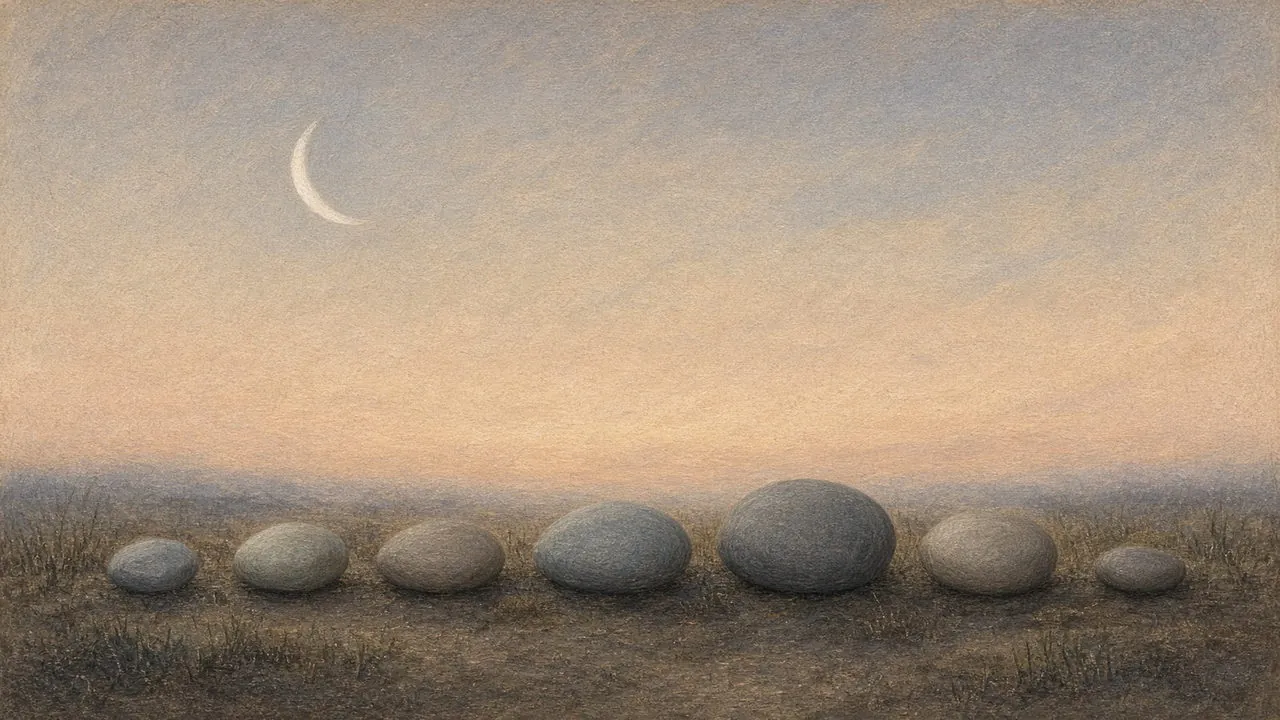
When an alarm rings every Monday, seven days can seem obvious. But unlike a day, a month, or a year, seven days doesn't match any cycle in the sky exactly. Many explanations say the week is a unit left behind by the Moon's phases together with the seven celestial bodies visible to the naked eye.
The Moon's cycle in four parts
The Moon returns to the same phase about every 29.5 days. Dividing the cycle into new moon, first quarter, full moon, and last quarter gives about seven and a half days per part. It isn't exactly seven.
Still, it was an easy number to count for people watching the Moon with their own eyes. Ancient Mesopotamian records show traces of treating the 7th, 14th, 21st, and 28th days of the lunar month as special. But that count started over with each new moon. The custom of seven days running on endlessly, regardless of the Moon, took hold separately.
Seven bodies in the day names
In Roman times, a week that named each day after one of the bodies visible to the naked eye spread: the Sun, the Moon, Mars, Mercury, Jupiter, Venus, and Saturn. Overlapping with the Jewish tradition of a day of rest every seven days, the seven-day week took root across the Mediterranean.
Korean day names share the same roots. Wol is the Moon, il is the Sun, and hwa, su, mok, geum, and to are the five planets. In English, Sunday, Monday, and Saturday still carry the Sun, the Moon, and Saturn. These names reached East Asia long ago, and Koreans began using them in modern times along with a new calendar.
There was a ten-day week too
During the French Revolution, months were divided into ten-day periods. The arithmetic was neat, but days off dropped to once every ten days, and market days and days of rest were already tied to seven days, so it was abandoned after a little over a decade. The Soviet Union also tried five-day and six-day weeks before going back to seven.
The week keeps running without a break even when a month or year changes. That's why 365 days is 52 weeks plus one day, and your birthday falls one weekday later each year. If February 29 comes in between, it moves two days.
A number kept by daily life
The seven-day week has lasted this long more because of daily life than the sky. Once market days, days off, and gathering days are set to seven days, no one can change it alone unless everyone changes together.
So the week is closer to an agreement among people than a unit set by calculation. If Monday feels heavy, it isn't Earth's fault. It's because that agreement has carried on for thousands of years.
Related reads
Earth didn't set the length of the week. A unit left by the Moon's phases and seven celestial bodies has carried on to this day.
Notes and references · Lunar phases and the history of weekdays. The Moon takes about 29.5 days to return to the same phase. The seven-day week likely blends Babylonian lunar counts, the Jewish Sabbath, and Roman planetary days; its exact origin is debated.
Editorial standardsReport an error
Quick quiz