No. 1Numbers3 minviews 32
Published by GK Library Annex
Why is a minute 60 seconds, not 100?
We count money by tens. Why does the clock tick by sixties?
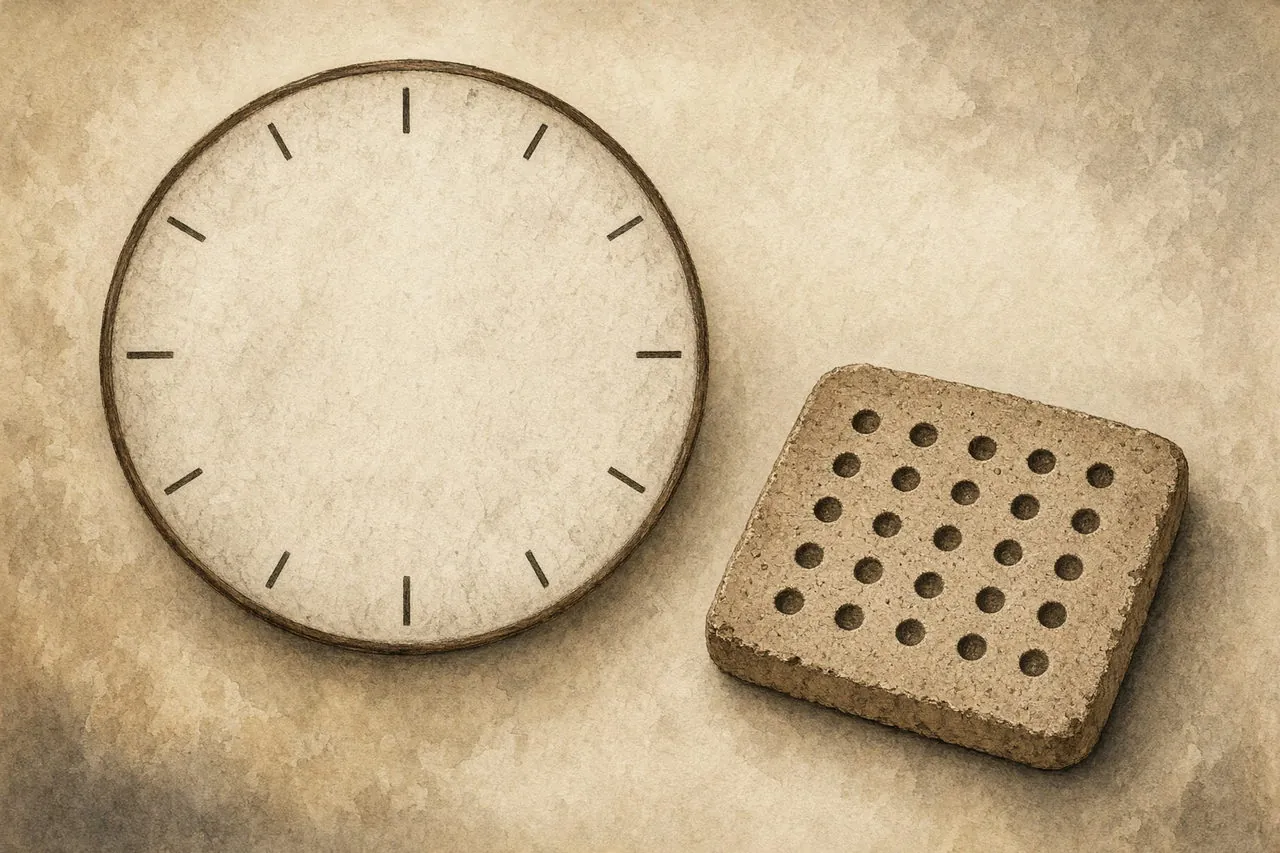
A minute is 60 seconds because of habit, not because nature picked that number. Money uses tens and hundreds, yet clocks run on 60. Sixty divides evenly by 2, 3, 4, 5, and 6, so it was handy for splitting time.
A number that divides well
Cut a pizza into 60 slices and two, three, four, five, or six people can share without leftovers. Ten slices get awkward for three. A common myth says the heart beats 60 times a second, or Earth turns exactly 60 times—neither explains the clock. Heart rates vary, and they are not tied to the second that way.
Ancient Mesopotamia used 60 as a counting unit. When people tracked the sun and stars, a well-divisible number was useful. Greek astronomers kept that tradition for angles and finer time splits. The words minute and second once meant the first and second small parts of a larger unit.
Left on clocks and circles
Sixty minutes in an hour and sixty seconds in a minute grew from that habit. Three hundred sixty degrees in a full circle sit in the same family of numbers. Latitude, longitude, and angle math still carry the mark. The 24-hour day also rode alongside base-12 and base-60 traditions for a long time.
During the French Revolution, reformers tried a day of 10 hours, 100 minutes per hour, and 100 seconds per minute—like the metric system, but for time. The math was neat, yet replacing clocks, tables, and daily habits all at once proved too hard, and the system did not last. Familiar time sense does not flip overnight.
Sixty in everyday life
So the second hand still has 60 marks. A 100-second minute might have been easier to add, but we never got used to that dial. Cooking timers and workout intervals still lean on 30 or 90 seconds—halves and multiples of 60. School exams and bus schedules speak in minutes and seconds too.
Ten fingers make base 10 feel natural, but for dividing time, sixty settled in first. When you wonder why the clock uses 60, think of an old calculating habit that never left. What feels 「natural」 in numbers is often just a long-lived custom.
Related reads
Sixty seconds are not a law of nature. An old base-60 habit stayed on the clock.
Notes and references · Counting time by sixties. Sexagesimal splits of time and angles trace to ancient Mesopotamia. A 10-hour clock was tried in revolutionary France but did not stick.
Editorial standardsReport an error
Quick quiz