No. 81Everyday life3 minviews 33
Published by GK Library Annex
Does tapping a shaken cola can really stop it overflowing?
People tap the lid before opening a soda shaken in their bag. Some researchers have put that to the test.
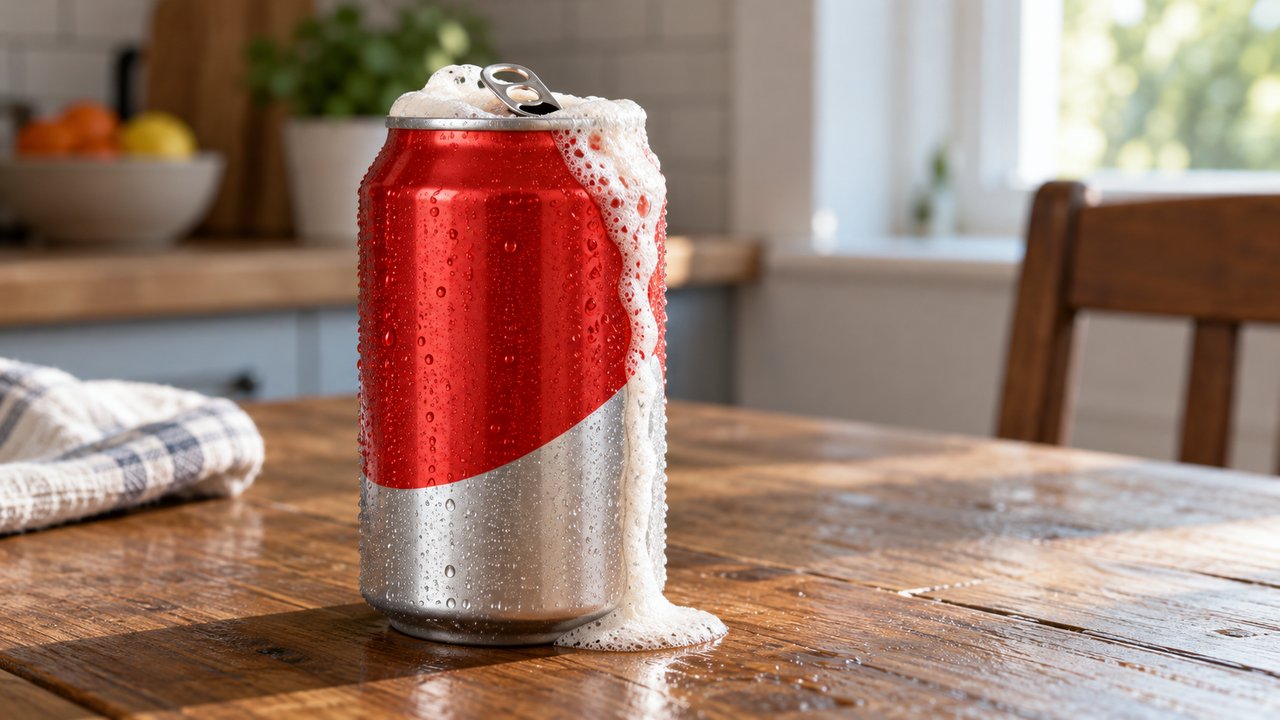
Shaken soda sprays not because the pressure inside the can has risen, but because of tiny bubbles formed during shaking. Experiments have found that tapping the can does little, and simply leaving it upright for a while is more reliable.
Tiny bubbles are the culprits
Carbon dioxide is dissolved under high pressure inside a closed can. Shaking turns some of this gas into tiny bubbles that sit in the liquid and cling to the inside walls.
As soon as you open the can, the pressure drops sharply and the dissolved carbon dioxide tries to escape. The bubbles already there serve as exit points. They expand all at once and rise, pushing the surrounding drink up with them.
Does shaking raise the pressure?
Because a shaken can bursts open with a pop, it's easy to assume pressure has built up inside. In 2001, the American physicist David Kagan reported in The Physics Teacher on tests using a container fitted with a pressure gauge: once the gas had settled, shaking left the pressure unchanged.
You can get a feel for this at home. Squeeze a plastic bottle of soda, shake it, and squeeze it again, and it feels about as firm as before. What changes is not the pressure but the number of exits for the gas, that is, the bubbles.
Does tapping help?
A widely shared explanation says tapping knocks bubbles off the walls so they rise to the top, reducing overflow. A team at the University of Southern Denmark split 1,031 cans of beer (330 mL) into shaken and unshaken groups, and into cans flicked three times on the side with a finger and cans left alone, then opened them. Shaken cans lost about 3.5 g on average whether tapped or not, with no clear difference.
The team noted, however, that proteins in beer can hold bubbles in place, so whether the same holds for drinks like cola needs further study.
Waiting is the answer
The researchers' own conclusion was to wait for the bubbles to settle. People who tap a can naturally wait a moment before opening it, so the benefit they feel may come from that wait. Over time, the bubbles rise or dissolve back into the drink.
The warmer the drink, the less carbon dioxide it can hold, so it sprays harder. Keep a can that's been jostled in your bag cool, open it while it stands upright, and lift the tab just slightly at first to let the gas out. And remember to point it away from your face or your laptop.
Related reads
A shaken can is less likely to overflow if you leave it upright briefly and open it slowly than if you tap it.
Notes and references · Sopina et al. 2019 (arXiv) · Kagan 2001 (The Physics Teacher). The tapping experiment is based on a randomized controlled trial by a University of Southern Denmark team (1,031 beer cans, posted on arXiv in 2019) and an MIT Technology Review article about it. The points that shaking leaves pressure unchanged and that bubble number is the cause follow Kagan's ‘The Shaken-Soda Syndrome.’ The link between temperature and dissolved gas is general chemistry.
Editorial standardsReport an error
Quick quiz