No. 80Numbers3 minviews 32
Published by GK Library Annex
Why does A4 paper keep its shape when folded in half?
A4, A3, and A5 differ in size but have the same shape. A number is hidden in their dimensions.
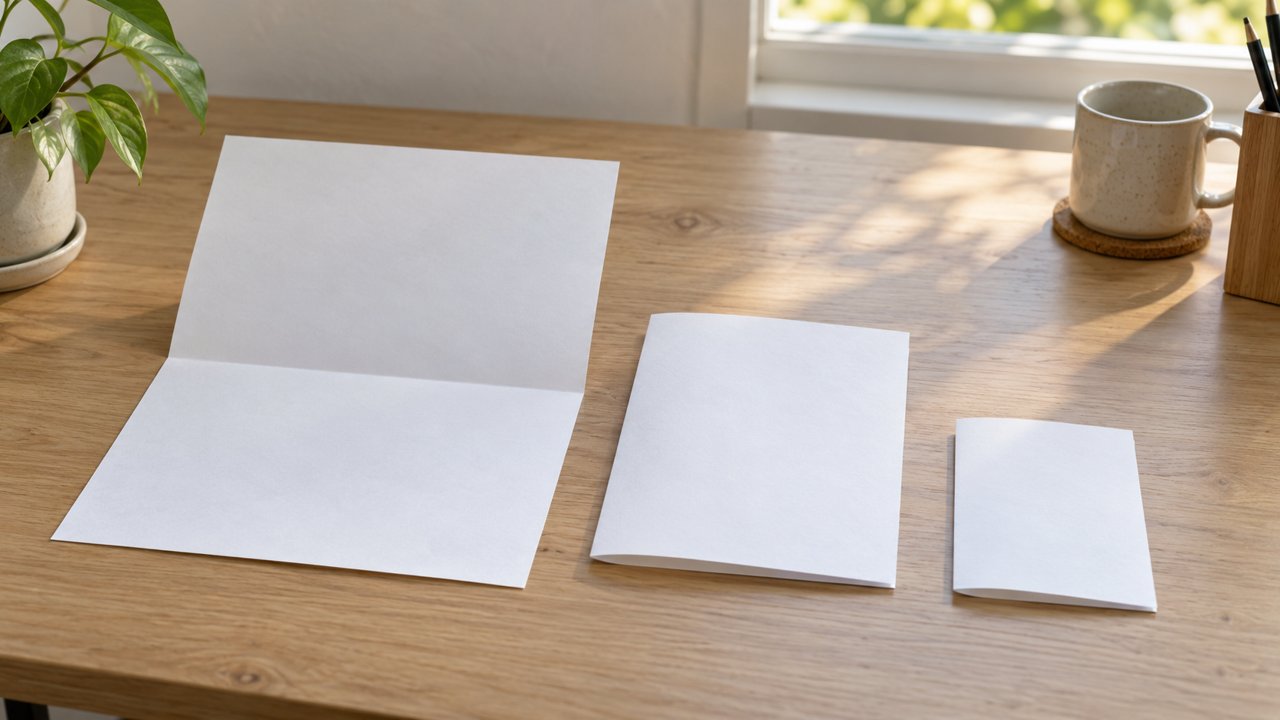
The long side of A4 paper is about 1.414 times its short side—the square root of 2. That preserves the same proportions when it is folded in half. Its area halves, but its shape stays the same.
The number that survives a fold
A4 paper is 210 mm wide and 297 mm long. Divide 297 by 210, and you get about 1.414. Fold the long dimension in half, and 210 mm becomes the new long side while a little over 148 mm becomes the short side. Dividing those gives about 1.414 again.
Most rectangles become longer and narrower, or shorter and wider, when folded in half. Only a square-root-of-2 ratio preserves the shape after folding.
A ladder starting with A0
At the top of the A series is A0, with an area of one square meter. Cut it in half to get A1, then in half again to get A2. Four cuts give A4. Two A4 sheets placed side by side are therefore the same size as one A3 sheet.
This lets a copier enlarge A4 to A3 or reduce it to A5 without throwing off the margins. The familiar enlargement and reduction settings of 141% and 71% come from this ratio too.
Not the golden ratio
You sometimes hear that A4 looks pleasing because of the golden ratio. But the golden ratio is about 1.618 and A4 is about 1.414, so they are different ratios. A golden rectangle becomes stubbier when folded in half, so you can't keep folding it and get the same shape the way the A series does.
Letter paper, common in the United States and Canada, measures 216 × 279 mm, a ratio of about 1.29. It's slightly wider and shorter than A4, so printing a document from abroad as-is can leave extra space at the bottom or cut off the edges. Choosing fit to page in the print dialog usually solves it.
An idea more than 200 years old
The oldest known record of the advantages of √2-ratio paper is a letter that Lichtenberg, a physics professor at the University of Göttingen in Germany, sent to Johann Beckmann in October 1786. He was delighted to find that the writing paper he was using already had that ratio.
The person who shaped the idea into today's system was the German engineer Walter Porstmann. A system starting from A0, with an area of one square meter, was published in August 1922 as the German standard DIN 476, and in 1975 it became the international standard ISO 216, now used around the world except in North America and a few other regions.
Related reads
A4's long side is the square root of 2 times its short side, so its shape stays the same when folded, cut, or enlarged.
Notes and references · ISO 216 · DIN ‘Happy birthday, A4!’ · Lichtenberg's letter. A-series dimensions and ratios follow ISO 216; A0 at 841 × 1189 mm, the 1922 publication of DIN 476, and Porstmann follow a DIN press release; the letter of 25 October 1786 follows the original and translation published by M. Kuhn of the University of Cambridge. The golden ratio and the Letter paper ratio (about 1.29) were calculated directly.
Editorial standardsReport an error
Quick quiz