No. 141Everyday life4 minviews 51
Published by GK Library Annex
Honey turned white and solid: has it gone bad?
It's a natural change where the glucose in honey clumps into crystals. Set the jar in warm water and it loosens again.
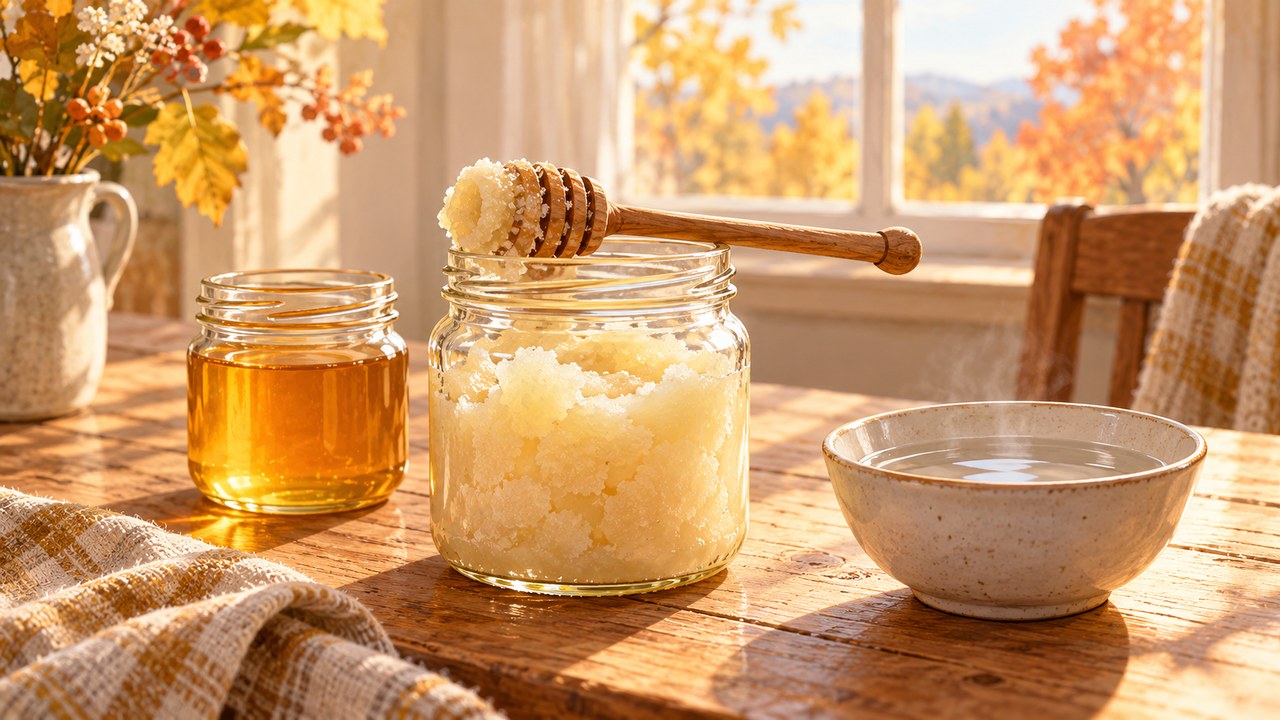
When honey left in the cupboard turns white and stiff one day, it's easy to think it has spoiled. But hardened honey hasn't gone bad. It's a natural change in which the glucose in honey gathers into tiny crystals. The taste and nutrients stay the same, so you can eat it as it is, or melt it back down.
Sugar water that's too thick
About 80% of honey's weight is sugar, and water makes up less than 20%. That's far too much sugar to stay dissolved in so little water, so honey is always dissolved a little beyond its limit. Honey's sugars are mainly fructose and glucose, and because glucose dissolves less easily in water, it is the one that comes out first and forms crystals.
Crystals first form on pollen or very small particles, then spread until the whole jar turns white and opaque. The gritty feel you get when you rub hardened honey between your fingers is these glucose crystals. Crystals don't mean its makeup has changed, so it's fine to eat it while it's solid.
It depends on flowers and heat
How fast honey hardens varies a lot from one honey to another. Acacia honey has a lot of fructose and little glucose, so it rarely hardens even after a long time, while honey high in glucose, such as rapeseed honey, can harden within a few weeks. So it isn't right to judge honey as fake because it hardened, or real because it didn't.
Temperature matters too. Honey is known to harden fastest somewhere cool, around 10 to 15°C. It hardens more easily in the fridge than at room temperature, so it's better to close the lid tightly and keep honey at room temperature. This is also why honey often hardens in late autumn as the weather turns chilly.
When to melt, when to toss
To make hardened honey runny again, set the whole jar in warm water at about 40°C and stir now and then. Heating it hard with boiling water or a microwave can drive off its aroma and change the taste. If the jar is large, it's better to scoop just what you'll eat into a small bowl and melt that. That way you don't have to heat and cool the rest over and over. For spreading on bread, hardened honey can actually be handier because it doesn't drip.
What to watch for is not hardening but a sour smell. When honey hardens, water collects in the part that didn't crystallize and makes it thinner, and with more moisture, yeast can grow and make it ferment. If it smells sour or bubbles rise, it hasn't just hardened but fermented, so it's best not to eat it.
Related reads
Honey that turns white and solid is just glucose clumped into crystals, not spoiled honey. Melt it in warm water, and only watch out for a sour smell.
Notes and references · National Honey Board (US) guidance on honey crystallization and storage. Hardening is natural glucose crystallization; it advises room-temperature storage and a warm water bath. The speed varies greatly with flower type and temperature.
Editorial standardsReport an error
Quick quiz