No. 109Everyday life4 minviews 61
Published by GK Library Annex
Why do you have to tap a ketchup bottle?
Ketchup sits still in an upside-down bottle, then suddenly rushes out.
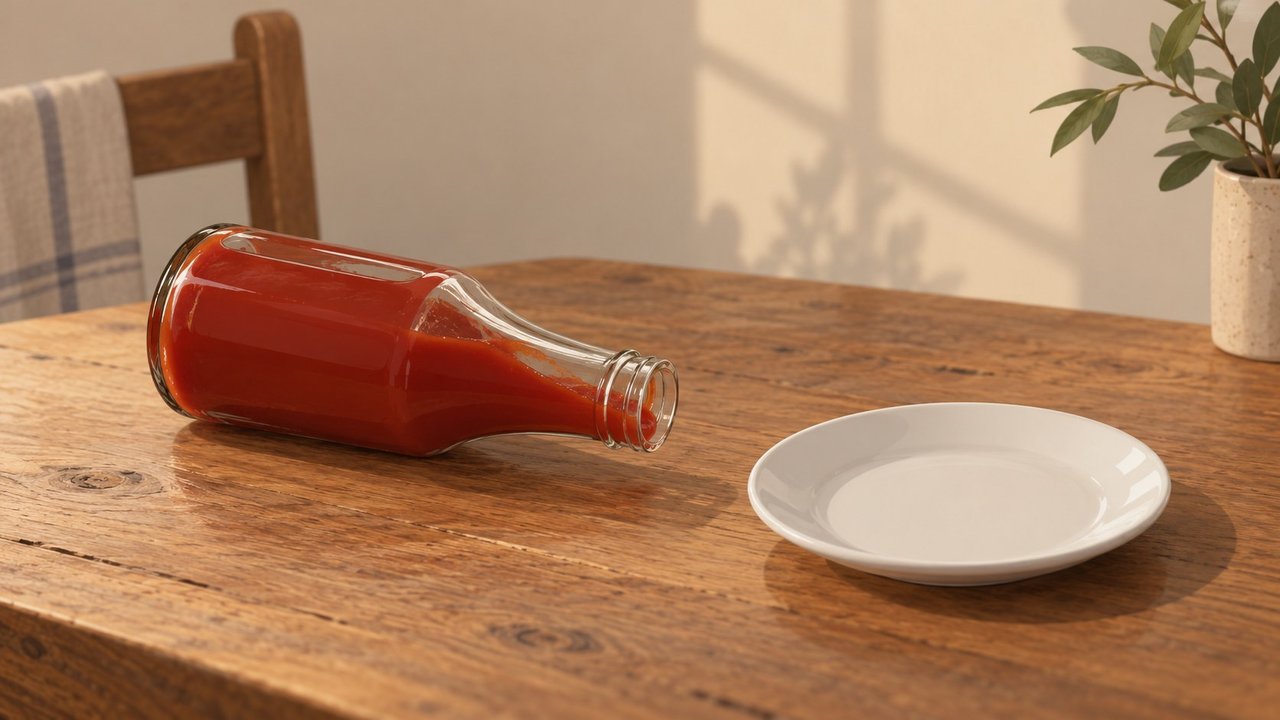
Left alone, ketchup holds itself up like a thick paste, but under force it briefly turns runny. That is why it sits still when you tip the bottle upside down, then suddenly pours once you shake or tap it.
Solid-like at rest
Ketchup is packed with finely ground bits of tomato. When those bits touch and link up into a loose network, that network resists flowing, so tilting the bottle is often not enough. It is the same reason a squeeze of ketchup stands in a little mound on a plate instead of spreading out like water.
Scientists call ketchup a soft solid: it barely moves until the push on it passes a certain threshold. If the weight of ketchup in the bottle cannot get past that threshold, it stays put even upside down.
Force makes it runny
Shake the bottle or give it a sharp tap, and the tomato network breaks up in an instant. The bits gain room to slide and line up along the direction of flow. Once ketchup starts moving, the faster it flows the thinner it gets, which is why a trickle can suddenly turn into a gush.
Scientists call getting thinner under force shear thinning, and thickening back up over time at rest thixotropy. So you get a short window right after shaking, but leave the bottle standing and it firms up again.
Not just the opening
The usual explanations are that the opening is clogged or that air cannot get in. Both are partly true. Dried ketchup in the neck really can plug it, and for sauce to leave through a narrow opening, the same volume of air has to get in. Giving air a path can help a bit.
But even with the cap off and the opening wiped clean, ketchup will sit inside an upside-down bottle. The key is the strength of the ketchup itself, and shaking or tapping is how you push it past that strength.
Pouring with less mess
First, shake the bottle hard a few times with the cap on. That remixes settled solids and any watery layer on top. Then open it and tilt it to about 45 degrees. Hold the neck with one hand and tap the bottom or the neck lightly with the other. Some glass bottles even mark a spot on the neck for tapping.
Start gently and build up, because a hard first whack tends to send out a flood. When little is left, cap it, hold it upside down, and swing it down sharply and stop, so the ketchup slumps into the neck.
Related reads
Ketchup resists at rest and turns briefly runny under force, so a shake or tap gets it past that threshold.
Notes and references · Juszczak et al. 2012 · Univ. of Melbourne 2016. Ketchup is a shear-thinning yield-stress fluid with thixotropy (Juszczak 2012; not every sample). Taps break the tomato network (Melbourne). Gentle tapping is still studied.
Editorial standardsReport an error
Quick quiz