No. 86Everyday life3 minviews 43
Published by GK Library Annex
Why is microwaved rice still cold in the middle?
The outside is steaming, but a spoonful from the center is lukewarm. Why can it stay that way even after more heating?
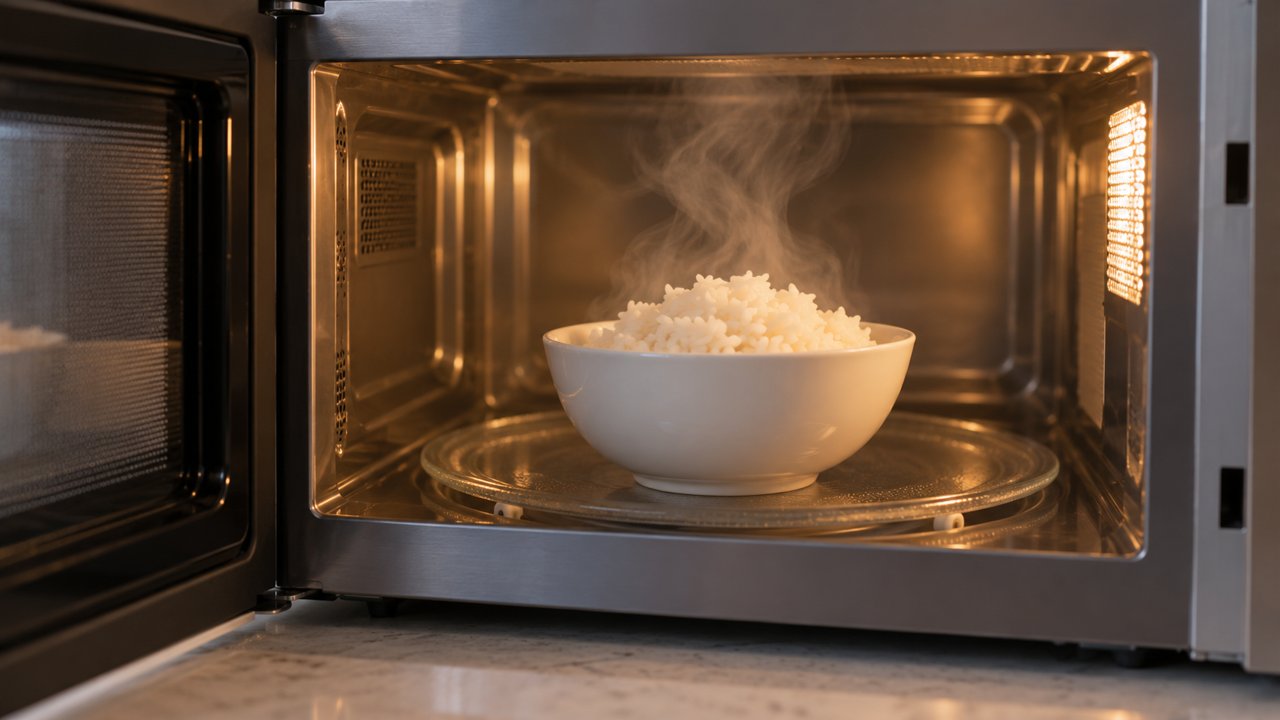
A microwave cannot heat all of a food at once. Microwaves penetrate only about 2.5–3.8 cm from the surface and heat the water there. The inside warms more slowly because it has to wait for heat to spread inward.
Food heats from the outside first
Microwaves make water, fat, and sugar molecules in food move very rapidly, producing heat. But much of the energy is absorbed near the surface, so it does not easily reach the center of a thick pile of rice or a deep portion of soup. Watery vegetables heat up especially fast for the same reason: water takes in microwaves readily.
The edges of a heaped bowl of rice therefore become hot first, while the middle stays lukewarm until heat slowly spreads toward it.
There are weak spots inside the oven too
Microwaves do not spread evenly inside the oven; some areas receive more energy and others less. The turntable rotates the food and reduces much of this difference, but it does not remove differences between the top and bottom.
That's why the US Department of Agriculture recommends stirring or turning food once during heating even if your oven has a turntable, then letting it stand for a few minutes afterward. Heat continues to move inward during that time, evening out the temperature. Spreading rice into a ring with an empty center is another option.
The inside-out myth
Many people say a microwave heats food from the inside out, but both the US Food and Drug Administration (FDA) and the Department of Agriculture say that isn't true. In thick foods, the outer layers are heated first by microwaves, and the inside cooks as that heat moves inward. That's why frozen dumplings can come out hot on the outside but still cold in the middle.
The worry that food becomes radioactive has no basis either. Microwaves are the same kind of waves as radio and radar signals, and once food absorbs them, they simply turn into heat.
Habits for even heating
The Department of Agriculture advises spreading food evenly in the dish and covering it with a lid or plastic wrap left slightly open. The steam that stays inside helps spread heat evenly and also helps kill bacteria. Keep the wrap from touching the food.
For large portions, heating on medium power a little longer, rather than briefly on full power, keeps the outside from drying out and warms the inside better. For leftovers, the Department of Agriculture's safety guideline is to reheat them until the inside reaches 74°C (165°F).
Related reads
Microwaves are mainly absorbed near the surface, and the oven has weak spots too. Stirring and letting food stand help it warm evenly all the way through.
Notes and references · USDA FSIS · FDA, ‘Microwave Ovens’. Penetration depth (1–1.5 inches), stirring and standing time, covering, and medium power follow the US Department of Agriculture's Food Safety and Inspection Service; the point that food doesn't cook from the inside out and the radioactivity myth follow the FDA. Penetration depth varies with the food and its moisture content.
Editorial standardsReport an error
Quick quiz