No. 75Language3 minviews 47
Published by GK Library Annex
Was ‘jjajangmyeon’ once considered incorrect Korean?
Restaurant menus always said ‘jjajangmyeon,’ but dictionaries long accepted only a different spelling.
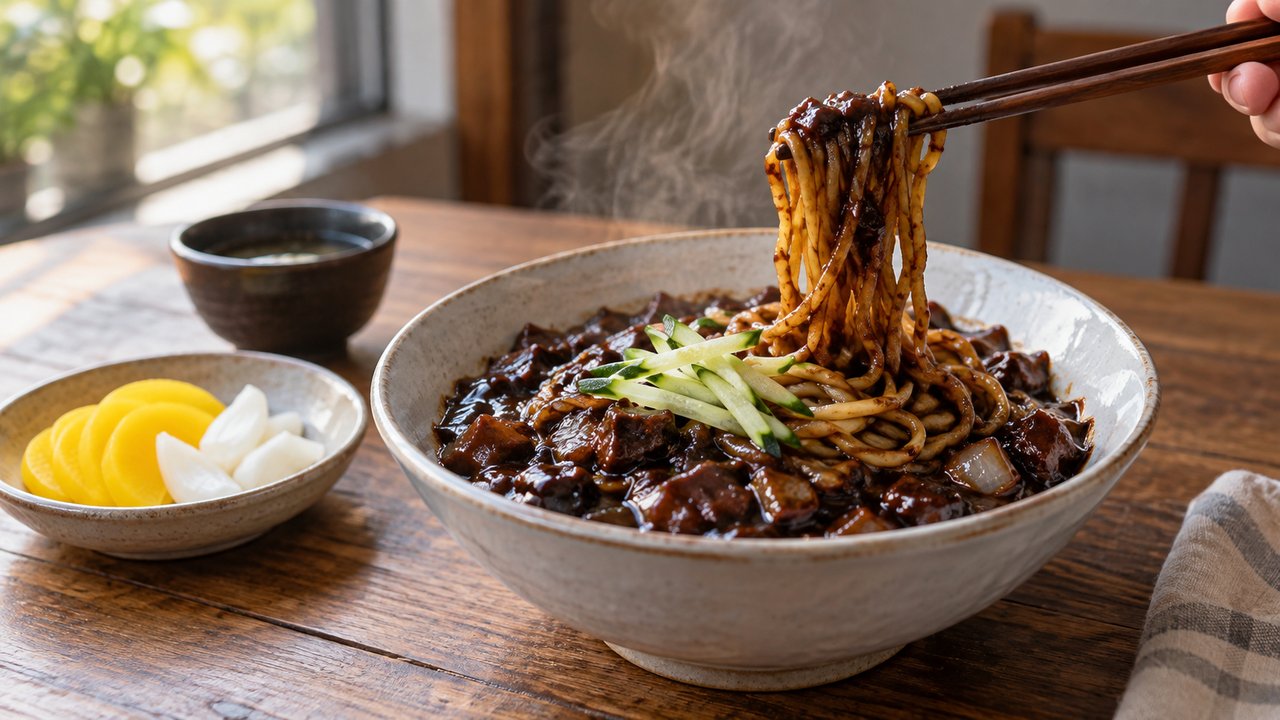
Yes. ‘Jjajangmyeon’ (짜장면) was an incorrect spelling until 2011, and only ‘jajangmyeon’ (자장면) was standard Korean. Both are now standard. The National Institute of Korean Language accepted ‘jjajangmyeon’ as an additional standard form on August 31, 2011.
Why was it ‘jajangmyeon’?
Jjajangmyeon combines the Chinese dish name 炸醬 (fried bean sauce) with ‘myeon’ (麵, noodles). In Chinese, 炸醬 is pronounced zhajiang, and the Chinese table in Korea's loanword spelling rules writes zh as ㅈ (j). So it was spelled ‘jajang’ (자장), and the standard pronunciation followed the letters as [jajang].
The problem was that almost everyone said ‘jjajangmyeon’ (짜장면). Menus and signs used it too, while only broadcasters carefully read it as ‘jajangmyeon’ on air.
‘Jjamppong’ was ‘jjamppong’ from the start
Jjamppong (짬뽕), another dish on Korean Chinese restaurant menus, was written with a tense consonant from the beginning. The loanword rules say established loanwords keep their customary form, and jjamppong was already in the dictionary that way. Jjajangmyeon was also recognized as a word long settled in everyday speech, so it became usable alongside the old form in 2011.
Words such as ‘meokgeori’ (먹거리, food), ‘maennal’ (맨날, every day), and ‘taekkyeon’ (택견, a traditional martial art) became standard at the same time, adding 39 entries in all.
‘Jajangmyeon’ is still correct
Many people think that once ‘jjajangmyeon’ became standard, ‘jajangmyeon’ turned incorrect. But a multiple standard form keeps both the original and the new word, so ‘jajangmyeon’ is still standard. The institute still answers that both spellings can be used, and either one is fine in textbooks and official documents. 택견 and 태껸 (both read taekkyeon), and 품새 and 품세 (pumsae and pumse) were accepted together in the same way.
Not every tense sound was freed
That does not mean every loanword said with a tense sound changed. ‘Donkkaseu’ (돈까스, pork cutlet), common on menus, is still standard only as ‘dongaseu’ (돈가스), and ‘kkape’ (까페) is still written ‘kape’ (카페, café). That is why a spell checker leaves 짜장면 alone but flags 돈까스. The loanword rules as a whole did not change; only a few long-settled words like jjajangmyeon were accepted separately. When in doubt, look the word up in the Standard Korean Language Dictionary.
Related reads
Since 2011, ‘jjajangmyeon’ has been an accepted standard form alongside ‘jajangmyeon.’
Notes and references · NIKL · New Korean Language Life · Yonhap. National Institute of Korean Language, Aug 31, 2011 release on 39 new standard entries (confirmed Aug 22); loanword rules' Chinese table (zh→ㅈ); New Korean Language Life 2011 No. 4; NIKL Q&A (자장면/짜장면, 돈가스); Yonhap, Aug 31, 2011.
Editorial standardsReport an error
Quick quiz