No. 61Science3 minviews 25
Published by GK Library Annex
Why does a spoon look bent in a glass of water?
The spoon is straight, yet the part below the water looks out of line. There is a reason the apparent bend moves when you lower your head.
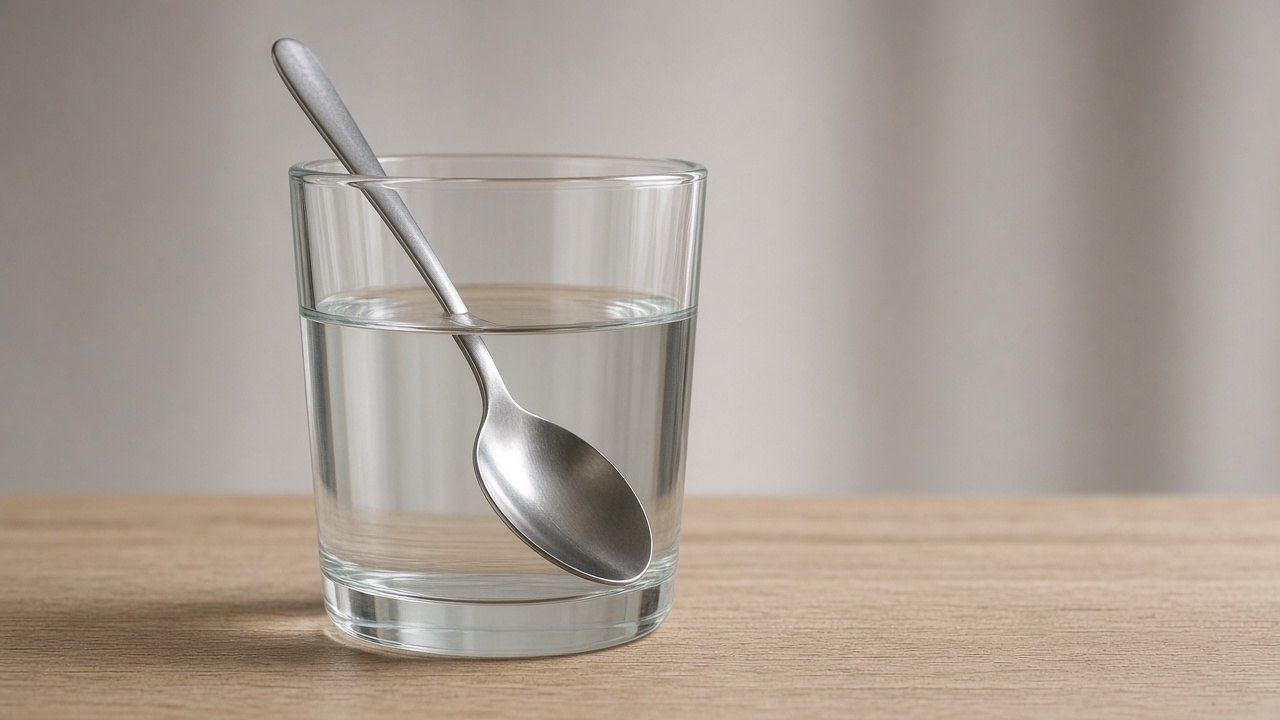
A spoon in a glass of water looks bent at the surface because of light, not because the spoon bends. Light from underwater changes direction as it passes through the surface into the air, but your eyes assume it traveled straight.
Light bends at the water's surface
Light travels more slowly in water than in air. So when it passes through the surface at an angle, its direction changes a little at the boundary. Light from the submerged spoon also bends once at the surface before reaching your eyes. But the brain does not separately work out that bend. It traces the incoming light backward in a straight line to place the object. The submerged part therefore looks shallower and slightly to one side of its actual position. Light from the handle outside the water comes straight to you, so it looks correctly placed. The two parts appear out of line at the surface, making the spoon look bent.
The viewing angle makes a difference
Looking straight down into the glass, you see very little bend. The light crosses the surface almost at a right angle, so its direction does not change much. The more slanted your view, the greater the bend, so from the side while sitting at the table, the submerged part can look sharply displaced. From the side of a round glass, the water-filled glass can also gather light like a convex lens, making the submerged part look thicker. Change the height of your head and the apparent bend moves with it, but the spoon stays exactly where it was.
Light doesn't curve inside water
Because the spoon looks bent, it is easy to assume light curves as it travels through water. But light goes straight both in water and in air. The only place its direction changes is the surface, where water meets air. That is why the bend always appears right at the water line, not at some random point along the spoon.
Water looks shallower than it is
For the same reason, the bottom under water looks closer than it really is. Seen from directly above, the floor of a 1.2m-deep pool looks as if it were about 90cm down, and it looks even shallower at an angle. That is also why people wading into a stream or the sea, expecting to touch bottom, get a surprise. The clearer the water, the safer it is to assume it is deeper than it looks. One observational study even found that archerfish, which knock insects off perches above the water with jets of water, take this shift into account when they aim.
Related reads
The spoon stays straight. It looks out of line because your eyes trace light that bent at the water's surface as though it traveled straight.
Notes and references · Snell's law · Dill (1977) archerfish study. Water has a refractive index of about 1.33, so viewed from directly above, an underwater object appears to be at roughly three-quarters of its actual depth. The shift grows at an angle. The archerfish observations are from Dill (1977, Behavioral Ecology and Sociobiology).
Editorial standardsReport an error
Quick quiz