No. 130Science3 minviews 26
Published by GK Library Annex
Why does the moon follow your car?
Roadside trees whoosh past, but the moon stays put. Is it really following you, or does it just look that way because it's far?
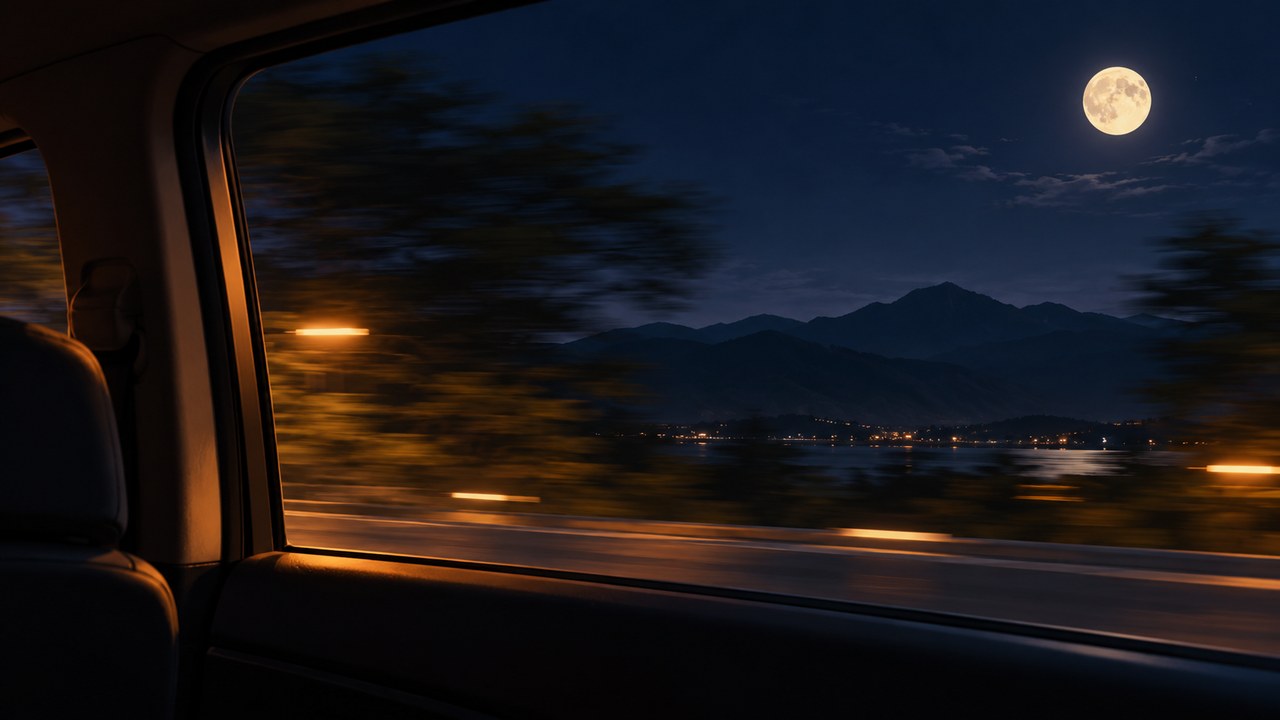
Look out the window of a moving car and the roadside trees and buildings whoosh backward, while the moon hangs in the same spot. The moon seems to follow you because it is so far away that no matter how far the car drives, the direction you see it in barely changes.
The moon is too far to shift
The moon is about 384,000 km from Earth on average. Even if you drive about 140 km in a straight line, roughly the distance from Seoul to Daejeon, the direction you look at the moon changes by only about 0.02 degrees. The moon is about 0.5 degrees wide in the sky, so that's a shift of about 1/25 of its width.
That's why, even after driving for a long time, the moon is still in the same corner of the window. The moon didn't drive along with you; the distance you traveled was just far too short compared with the distance to the moon.
Only nearby things slide back
The closer an object is, the more its direction changes as you move. Roadside trees flip from front to back in the blink of an eye, distant mountains slide by slowly, and the moon barely moves at all. This difference in apparent motion depending on distance is called motion parallax.
When the scenery around you flows backward, your brain concludes that you are moving forward. But since the moon alone doesn't slip back and stays in the same spot, your brain takes it that the moon is moving along with you. That's where the feeling of being followed comes from.
Children truly believed it
In 1924, Swiss psychologist Jean Piaget asked about 60 children aged 4 to 12 living in Geneva nothing more than "What does the sun do when you go for a walk?" Many of them answered without hesitation that the sun and moon follow them, and stop when they stop.
Piaget wrote that this belief lasts until about age 8 on average. Around ages 8 to 10, children mix the two ideas, explaining for example that the sun stays still but its light follows them, and only at about 11 to 12 do they understand that it merely looks that way because it is far away.
Sometimes the moon does move
It's not that the moon never moves across the sky. Because the Earth rotates, the moon drifts west by its own width about every 2 minutes. If the moon's position has changed after driving for more than an hour, that's thanks to the Earth turning, not the car.
You can check this at home too. Hold out your arm with a finger raised and close one eye at a time. Your finger jumps left and right from a difference of just over 6 cm between your eyes, but the moon outside the window doesn't budge.
Related reads
The moon is so far away that its direction barely changes as the car drives. Only nearby scenery slides back, so the moon feels like it's following you.
Notes and references · NASA moon data · Piaget 1924, "Une croyance enfantine". Piaget's study is a record of interviews with about 60 Geneva children in the 1920s, so today's children may differ. The angles are estimates based on the moon's average distance.
Editorial standardsReport an error
Quick quiz