No. 96Nature3 minviews 36
Published by GK Library Annex
Does salt on icy pavement really melt the ice?
After white crystals hit a slick path, the surface often looks different.
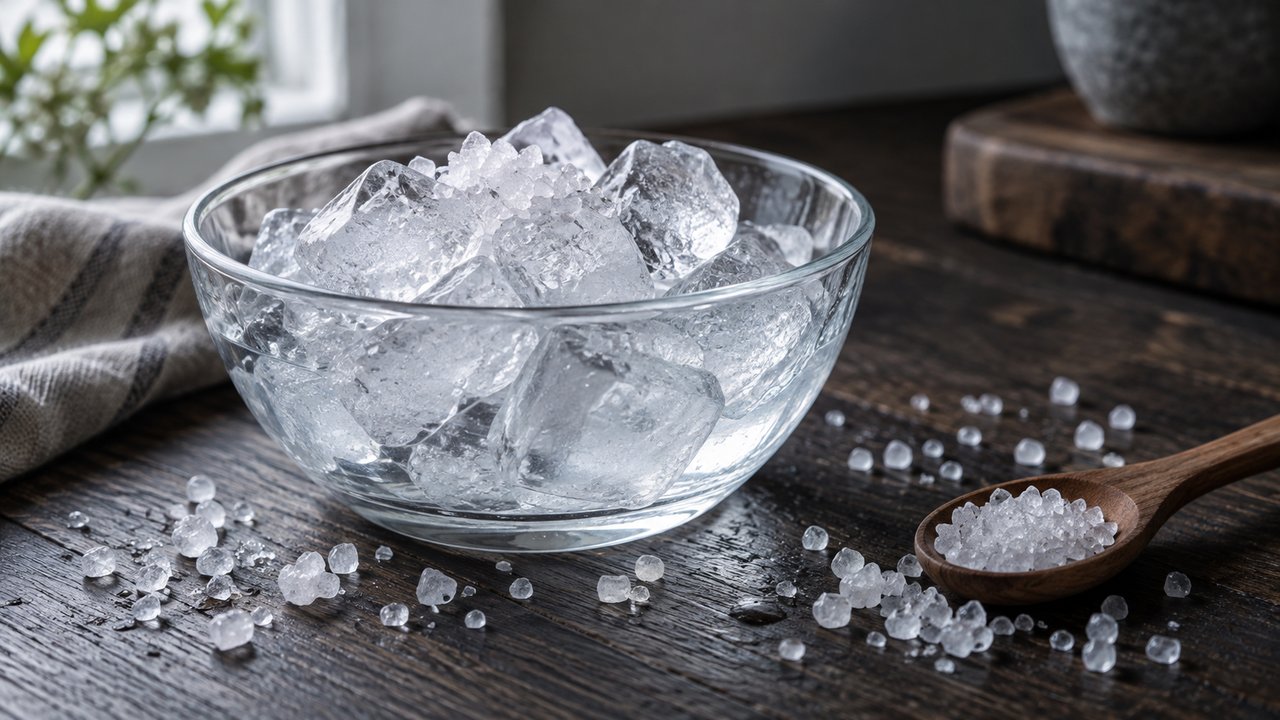
Salt often melts ice on roads and sidewalks. Dissolved salt makes a brine that freezes only at a lower temperature than pure water, so ice can turn to liquid even in the same cold air.
The freezing point drops
Ice usually has a thin film of liquid water on its surface. Salt dissolves into that film first and makes brine, whose freezing point sits below 0°C. Even when the ice is still colder than 0°C, ice touching the brine can melt, making more water that dissolves more salt.
In plain terms, salt gets in the way of water molecules locking back into ice. Melting keeps going at about the same pace while refreezing slows, so the ice shrinks overall.
It is not heat that does it
Many people believe salt gives off heat as it dissolves and that this heat melts the ice. Scientific American once printed that explanation, then corrected it after readers pointed out the problem. As Professor Arthur Pelton of the University of Montreal explained, dissolving salt actually absorbs heat overall. Stir some salt into a glass of water and touch it, and it feels slightly cooler.
Too cold and it fails
You cannot lower the freezing point forever by adding more salt. Water holding as much salt as it can still freezes around −18°C. On real pavement, salt loses power well before that. Figures from the Minnesota Pollution Control Agency show that at a pavement temperature near −1°C, one pound of salt melts 46 pounds of ice in 5 minutes, but near −9°C it melts only a little over 6 pounds in an hour.
So on colder days crews switch to calcium chloride, which works to about −29°C, or spread sand, which adds grip but melts nothing.
More salt is not safer
That crunch underfoot feels reassuring, but believing more salt means more safety is a myth. The same agency says about one coffee mug of salt (roughly 340 g) treats a driveway about 6 m long or 10 sidewalk squares. Extra salt washes into rivers and lakes, and a single teaspoon can permanently pollute about 19 L of water.
When clearing ice at home, shovel and scrape first, then spread salt evenly only where it is needed. Sweep up leftover grains on dry ground and save them for next time.
Related reads
Salt melts ice by lowering water’s freezing point. Below about −9°C pavement temperature it loses most of its power, and piling on more does not make you safer.
Notes and references · Scientific American·Minnesota Pollution Control Agency. Based on Scientific American’s “Why do we put salt on icy sidewalks in the winter?” (Prof. Pelton’s corrected explanation) and the Minnesota Pollution Control Agency (MPCA) Deicer fact sheet and winter salt tips. Fahrenheit and pound figures are rounded.
Editorial standardsReport an error
Quick quiz