No. 66Health3 minviews 34
Published by GK Library Annex
Is there really a way to cut onions without crying?
Cold water, the refrigerator, goggles—there are plenty of tricks. In an experiment, the difference came from something already on the cutting board.
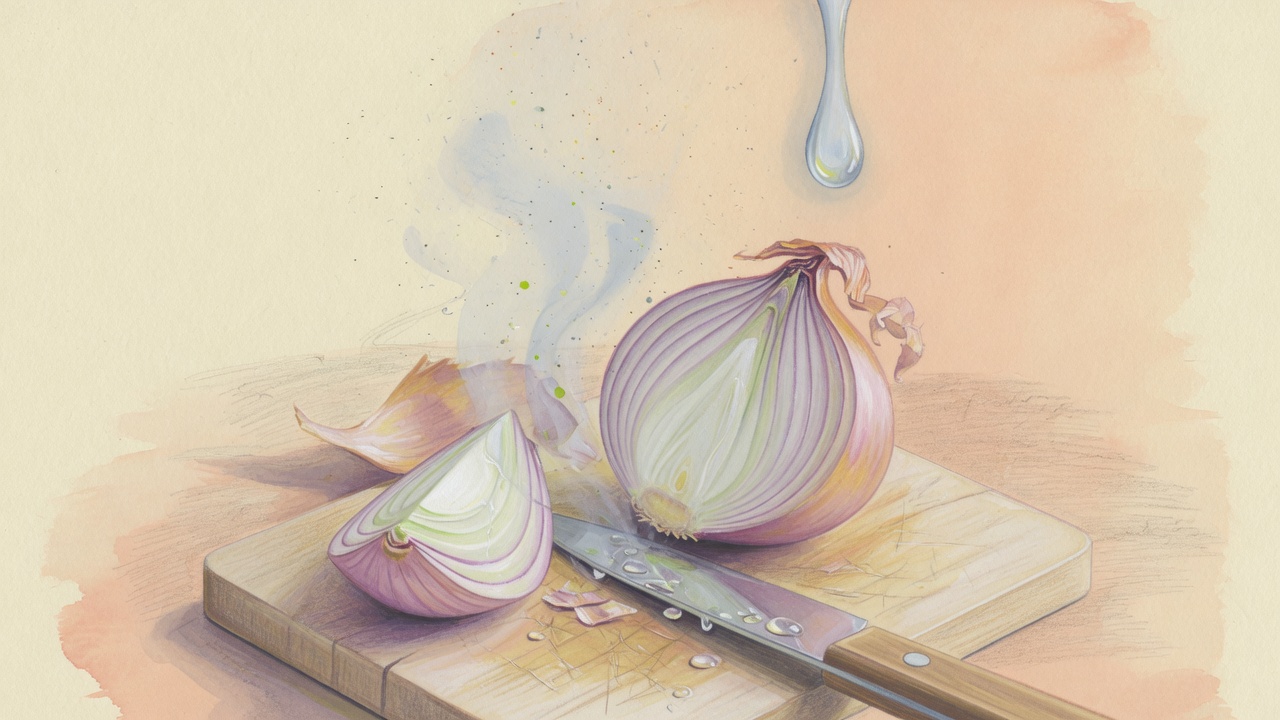
You can reduce onion tears. The most reliable method is to cut slowly with a sharp knife. Cutting onions sends up tiny droplets carrying eye-irritating compounds, and a dull knife used quickly produces far more of them.
Tiny droplets that bring tears
The inside of an onion is divided into compartments by thin membranes. When a knife breaks them, previously separate substances meet and form eye-irritating sulfur compounds. These spread as a readily airborne gas and can also travel in microscopic droplets thrown up during cutting. Nerves on the eye's surface detect them, and the eye produces tears to wash them away.
A dull knife produces more droplets
In 2025, researchers at Cornell University in the US filmed onion cutting with a high-speed camera. A dull blade cannot immediately pierce the onion's outer layer and instead presses down on it. Pressure builds inside until the layer breaks, sending droplets out like a mist. A duller, faster blade greatly increased their number, and some traveled more than 60 cm. Raising the cutting speed from 0.4 to 2 meters per second made about four times as many droplets, and blunting the blade's edge produced up to about 40 times as many. The droplets could shoot out at up to 40 meters per second, far faster than the knife itself was moving.
Does cutting fast mean fewer tears?
People often say it is best to cut onions quickly and finish before the tears start. But in the experiment, faster cutting made droplets fly out in greater numbers and with more force. Chopping hard with a dull knife is the worst. The droplets the researchers saw shot up almost vertically along the face of the blade, so rather than leaning right over the cutting board, it is better to stand a little to one side. These droplets can also carry bacteria from the onion and spread them around, so the researchers noted that keeping knives sharp helps kitchen hygiene too.
Keep it cool and move the air out
Putting an onion in the refrigerator for about 30 minutes helps too. Cold temperatures reduce the formation and release of irritating compounds. The root end is said to contain more of them, so cut it last. Opening a window or running an extractor fan also helps remove air above the cutting board. Holding bread in your mouth or chewing gum has no clear supporting evidence. If you wonder whether your knife is dull, rest the blade lightly on a tomato's skin. If it slides in without any pressure, the knife is sharp.
Related reads
If onions often make you cry, try sharpening your knife first. Cutting slowly and chilling the onion can make things easier on your eyes.
Notes and references · Wu et al., PNAS (2025), study of droplets released by onion cutting. High-speed filming showed that dull blades used quickly increased the number and speed of flying droplets (about 4 times with faster cutting, up to about 40 times with blunter blades). Cooling and ventilation are practical recommendations based on experience, so their perceived effects vary between people.
Editorial standardsReport an error
Quick quiz