No. 51Health3 minviews 25
Published by GK Library Annex
Why does spicy food make your nose run?
One spoonful of spicy soup and your nose starts sniffling first. It's not a cold—so where does the drip come from, and what should you drink to calm it?
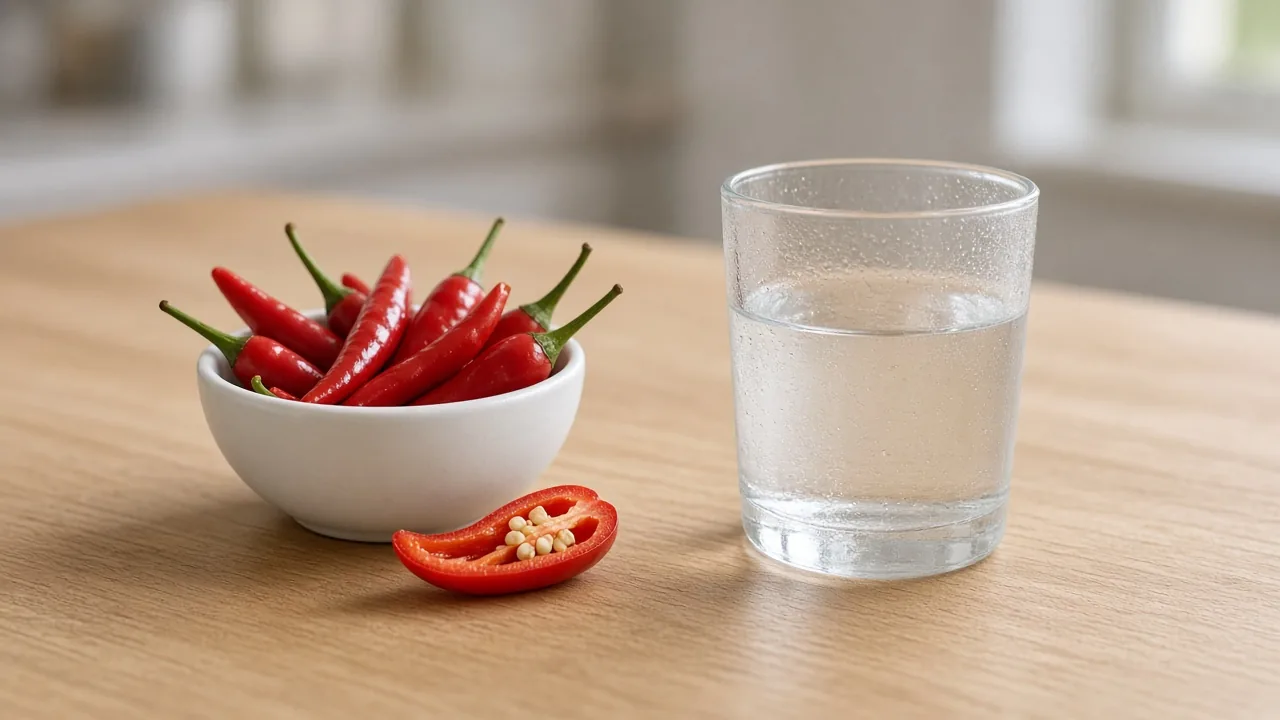
One spoonful of spicy soup and your nose starts to sniffle. It's not a cold or an allergy, yet clear liquid runs. Doctors call this food-triggered drip 「gustatory rhinitis」. It's a very common reaction to spicy food.
Spice switches on a heat sensor
Capsaicin, the hot compound in chili peppers, binds to a sensor called TRPV1 on nerves inside the mouth and nose. That sensor normally reports heat above roughly 43°C. The real temperature hasn't changed, but the nerves send a 「hot」 signal. David Julius, who discovered this sensor, won the 2021 Nobel Prize in Physiology or Medicine.
The body answers by telling the glands in the nasal lining to release fluid. It's a reflex to wash the irritant away, so the drip is thin and clear. The same nerves reach the eyes, which is why they can water too.
Not the same path as a cold
In 1989, researchers at the U.S. National Institutes of Health studied people's noses after spicy food. The drip began within minutes of eating, and when atropine, which blocks parasympathetic nerves, was given beforehand, almost none appeared. It's a nerve reflex, not inflammation.
That's why the antihistamines used for allergy drip tend not to help much. If spicy food reliably makes your nose run badly, an ENT doctor can talk with you about a nasal spray that blocks this reflex.
Wasabi stings the nose
The heat of wasabi and mustard is a little different. Its compound triggers another sensor, TRPA1, and it rises easily into the air and straight into the nose. So chili burns the mouth, while wasabi gives a sharp sting at the tip of the nose. Wasabi's sting fades quickly because the compound evaporates away.
Either way, the drip is the body trying to rinse out the irritant.
Milk beats plain water
Many people gulp cold water to put out the fire. But capsaicin dissolves well in fat and poorly in water, so plain water only cools the mouth for a moment. In a 2019 Penn State experiment, milk reduced the burn the most, while seltzer did the least.
The reflex settles as the irritation fades. When you eat something spicy, keep tissues nearby and take a sip of milk or yogurt instead of water.
Related reads
A spicy-food drip isn't a cold—it's your nose reflexing after a heat sensor switches on. To calm it, milk works better than plain water.
Notes and references · Raphael et al. 1989 · Caterina et al. 1997 · Nolden et al. 2019. The nerve reflex behind spicy-food drip (gustatory rhinitis) is from Raphael et al. 1989 (J Allergy Clin Immunol); the capsaicin sensor TRPV1 from Caterina et al. 1997 (Nature); wasabi and TRPA1 from Jordt et al. 2004; the beverage test from Nolden et al. 2019.
Editorial standardsReport an error
Quick quiz