No. 34Health3 minviews 21
Published by GK Library Annex
Why does a big bite of ice cream make your head ache?
A few seconds of sharp pain behind your forehead. Where does that signal really start?
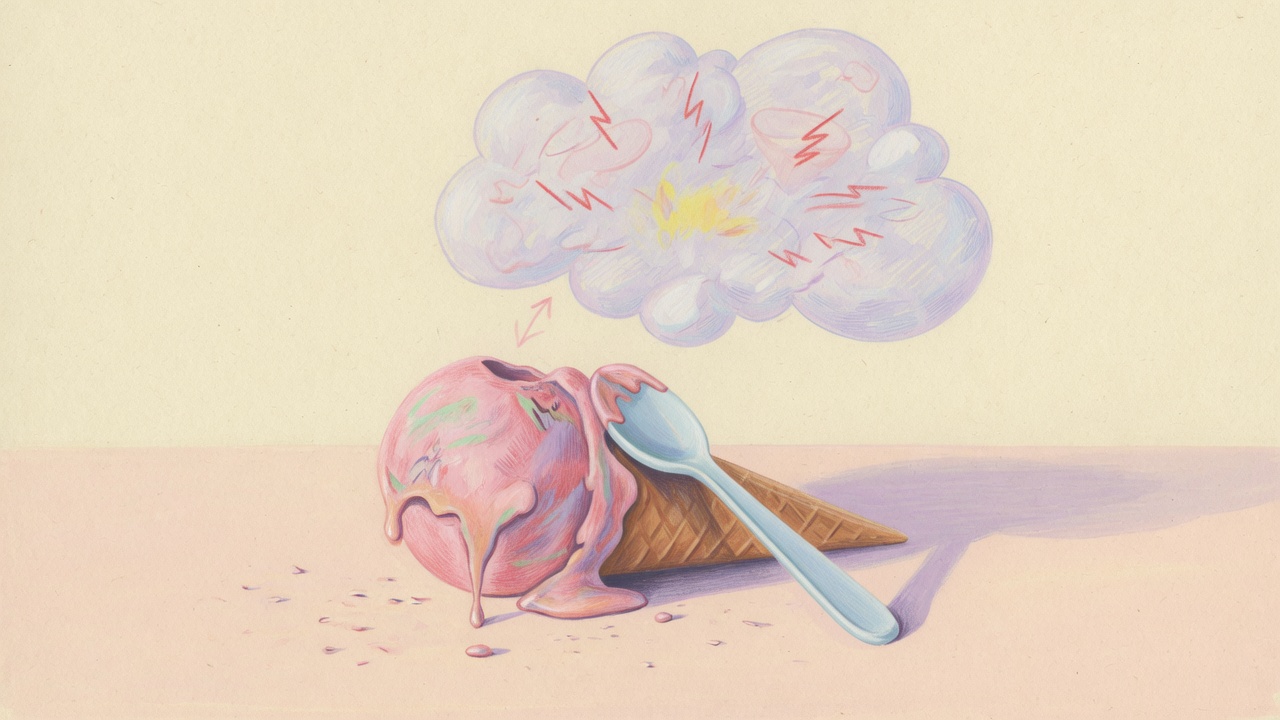
When you wolf down ice cream and feel a sharp ache behind your forehead, your brain isn't freezing. When the roof of your mouth and the back of your throat suddenly turn cold, the signal travels up a facial nerve, and it feels as if your head hurts.
The palate and throat send the signal
When something cold passes quickly over the roof of your mouth or the back wall of your throat, a strong signal travels along the nerve that handles feeling in your face, the trigeminal nerve. That same nerve also covers the forehead, so the brain reads the pain as coming from your forehead. The cold spot and the sore spot simply feel like different places.
It's easy to think cold water is fine if you swallow it straight down, but experiments show the opposite. In 2017, researchers at the University of Halle in Germany tested 77 people: holding an ice cube against the palate gave only 9 of them a headache, while quickly drinking 200 mL of 0°C ice water gave 39 a headache. The more the mouth and the back of the throat cool all at once, the more likely it is.
A blood vessel briefly widens
In 2012, Jorge Serrador's team at Harvard Medical School measured blood flow in the brain while 13 people sipped ice water through a straw pressed against the palate. Around the moment they felt pain, blood rushed into a large artery heading toward the front of the brain, and as the vessel narrowed again, the pain faded. The researchers saw it as a response to protect the brain from the cold.
But the group was small and the difference wasn't clear-cut, so research continues alongside the nerve explanation. Either way, the brain itself never freezes.
Eating faster makes it more common
In 2002, 145 students at a middle school in Hamilton, Canada, took part in an experiment. Among those who finished a cup of ice cream within 5 seconds, 27% got a headache, compared with 13% of those who ate slowly.
The study was deliberately run in winter, and plenty of students still got headaches, showing that this doesn't happen only on hot days. 79% of the students said they had felt it at least once in their lives, and more than half of the headaches were gone within 10 seconds.
What to try when it hits
If it has already hit, press your tongue firmly against the roof of your mouth or hold a sip of lukewarm water in your mouth. Both warm the chilled spot quickly. Rubbing your forehead doesn't help much, because that's not where the pain started.
To head it off, let each spoonful melt briefly at the front of your mouth before swallowing. When drinking shaved ice or a slushie through a straw, it also helps not to shoot it straight at the back of your throat. After a headache, pausing for a moment often means the next bite is fine.
Related reads
When something cold chills the palate and the back of the throat all at once, your forehead aches. Let it melt slowly, and if it hits, warm the palate with your tongue.
Notes and references · Kaczorowski 2002 BMJ; Mages et al. 2017; Serrador 2012. A trial with 145 middle schoolers (27% when fast, 13% when slow) and one with 77 adults (39 with ice water, 9 with an ice cube). The blood flow study had only 13 people, so it is still debated alongside the nerve explanation.
Editorial standardsReport an error
Quick quiz