No. 98Everyday life3 minviews 40
Published by GK Library Annex
Why do water drops skitter on a hot pan?
Ever sprinkled water to check if the pan is ready? That jittery dance has a simple cause.
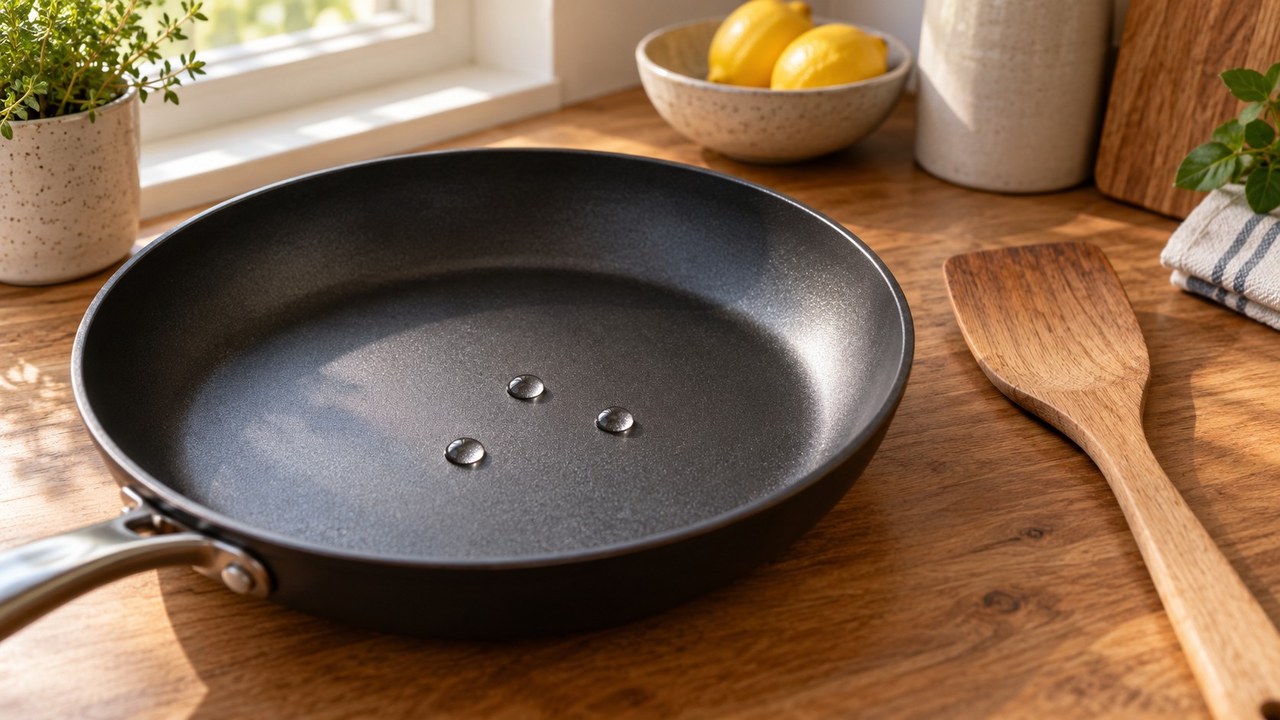
On a very hot pan, the bottom of a water drop turns to steam instantly, and the drop floats and bounces on that thin cushion. Because the steam blocks heat, the drop can last longer than on a cooler pan. The effect is named after Leidenfrost, a German doctor who described it in 1756.
A thin steam layer lifts the drop
The moment a water drop touches very hot metal, only its underside turns to steam. That steam forms a thin layer between the drop and the pan and lifts the drop slightly. Steam carries heat far worse than metal, so heat enters the water more slowly than if it touched the pan directly.
With almost no friction underneath, the drop beads into a small ball and glides around. It is a bit like a puck sliding on the cushion of air on an air hockey table.
How it changes with temperature
Below 100°C, water spreads out and dries slowly. Above 100°C, it hisses and vanishes quickly. Then, at roughly 190°C or so for water, a stable steam layer forms and the drop rolls around like a ball.
This threshold is not one fixed number. It shifts with the condition of the pan's surface and what is mixed into the water; on copper, values above 250°C have been reported.
Hotter doesn't mean faster drying
It is a common misconception that water always evaporates faster on a hotter pan. In an experiment cited by the 19th-century British boiler designer William Fairbairn in his lectures, a drop that vanished almost at once on iron at 168°C lasted 152 seconds at 202°C.
That made the effect a headache for boilers: when the iron got too hot, less heat actually reached the water. Once the pan cools and the steam layer breaks, the drop boils hard again and disappears fast.
The water-drop test in the kitchen
Cooks who use stainless steel pans treat this as a preheating signal. They heat the pan slowly over medium heat and add a little water now and then; when the drop pulls together into one bead that rolls like a ball of mercury, the pan is ready. Wipe away the water, then add oil.
Cast iron has a rougher surface, so the bead may not form as cleanly. In that case, judge by the heat rising from the pan and the sizzle when food goes in.
Related reads
On a very hot pan, water rides a thin steam cushion, so it slides and often shrinks more slowly than when it touches the metal directly.
Notes and references · Wikipedia · Rouxbe Cooking School. Based on Wikipedia's ‘Leidenfrost effect’ (water about 193°C, copper case 257°C, Fairbairn's 1851 lectures: 168°C vs 202°C, 152 s) and Rouxbe's ‘mercury ball test.’ The threshold varies with surface and water condition.
Editorial standardsReport an error
Quick quiz