No. 15Everyday life3 minviews 26
Published by GK Library Annex
Your glasses fog up when you come in from outside
That moment when the lenses go cloudy as you step into a warm room
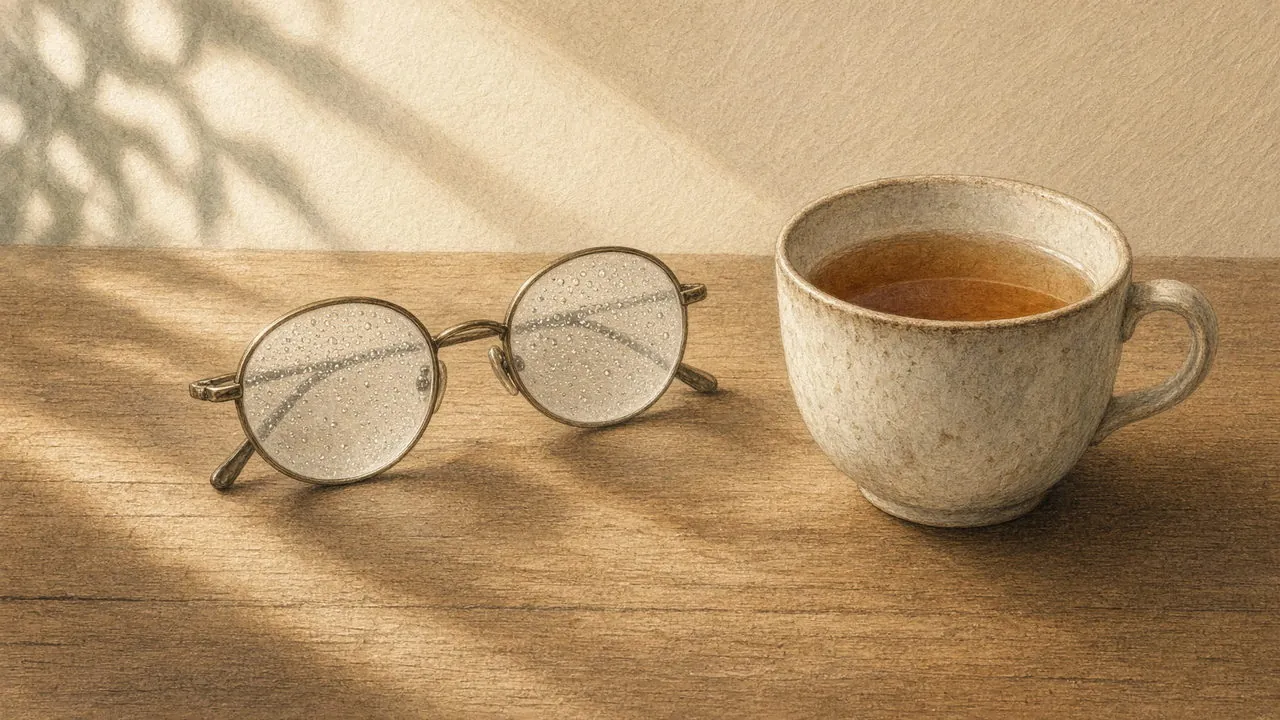
When you come in from outside into a warm room, your glasses fog up. It is not only breath stuck on the lenses. Water vapor in the room air settles as tiny droplets on glass that is still cold.
The lenses are still outdoors
Glasses that were outside warm up more slowly than the room. The lenses on your nose are still chilly.
Warm indoor air holds more water. When that air touches cold lenses and cools below the dew point, the vapor it carried turns into tiny droplets. Those droplets scatter light, so the lenses look cloudy. Even at the same temperature, humid days fog more easily. That is why you notice it more stepping into a steamy restaurant than into a dry winter living room.
It is not only your breath
Breath when you speak does the same thing. Breath is warm and full of water. A cold cup, a bus window, and a bathroom mirror right after a shower pick up the same pattern.
Wiping the fog with your hand mixes it with oil and spreads it. Once the lenses catch up to room temperature, the droplets go back into the air and the view clears on its own. Waiting a moment often works better than wiping. Rubbing with a sleeve in a hurry can make things look worse.
Like a cold can
It is the same idea as water beading on a can from the fridge. Room air lays water on a cold surface. Going from an air-conditioned shop into humid outdoor air in summer can reverse the direction and do the same thing.
Glasses fog more often when a shop door opens in winter because the temperature gap is larger. A mask can push breath up toward the lenses and make fog more frequent. Giving the lenses a moment to warm is the simplest fix.
A common mix-up
It is not that the lens coating melted, or that room lights painted the glass white. The haze is not the glass itself going cloudy. It is a thin layer of tiny water droplets on the surface.
Anti-fog spray keeps droplets from clumping so they spread in a thinner film and block less of your view. Water still settles if the lenses are cold and the air is humid. How fast the fog clears depends on room temperature and humidity.
Related reads
Foggy glasses are not only breath marks. They are tiny water droplets on cold lenses.
Notes and references · Condensation and foggy glasses. USGS and NOAA: when warm, moist air meets a cold surface below the dew point, vapor condenses into droplets. Glasses, cold cups, and windows work the same way.
Editorial standardsReport an error
Quick quiz