No. 41Numbers3 minviews 29
Published by GK Library Annex
Why does a new digit appear after nine?
How tens place value relates to finger counting—and leftover dozen, score, and sixty groupings.
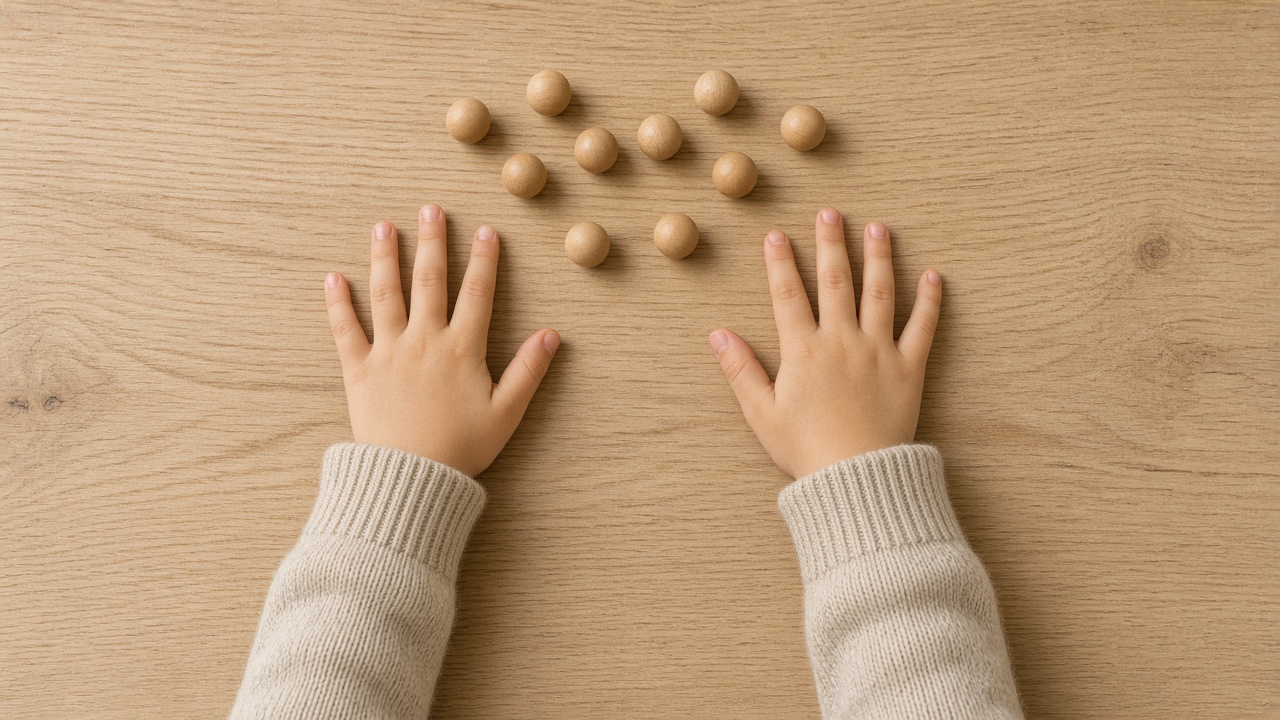
The most common explanation for raising a place every ten is that people have ten fingers. Old records do not prove 「base ten came only from fingers」 as a single fact. It is closer to a widely accepted hypothesis: the two-hand bundle survived as place value.
Two hands make one bundle
Count apples by folding fingers and both hands are closed at ten. For the eleventh you run out of fingers, so you keep 「one ten」 in mind and start again from the first finger.
Grouping by tens keeps large counts clear. Two bundles are twenty; three are thirty. Korean number words that name each ten-step follow the same idea. Treating ten as one 「hand bundle」 fits the later rules of place value on paper.
The same rule on paper
Writing numbers works the same way. When the ones digit passes 9, you carry 1 to the tens place and reset ones to 0. The tens digit is like a record of how many times both hands closed.
Cultures that counted fingers and toes together often bundled by twenties. French quatre-vingts for 80—literally 「four twenties」—is often cited as a remnant. English score (twenty) is discussed as a similar leftover. These examples support the idea that grouping units came from the body.
Not only tens
A dozen eggs is a twelve-bundle, and 60 minutes and 60 seconds echo Mesopotamian sexagesimal counting. Saying 「math came only from fingers」 leaves those traces out. Cultures without a ten-finger habit could—and did—use other bases. Some records, including Maya counting, used twenty as a main bundle.
Binary in computers comes from on/off states, not finger count. Everyday life still mixes tools: place value by 10, eggs by 12, time by 60. The question is less 「why must it be 10」 than 「which bundle was handy」.
Related reads
Raising a place at ten is best read as a strong hypothesis from ten-finger bundling. Traces of 12, 20, and 60 still show up elsewhere.
Notes and references · Ifrah, Universal History of Numbers · Britannica overview of bases. Georges Ifrah argues ten fingers helped spread decimal counting, while fingers-plus-toes favor base 20. French quatre-vingts is often cited as a vigesimal remnant. Dozen and sexagesimal time traces remain in many cultures; the finger origin is a strong account, not a single proof.
Editorial standardsReport an error
Quick quiz