No. 114Everyday life4 minviews 25
Published by GK Library Annex
How does a bitter-dry persimmon turn sweet and soft?
A persimmon that made your mouth pucker turns sweet in days. What changes inside?
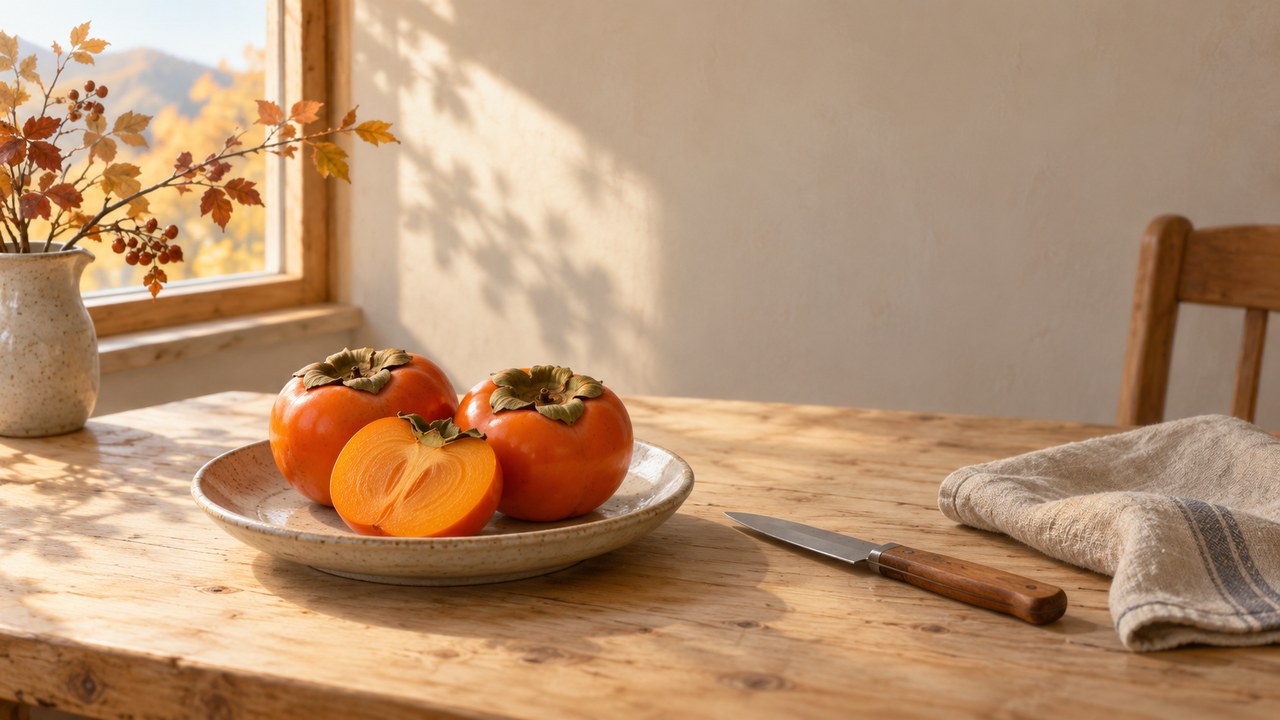
When an astringent persimmon becomes a soft ripe hongsi or a dried gotgam and only the sweetness remains, it is not because the puckering compound disappears. It hardens into clumps that no longer dissolve in water, and once it cannot dissolve, it no longer feels astringent on your tongue.
Astringency is not a taste
Bite into an unripe persimmon and your mouth turns dry and furry. That feeling is not a taste the tongue detects, like sweet or salty. It is closer to a touch sensation, as if the inside of your mouth were shrinking.
When the tannins in the persimmon latch onto proteins in your saliva and clump together, the slippery film of saliva that coats your mouth disappears. Your tongue and the insides of your cheeks then rub roughly against each other, and you feel astringency. Strongly brewed green tea gives a similar feeling because of compounds from the same family.
Dissolved or hardened
An astringent persimmon is full of tannins dissolved in water and packed into tiny pouch-like cells. When you chew, these cells burst and the tannins mix into your saliva.
As the fruit ripens fully, or when people help it along, a substance called acetaldehyde forms inside it. This substance links the tannin particles together into large clumps that do not dissolve in water. Clumped tannins stay put when you chew instead of leaking into your saliva, so the astringency is gone. The black, sesame-like specks you sometimes see inside a persimmon are tannins that hardened this way.
Are sweet persimmons sweeter?
It is easy to assume astringent persimmons taste bad because they have less sugar, but that is not necessarily so. Astringent types like daebong contain plenty of sugar; the astringency is simply strong enough to hide the sweetness. Once the tannins harden, the hidden sweetness comes through.
Sweet persimmons are varieties whose tannins harden or get diluted while the fruit grows on the tree, so they are not astringent even when picked. So sweet and astringent persimmons differ not in how ripe they are but in variety.
Removing astringency at home
If you bought astringent persimmons, the easiest way is to leave them at room temperature until they turn soft. The tannins harden slowly as the fruit ripens. Putting them in a bag with an apple makes them soften a bit faster, thanks to a gas the apple gives off.
Some households dab a little soju on the stems, seal the fruit in a plastic bag, and leave it for a few days. With the air shut out and the alcohol seeping in, the tannins harden faster inside the fruit. Peeling and drying persimmons into gotgam, or freezing and thawing them once, also hardens the tannins and reduces astringency.
Related reads
An astringent persimmon turns sweet not because the puckering compound disappears but because it hardens and stops dissolving. Waiting, drying, or freezing lets the hidden sweetness show.
Notes and references · Taira et al. 1999, J. Japan. Soc. Hort. Sci.. Six methods, incl. alcohol, CO2, drying and freezing, all made tannins insoluble and removed astringency. Whether alcohol acts via acetaldehyde is debated.
Editorial standardsReport an error
Quick quiz