No. 77Science3 minviews 29
Published by GK Library Annex
Why do stars twinkle in the night sky?
Some points in the same night sky flicker noticeably less. What makes the difference?
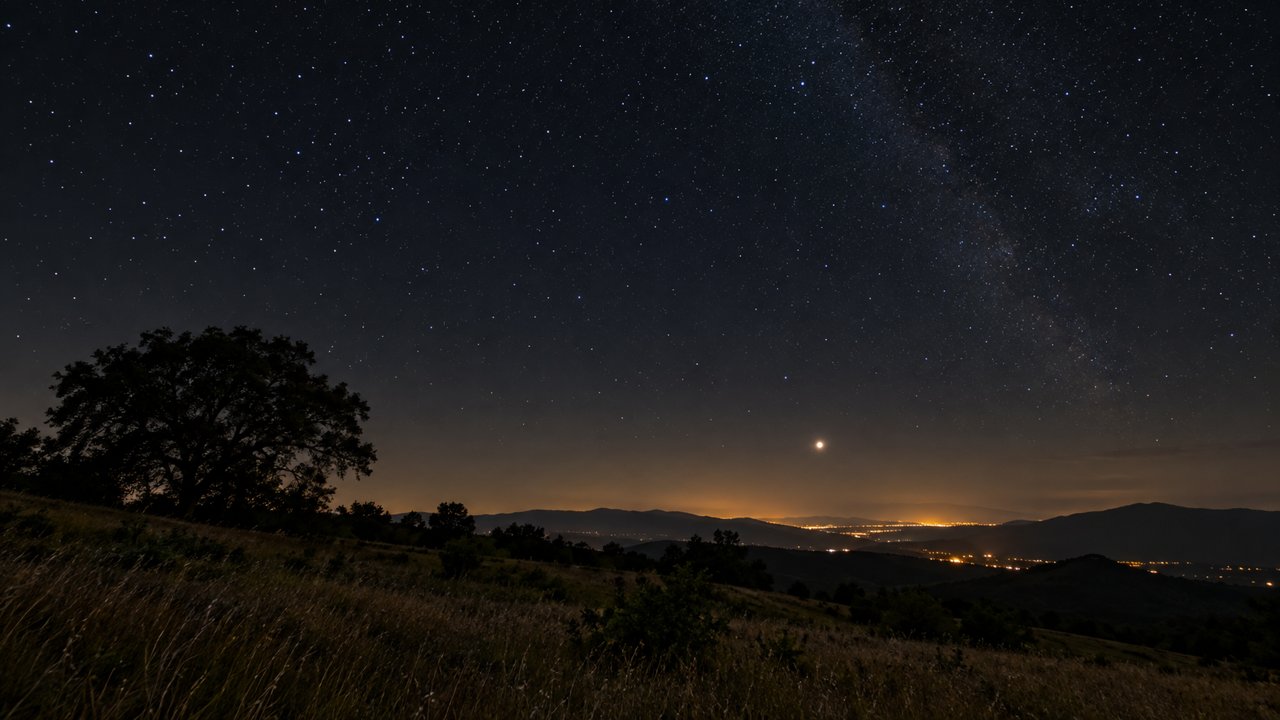
Stars twinkle because the air above us constantly shifts their light slightly, rather than because the starlight itself flickers. From space, stars appear to shine almost steadily.
Air shifts the light
Starlight passes through a thick atmosphere before reaching Earth. Air temperature and density vary slightly with height and location, so the light bends a little each time it passes between different regions.
These pockets of air are always moving, making starlight enter your eyes and then miss them slightly, over and over. The star therefore seems to brighten and dim. It is similar to a distant car shimmering above hot asphalt in midsummer. Astronomers call this twinkling scintillation.
Planets flicker less
Stars are so far away that even through a telescope they look like single points. A small shift in light from a point is easy to notice.
Planets such as Venus and Jupiter are much closer and appear as very small disks. Light from different parts of a disk shifts differently, so the effects mix and cancel out, producing a steadier glow. But both stars and planets low near the horizon send their light through more air and therefore twinkle more.
Stars that flash colors
Look at Sirius low in the sky on a winter night and it may flash red, green, and blue, so much that it is sometimes reported as a UFO. The air acts like a prism, bending each color of light slightly differently, and the shimmering happens separately for each color. This happens with other stars too, but Sirius is the brightest star in the night sky, so the changes stand out.
Is lots of twinkling a good sign?
It is easy to think a night of strong twinkling is a good night for stargazing. For astronomers, though, it signals that the air is that turbulent. Through a telescope, the image wavers and blurs. That is why large observatories are built on high mountaintops where the air is thin and calm, and space telescopes such as Hubble go above the atmosphere altogether to capture starlight without the shimmer. If you plan to take a telescope out at home, it is better to choose a night when stars twinkle less. When looking for planets with the naked eye, find a bright point that flickers less and compare it with a nearby star.
Related reads
Twinkling is an effect of Earth's atmosphere rather than the star itself. It is stronger for stars low in the sky.
Notes and references · NASA StarChild · EarthSky · Britannica. Based on explanations of stellar twinkling (scintillation) from NASA StarChild, EarthSky, and Britannica, and EarthSky's explanation of Sirius's color changes. Planets can also twinkle when low in the sky.
Editorial standardsReport an error
Quick quiz