No. 151Science4 minviews 8
Published by GK Library Annex
Shooting stars: are stars really falling?
What falls is space dust the size of a grain of sand. In late October you can even see debris left by Halley's Comet.
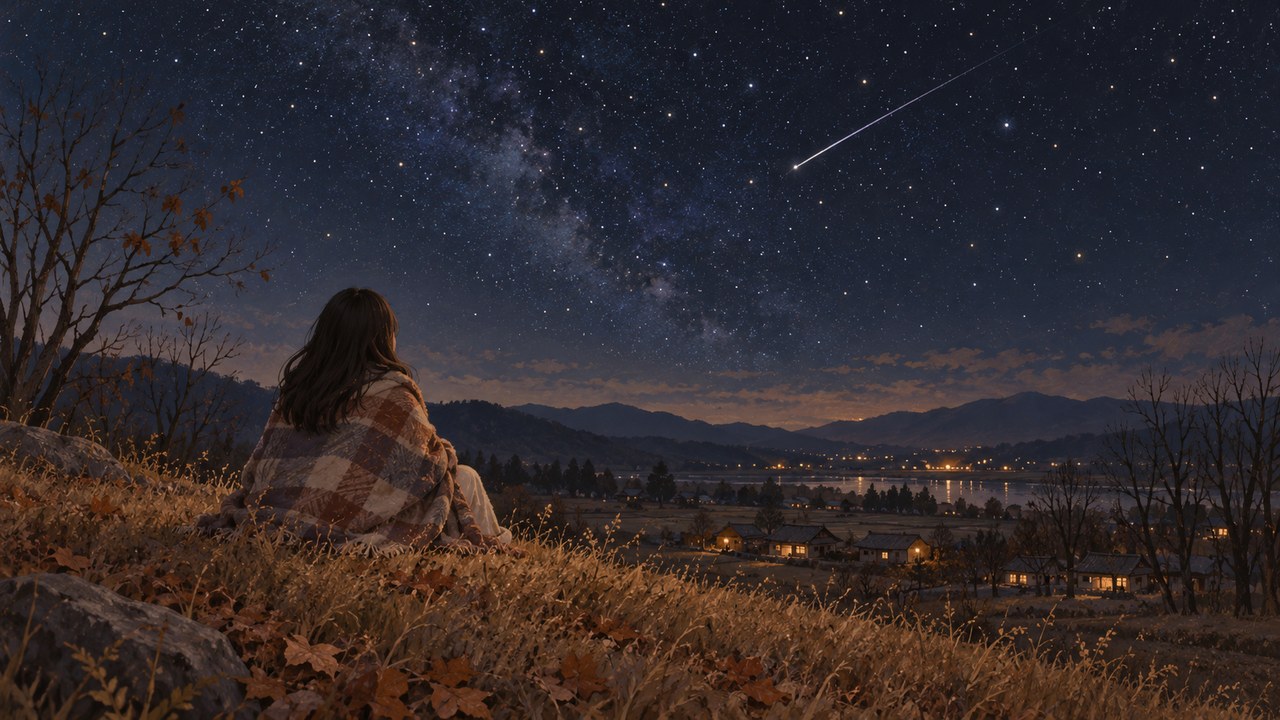
Despite the name, a shooting star is not a star falling. It is a speck of space dust about the size of a grain of sand that plunges into Earth's atmosphere and glows as it heats up high in the sky. Real stars are huge, like the Sun, and very far away, so they never fall to Earth.
Light from a grain of sand
Most of the particles that make shooting stars are the size of a grain of sand or smaller. When one of these tiny grains hits the atmosphere at tens of kilometers per second, sometimes more than 70 km per second, the air in front of it is squeezed and heated in an instant. The grain vaporizes and the surrounding air glows too, all at a height of about 80 to 120 km above the ground. That is roughly ten times higher than airliners fly.
A common misunderstanding is that shooting stars land somewhere on the ground. Most burn up completely in the sky in less than a second. On rare occasions a larger chunk survives all the way down, and the piece that reaches the ground is called a meteorite.
Autumn night meteor showers
When a comet passes close to the Sun, it leaves dust that has boiled off along its path. When Earth crosses this trail of dust around the same date every year, we see more shooting stars than usual, and this is called a meteor shower. The Orionid meteor shower seen in late October comes from dust left behind by Halley's Comet. Halley's Comet returns every 76 years and has not been visible since 1986, but you can still see its crumbs every year.
In Korean a meteor shower is called a "meteor rain," but it does not pour the way the name suggests. Even under very dark skies the Orionids usually show about twenty an hour, and in a brightly lit city it can be hard to see even a few.
How to see more shooting stars
Shooting stars are better seen with the naked eye than with a telescope. Since you cannot know where in the sky one will appear, watching a wide area matters more than magnifying one spot. Find a place with few streetlights, lie down or lean back in a chair to take in as much sky as you can, keep your phone screen off, and wait about twenty minutes. Your eyes adjust to the dark and you will start to see even faint shooting stars.
You tend to see more after midnight and toward dawn. Before dawn, the side of Earth where you stand faces forward in the direction Earth is moving in its orbit, so it meets dust head-on, just as more raindrops hit the windshield of a moving car.
A shooting star is light from sand-sized space dust burning up about 100 km high, and only the rare pieces that reach the ground become meteorites.
Notes and references · NASA and International Meteor Organization (IMO) meteor observation data. Speeds, glowing heights and hourly counts are approximate; how many you actually see depends greatly on sky brightness, moonlight and weather.
Editorial standardsReport an error
Quick quiz