No. 30Everyday life3 minviews 19
Published by GK Library Annex
My earphone cord is tangled again when I take it out of my pocket
You put it away neatly, yet every time it comes out of your pocket the cord is a mess.
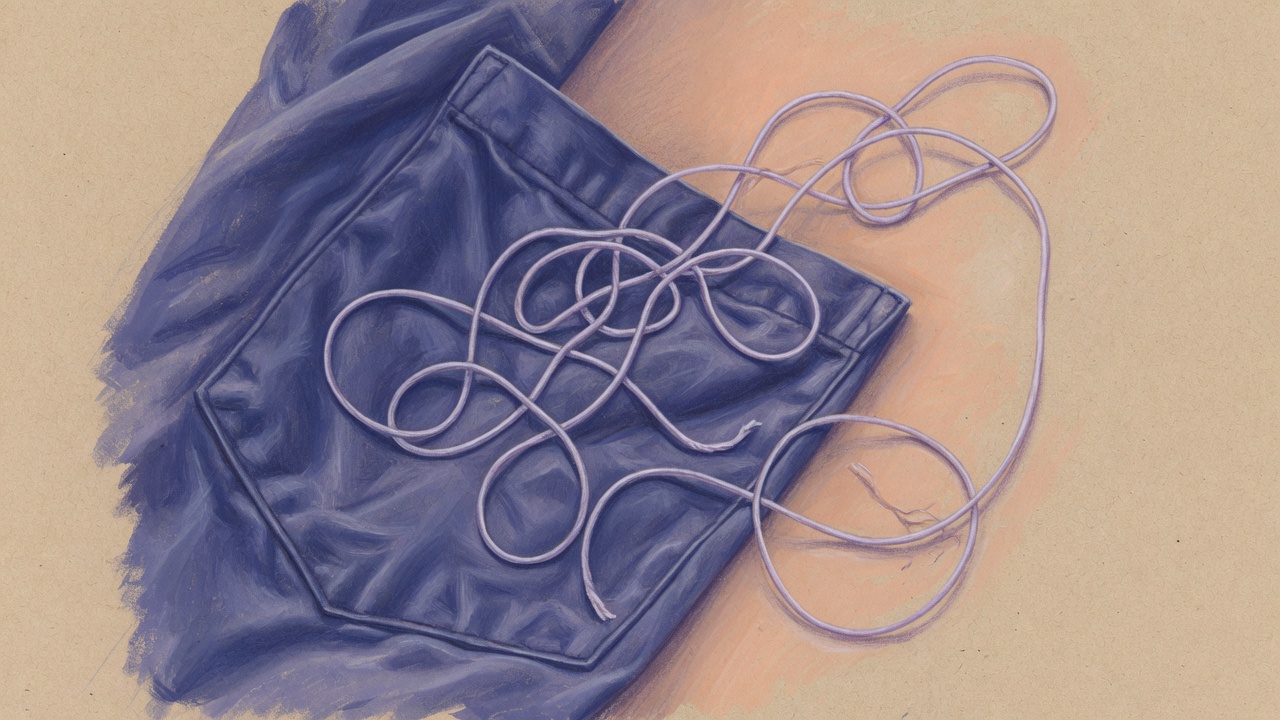
An earphone cord comes out of your pocket tangled not because anyone tied it. As you walk, the jostled cord folds over itself in layers, and the end slips in and out between them, forming knots. It can happen in less time than you'd think.
The string-in-a-box experiment
In 2007, researchers at the University of California, San Diego put string in a box and spun it, repeating the test more than 3,400 times. Even 10 seconds of spinning often produced fairly complex knots, and there were more than a hundred kinds of them. Some were so complicated they'd be hard to tie on purpose.
Here is the mechanism the researchers saw. Inside the box, the string curls up so that several strands lie side by side, and the end of the string randomly weaves over and under those strands. As those moves add up, you get knots that look tied by hand.
Do shorter cords tangle more?
It's a common misconception that shorter cords tangle more easily. In the experiment, strings shorter than 46 cm never formed a knot, and up to 1.5 m the chance of knotting rose steeply with length. Beyond that, it leveled off at around 50%.
Softer string tangled more, and stiffer string tangled less. An earphone cord of a meter or so is thin and soft, which fits the tangle-prone conditions exactly. It isn't that the cord likes to tangle; the longer and softer it is, the more strands its end has to weave through.
The pulling hand can tighten it
A tangle formed in your pocket often starts out as loose loops. But grab one end and yank, and the loops pull on each other and cinch into a tight knot.
To undo it, rather than pulling, rest the clump in your palm and widen the loops as you work the end out. Retracing the path the end took usually frees it. Pulling on a twisted cord again and again can also bend the thin wires inside at one spot until they break.
Putting it away so it tangles less
A knot forms only when the end of the cord weaves between strands. So clipping both ends together, or loosely winding the cord around your fingers a few times and tucking the end into the loops, leaves less room for tangles.
Keeping it in a small case helps too. In the experiment, when string wedged against the walls of a tight box and tumbled less, fewer knots formed. The key is to give the cord less space to roll around in your pocket.
Related reads
An earphone cord tangles as its end weaves between strands while it's jostled. It's not the short cords but soft ones about a meter long that tangle more easily.
Notes and references · Raymer and Smith 2007, PNAS. An experiment that spun string in a box and measured how often knots formed by length, stiffness, and time. A pocket differs from a box, so treat the numbers as a reference.
Editorial standardsReport an error
Quick quiz