No. 56Health3 minviews 32
Published by GK Library Annex
Why do we get goosebumps in the cold when our body hair is so short?
Your arm turns bumpy as soon as you roll up your sleeve. What is moving beneath the skin?
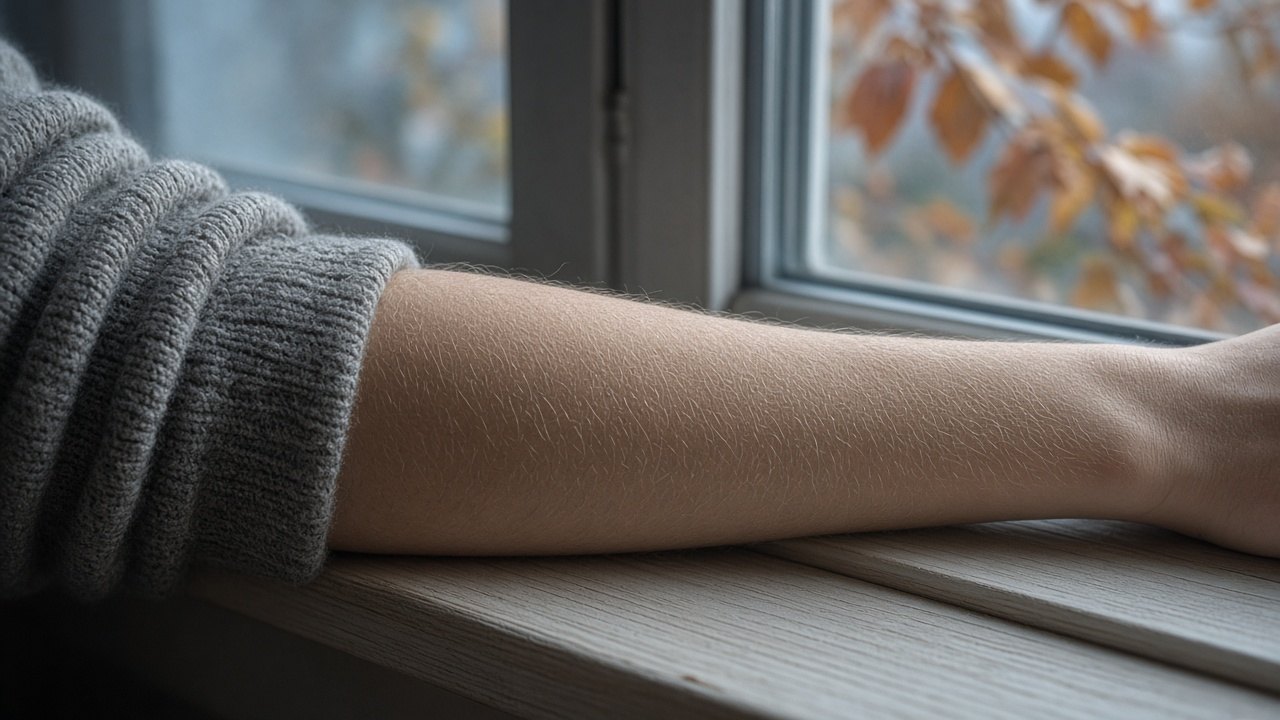
Goosebumps form when tiny muscles attached to each hair root contract. As the muscles pull the hairs upright, the skin around the follicles rises too, creating little grain-like bumps.
A tiny hair-raising muscle
This muscle is called the arrector pili. One end is attached to the hair root and the other sits at an angle just beneath the skin, so when it contracts, a flattened hair stands up and that spot bulges. It isn't a muscle you control at will, so it moves on its own when your body senses cold and relaxes within a few minutes once you get somewhere warm. Your palms and soles have no hair, so they don't get goosebumps.
A response left over in humans
Animals with thick fur raise it in the cold to build a deeper layer of air between the hairs. That air keeps body heat from escaping. Human body hair is short and sparse, so raising it does almost nothing to keep us warm.
So the idea that goosebumps warm you up doesn't hold for people. What actually makes heat in the cold is shivering. We have less hair, but the muscles and the signals remain, so the response still happens as it always did, even if it's of little use.
Fright brings them too
The nerves that signal this muscle are the same ones that speed up your heart when you're tense. That's why, even without any cold, you get goosebumps when you're on edge, like when listening to a scary story. Getting chills at the peak of a favorite song or during a moving scene comes from the same signal.
Most people can't produce goosebumps at will, but a 2018 study found and described 32 people who said they could raise them on their own. It's very rare.
They help hair grow, too
In 2020, a Harvard University team showed in mice that this muscle and its nerve sit right next to the stem cells that regrow hair. Mice that spent two weeks in the cold regrew their hair sooner. Since these were mouse experiments, it's too early to say the same holds for people.
If goosebumps bother you, the quickest fix is to roll down your sleeves and get somewhere warm. Bumps that stay itchy or red for a long time even somewhere warm may be a skin problem other than goosebumps.
Related reads
Goosebumps are a remnant of tiny hair-raising muscles that still respond to cold and tension.
Notes and references · Shwartz et al. 2020 (Cell) · Heathers et al. 2018 (PeerJ). The arrector pili contracts on its own in response to sympathetic nerve signals and does little to keep humans warm. The muscle-nerve link to hair stem cells is from a mouse study (Shwartz et al. 2020); voluntary goosebumps from Heathers et al. 2018.
Editorial standardsReport an error
Quick quiz