No. 276Everyday life4 minviews 80
Published by GK Library Annex
How Does a Zipper Close in One Smooth Pull?
A Y-shaped path that locks hundreds of tiny teeth together, and the story behind the name "zipper."
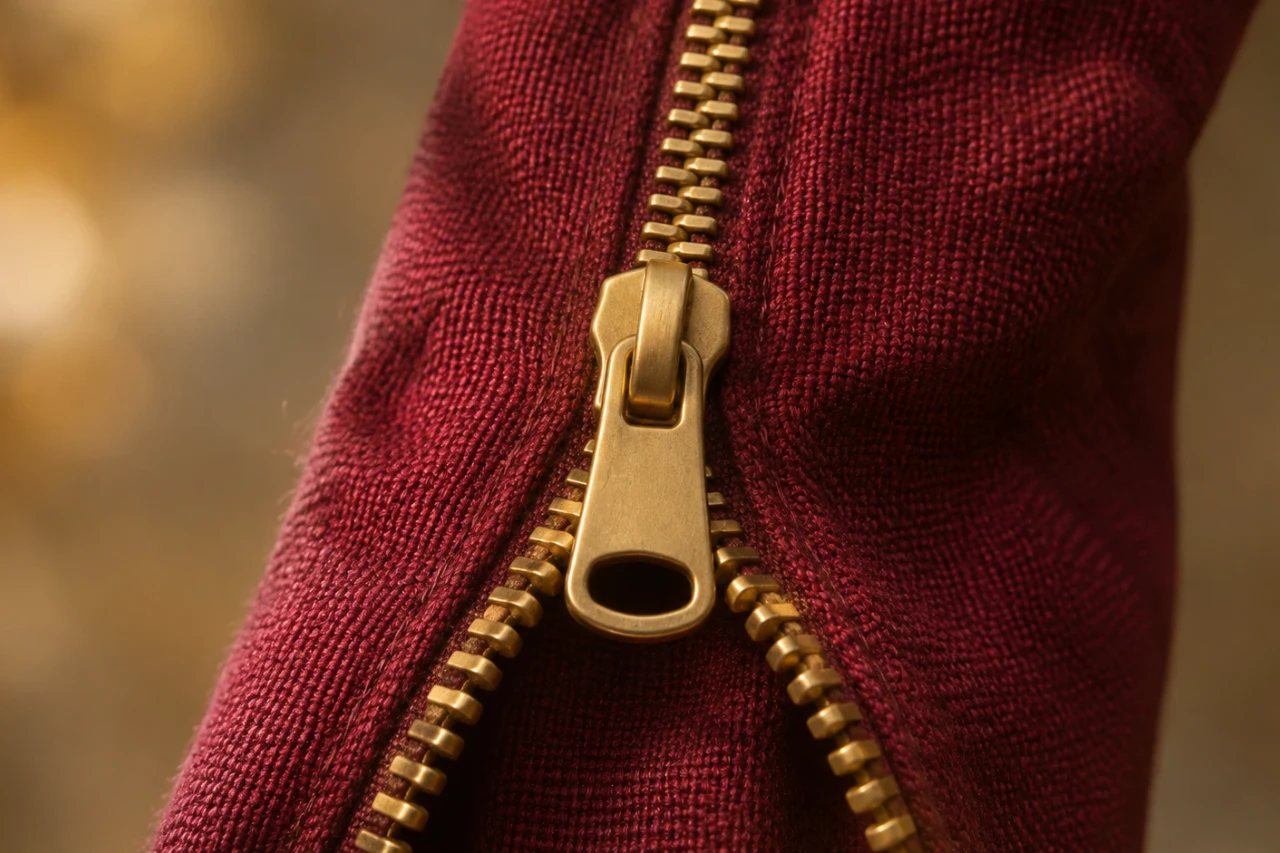
When you open or close a coat or bag, one quick pull of the zipper makes the teeth on both sides lock together instantly. A job that would take ages by hand, one small pull tab finishes in a few seconds. But how do these little metal teeth grip each other so tightly, and how do they come apart so easily when you pull the same tab the other way? It took more than 60 years of trial and error for today's design to settle in, and the name "zipper" itself started out as a trademark for rubber overshoes.
A bump and a hollow on every tooth
Look closely at a zipper and you'll see that all the teeth are exactly the same shape. According to Gideon Sundback's 1917 U.S. patent, each tooth has a raised projection on one side and a recess of the same shape on the other side.
When you close the zipper, the projection of one tooth settles neatly into the recess of the tooth next to it, and that tooth's projection in turn fits into the recess of the next one. The left and right teeth stack alternately in a zigzag, binding the two rows into one. Because each projection is caught inside a recess, the zipper doesn't come apart easily even when the fabric is pulled sideways.
Teeth passing through a Y-shaped path
The job of locking the teeth falls to the slider, the part with the pull tab. Inside the slider is a Y-shaped path, single on one end and split into two branches on the other, with a wedge-like tongue fixed in the middle.
When you pull the zipper up, the teeth that were spread apart enter the two branches of the Y and are pushed toward each other by the slanted inner walls. Because the two rows come in at a set angle and slightly offset, the recess of each tooth drops precisely onto the projection of the tooth opposite.
When you pull the zipper down, the wedge in the middle pushes in between the locked teeth and separates them one by one, much like a plow splitting soil to either side. So depending on which way you move the tab, the same device either locks or unlocks.
An invention that took over 60 years
The first person to patent a similar device was Elias Howe, famous for the sewing machine. He received a patent for a clothing fastener in 1851 but never seriously tried to sell it.
In 1893, Whitcomb Judson received a patent for a "clasp locker" for shoes and showed it at the World's Columbian Exposition in Chicago that same year. But because it linked hooks and eyes together, it would pop open under strain or jam often.
The modern zipper was perfected around 1913 by Swedish-born engineer Gideon Sundback. He replaced the hooks with rows of identical teeth, each with a projection and a recess, and increased the number of teeth from 4 to about 10 per inch (about 2.5 cm). The device was patented in 1917 under the name "Separable Fastener."
A name that came from rubber overshoes
The name came later. In 1923, the American B.F. Goodrich Company launched rubber overshoes fitted with this fastener, called them "Zipper," and registered the name as a trademark. It came from the "zip" sound the fastener makes when opened and closed. Merriam-Webster dates the first known use of the word "zipper" to 1924.
At first it was used mainly on boots and tobacco pouches, and around World War I it was also used on U.S. Navy flying suits. It spread widely in clothing from the late 1920s through the 1930s, and this was also when zippers began taking the place of buttons on the fly of trousers.
A zipper is a device in which a Y-shaped slider brings teeth with bumps and hollows together at an angle and stacks them one by one, and the name came from a 1923 trademark for rubber overshoes.
Notes and references · Sundback U.S. patent, Britannica, Merriam-Webster, National Inventors Hall of Fame. Based on U.S. Patent No. 1,219,881 (1917), Britannica "zipper," Merriam-Webster "zipper," National Inventors Hall of Fame "Gideon Sundback," and HowStuffWorks' explanation of how zippers work.
Editorial standardsReport an error
Quick quiz