No. 277Health4 minviews 65
Published by GK Library Annex
Why Is Everyone’s Fingerprint Different?
A pattern that spreads like waves in the womb, and why even identical twins have different fingerprints.
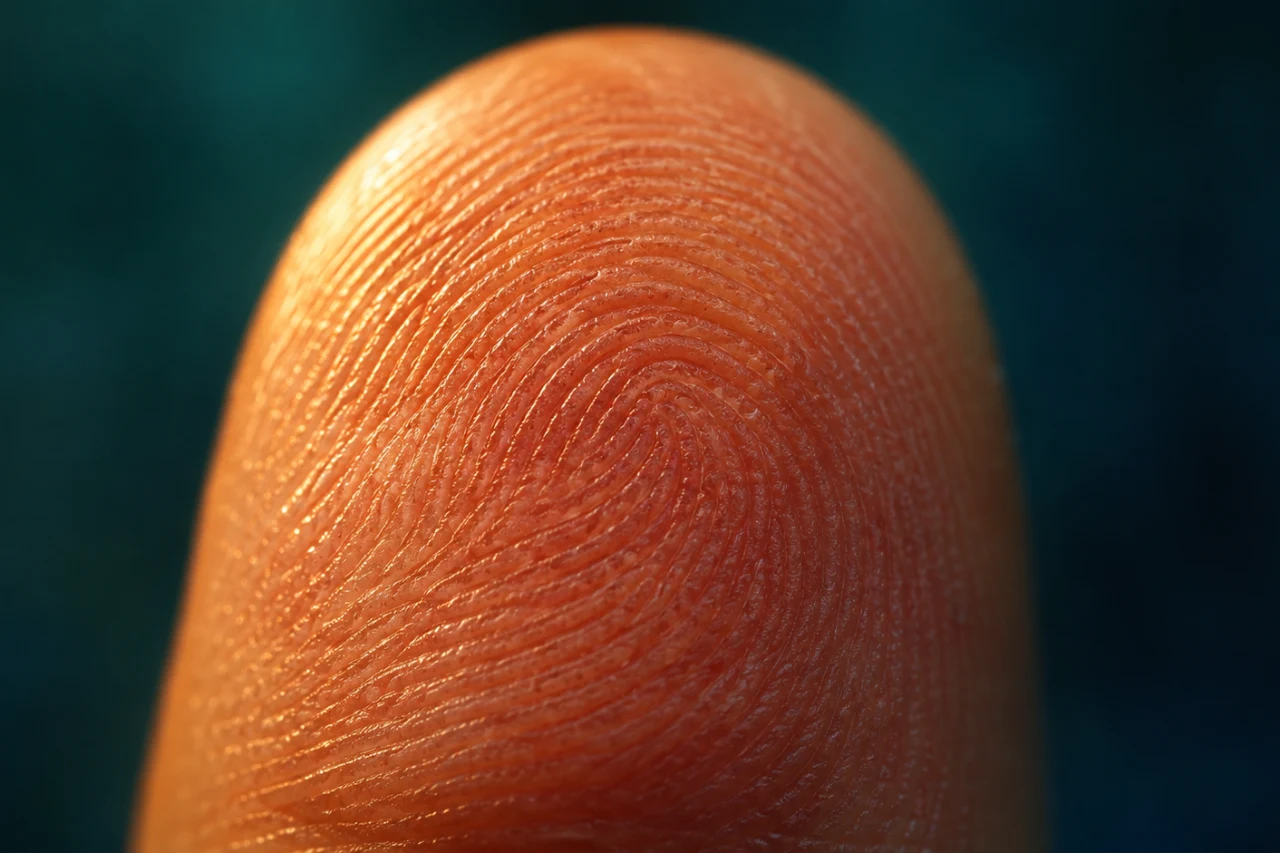
Whether you are unlocking your phone or standing at passport control, a machine can recognize you the moment you touch it with a fingertip. That is because the fine lines on your fingertips do not match anyone else’s. Even identical twins, who share the same genes, have different fingerprints. When and how does this pattern form, and why does it turn out differently for each person? Recent research is gradually revealing how fingerprints form, a process that long remained a mystery.
A Pattern Set in the Womb
Fingerprints form long before birth, in the womb. According to The Fingerprint Sourcebook published by the U.S. National Institute of Justice (NIJ), raised pads of tissue appear on the fingertips at around 7–8 weeks of pregnancy, and the first ridges (raised lines) appear in a deep layer of the skin from around week 10. The ridges keep deepening until around week 16, and by around weeks 15–17 even the fine details, such as where lines end or split, are in place. Sources differ by a few weeks, but roughly speaking, the pattern you will use for life is set at around four months of pregnancy.
Once set, the pattern only grows larger as the body grows; its shape does not change. Encyclopaedia Britannica explains that after a shallow cut or burn, the same pattern returns when the skin grows back, and the pattern is erased only by an injury deep enough to destroy the dermal papillae deep in the skin. With age, however, ridges become thinner and lower, so fingerprints can become harder to read.
Waves Spreading From Three Places
So how do shapes like whorls and loops form? In 2023, an international research team led by the Roslin Institute at the University of Edinburgh in the UK offered a clue in the journal Cell. Studying mouse toes and skin tissue grown in the lab, they found that ridges do not form across the whole fingertip at once. Instead, they start at three places, the center of the fingertip pad, under the tip of the nail, and near the crease of the fingertip joint, and spread outward like waves. Where and when these waves start, and how they meet, determines whether the pattern becomes a whorl, a loop, or an arch.
The waves are created by three signaling molecules called WNT, EDAR and BMP. WNT and EDAR boost each other to make ridges, while BMP suppresses them to form the valleys between ridges. The team also confirmed that more EDAR makes ridges thicker and more widely spaced, while less EDAR produces spots instead of lines. According to Britannica, about 65% of human fingerprints are loops, about 30% are whorls, and about 5% are arches.
Why Twins’ Fingerprints Differ
The broad type of pattern is influenced by genetics. Glenn Langenburg, an American fingerprint examiner, explained in Scientific American that the pattern type depends on when the fingertip pads shrink and when ridges begin to form, while the detailed arrangement of where ridges end and split is not inherited but is set at random. That is why identical twins often share the same pattern type but are not identical in the details.
MedlinePlus, the health information site of the U.S. National Institutes of Health (NIH), likewise explains that twins with the same DNA have different fingerprints and that the fine details are influenced by the environment in the womb. Even a slight difference in a finger’s position in the womb or in the shape of its pad changes where the waves start and meet, so it is hard to get identical fingerprints even with identical genes.
Not for Better Grip, It Seems
Many people think fingerprints help us grip things, but that is not necessarily true. In 2009, a research team at the University of Manchester in the UK dragged a smooth acrylic strip across a fingertip and found that the skin behaved like rubber, and the grooves of the fingerprint actually reduced the contact area with the strip by about one third, lowering friction. The experiment had the limitation of using a single person’s fingertip, and the team left open the possibility that fingerprints may help when gripping rough surfaces or draining away water.
That same year, a research team at the École Normale Supérieure in Paris, France, showed another use. When an artificial sensor with ridges like a fingerprint was swept across a surface, it produced vibrations up to 100 times stronger than a smooth sensor. The explanation is that fingerprints amplify the signals sent to the Pacinian corpuscles, which sense vibration deep in the fingertip, helping us detect even very fine textures. Sweat pores line up along the ridges, which is why touching an object can leave a fingerprint mark.
Fingerprints are set at around four months of pregnancy as ridge waves spreading from three places meet, and small chance events in that process make even twins’ fingerprints different.
Notes and references · NIJ Fingerprint Sourcebook, Cell (2023), Britannica, MedlinePlus. Based on NIJ’s The Fingerprint Sourcebook, chapter 3; Glover et al. 2023, Cell, and the University of Edinburgh press release; Britannica “fingerprint”; MedlinePlus; Warman & Ennos 2009; and Scheibert et al. 2009.
Editorial standardsReport an error
Quick quiz