No. 238Everyday life3 minviews 30
Published by GK Library Annex
Why soap bubbles shimmer with rainbow colors
It is not dye—colors come from light overlapping in a thin film
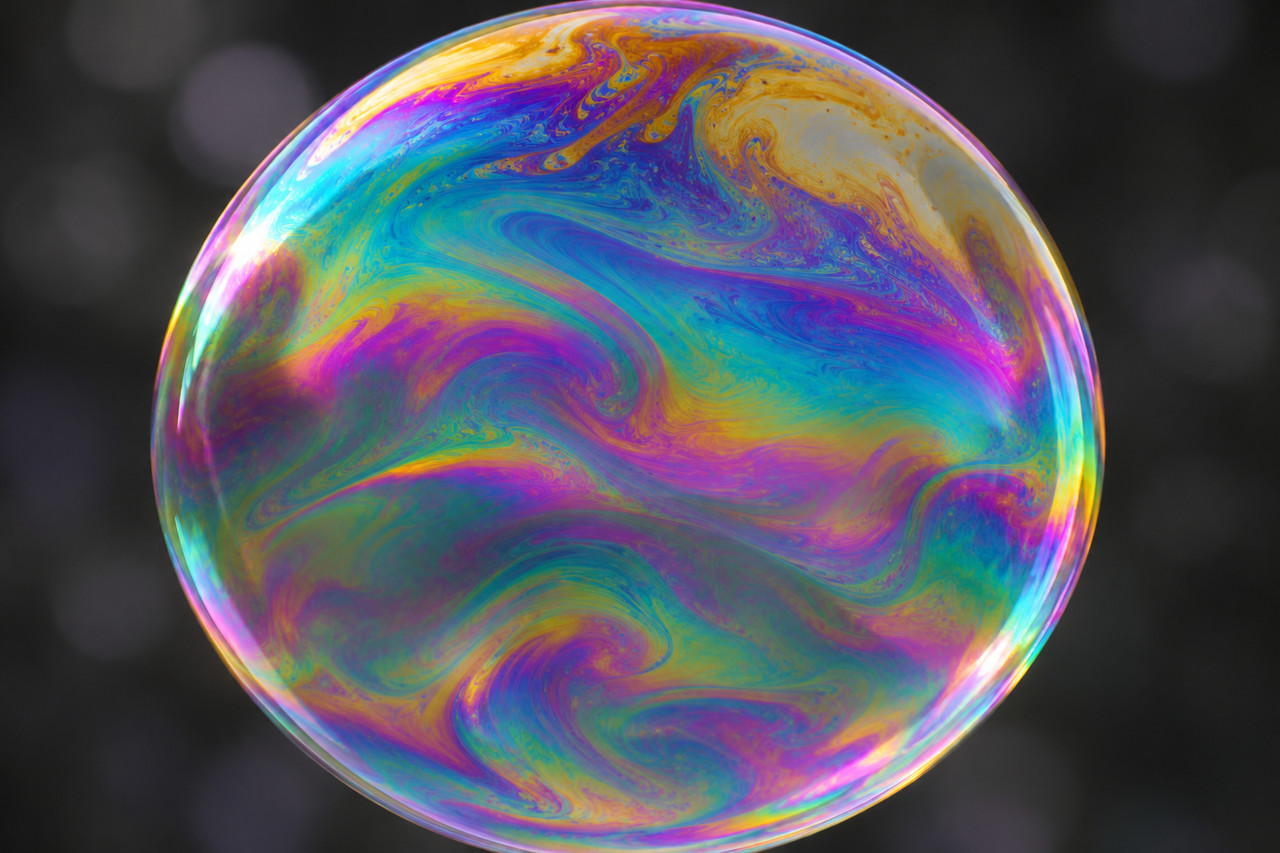
Soap bubbles look rainbow-colored not because the film holds dye. Light reflecting from the outer and inner surfaces of a very thin soapy-water film meets again, so some wavelengths add up and others cancel. Even a small change in film thickness shifts the colors you see, and the pattern drifts as the bubble moves.
Light bounces back from both surfaces
A soap-bubble wall is a thin soapy-water film sandwiched by air. When sunlight hits it, some light reflects at the outer surface, while some enters the film and reflects again at the inner surface. The inner reflection travels a slightly longer path than the outer one.
When the two reflections overlap at your eye, some colors (wavelengths) line up and brighten, while others fall out of step and fade. Physicists call this thin-film interference. The Physics Classroom and OpenStax explain soap-film and oil-film color bands with the same idea. Light can overlap like waves, not only act like particles.
When thickness changes, so do the colors
Even on one bubble, the top is often thinner and the bottom thicker. Water drains downward and slowly evaporates, so thickness varies from place to place. Different thicknesses reinforce different wavelengths, creating swirling pinks, greens, and purples.
If you tilt your head or the bubble wobbles, the viewing angle changes too, so the color at one spot can flip in an instant. RSC Education notes that colors shift as water drains downward. What you see is less a frozen rainbow than a moving color map.
The dark spot is where light cancels
As the bubble thins further, some patches look nearly black. When the film becomes much thinner than visible wavelengths, outer and inner reflections cancel across almost every color, leaving little reflected light. OpenStax also notes that a phase shift (a half-step change in the wave) at only one reflection helps explain why very thin soap films look dark.
So the rainbow is not a dyed sphere; it is light selected by thickness and angle. The colorful bands in a thin oil film on a wet road after rain belong to the same family of interference. Scientific American’s oil-slick explanation likewise points to overlapping light returned from two surfaces.
Soap-bubble rainbows come from interference—outer and inner reflections overlapping by wavelength—not from dye.
Notes and references · Physics Classroom · OpenStax · RSC · SciAm. Thin-film interference (constructive/destructive reflection from outer and inner surfaces), color shifts with thickness/angle, and dark regions in very thin films follow Physics…
Editorial standardsReport an error
Quick quiz