No. 275Language4 minviews 81
Published by GK Library Annex
Why Is Braille Written with Six Dots?
A size that fits neatly under one fingertip—the answer a fifteen-year-old boy found.
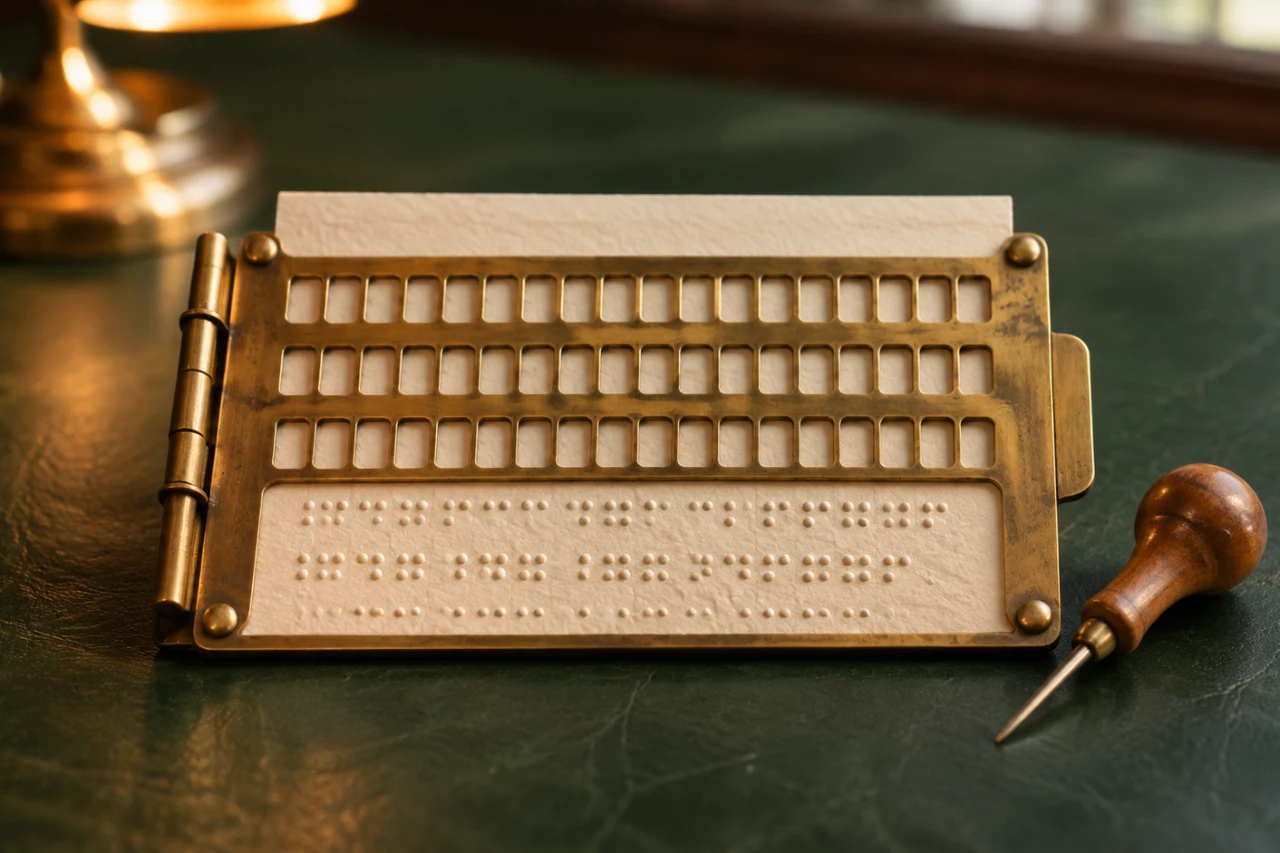
You have probably noticed tiny raised dots on elevator buttons or on some food packaging. Braille uses six dots as a single cell, arranged in two columns of three. Letters are formed by combinations in which some dots are raised and others are left blank. But why six? With more dots, you could fit more letters. The answer came about 200 years ago from a boy at a school in Paris who thought hard about the size of a fingertip.
A story that began with twelve dots
Louis Braille was born in 1809 in the village of Coupvray, near Paris. At the age of three, he injured one eye with a sharp tool belonging to his father, a harness maker, and the infection that followed eventually left him completely blind. He later received a scholarship to the Royal Institute for Blind Youth in Paris.
In 1821, Charles Barbier, a former French army officer, presented his own method at the school. It involved embossing dots on paper so they could be read by touch. Each cell was 2 dots wide and 6 dots high, twelve dots in all, and each combination of dots stood for a sound. The problem was size. A twelve-dot cell did not fit under a single fingertip, so a reader could not feel all the dots in one touch, and the layout was easy to confuse.
The method is often said to have come from a military code for night use, but the Perkins School for the Blind in the United States explains that this is a misconception that spread in the 1950s. Barbier had already presented it as a method for blind people in a book he published in 1815.
One cell, one touch
Starting in 1824, Braille began adapting Barbier's method to create a dot code of his own. He was fifteen years old at the time. The key was cutting the cell in half: a six-dot cell with dots 1, 2, and 3 in the left column and dots 4, 5, and 6 in the right column.
With six dots, a single touch of the fingertip is enough to feel the whole cell and move quickly to the next one. Even so, there are plenty of possible patterns. Each dot can be either raised or blank, so multiplying 2 by itself six times gives 64 combinations; leaving out the one with no dots at all gives 63 patterns. That is enough to represent the alphabet, numbers, and punctuation marks.
Braille published his method as a book in 1829. It did not spread overnight, though. In the English-speaking world, several dot systems competed until the United Kingdom adopted English Braille as its standard in 1916 and the United States did so in 1919. Braille died in 1852 at the age of forty-three, and 100 years later, in 1952, he was laid to rest in the Panthéon in France.
Korean written in six dots
Korean braille uses the same six-dot cell. Song-am Park Du-seong, who had worked as a teacher from 1913 at the school for the blind of Jesaengwon (the predecessor of today's Seoul National School for the Blind), created the Korean braille system "Hunmaengjeongeum" and promulgated it on November 4, 1926. Even before that, there was a Korean braille devised by Rosetta Hall.
Hunmaengjeongeum was built on the principles of being easy to learn, using few dots, and avoiding confusion between characters, and it distinguishes initial consonants from final consonants. Thanks to this achievement, Park Du-seong is called "the King Sejong of blind people." Every November 4 is Korean Braille Day in Korea, and this year, 2026, marks the 100th anniversary of the promulgation of Hunmaengjeongeum.
Braille uses six dots because that size lets one fingertip read a whole cell in a single touch while still offering 63 different patterns.
Notes and references · Perkins School for the Blind, U.S. Library of Congress, Korea Policy Briefing. Based on Perkins, "The history of braille" and "Louis Braille, Charles Barbier, and the making of a myth"; the U.S. Library of Congress NLS, "About Braille"; and Korea Policy Briefing articles on the 100th anniversary of Hunmaengjeongeum.
Editorial standardsReport an error
Quick quiz