No. 255Nature4 minviews 157
Published by GK Library Annex
Why Do Zebras Have Stripes?
Contrary to the guess that the pattern is for hiding, recent research leans toward shaking off blood-sucking flies.
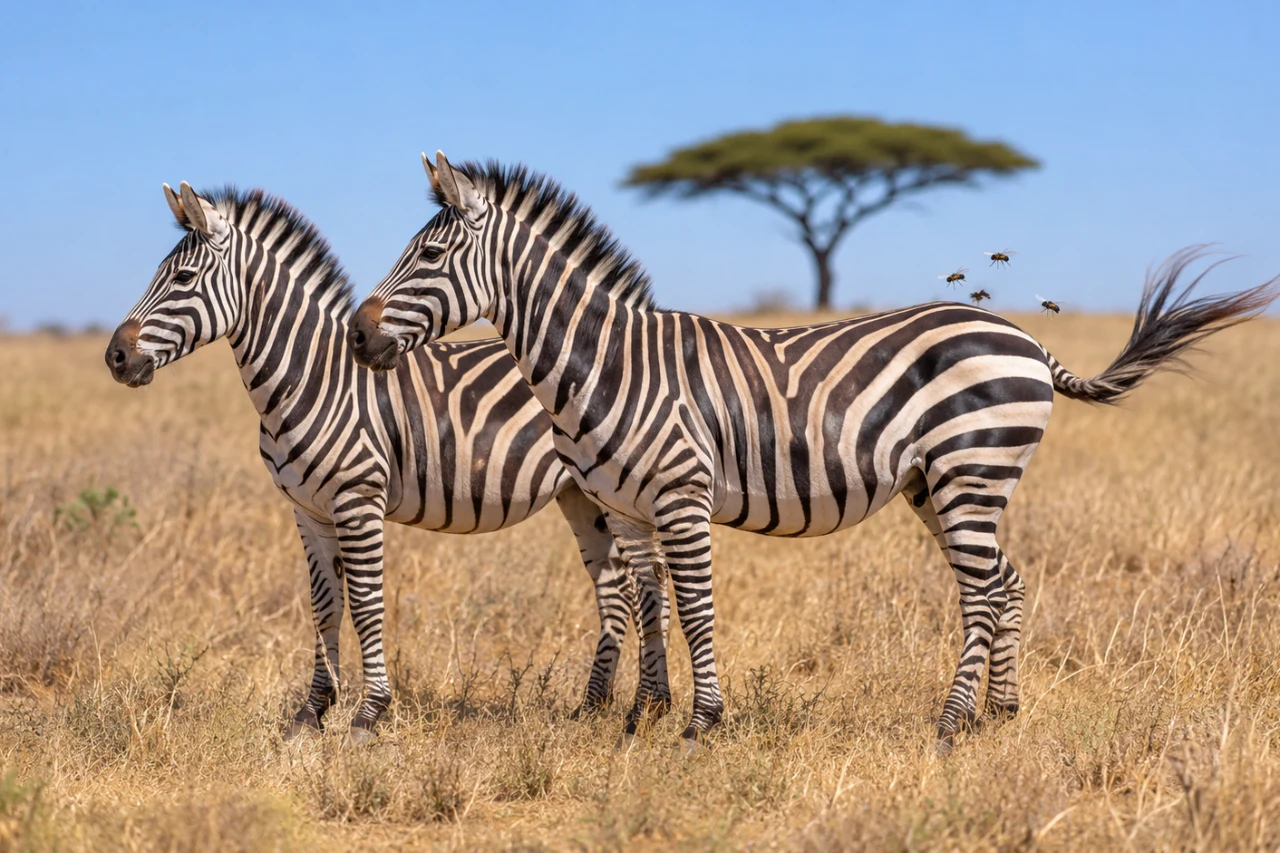
A zebra's black-and-white stripes actually stand out on the open grassland. That is why, since the days of Darwin and Wallace, scientists have argued for well over 100 years about "why stripes, of all things." Among the answers proposed so far, the one with the most evidence involves, surprisingly, a small insect: the blood-sucking horse fly.
Are the stripes for hiding?
There are five main guesses about the stripes: camouflage that hides the body in the grass, an effect that confuses the eyes of predators such as lions when the herd runs together, body temperature control, a social signal for recognizing one another, and an effect that helps avoid blood-sucking flies.
In 2014, a team led by Professor Tim Caro at UC Davis in the United States mapped where seven species of zebras, horses and asses and their subspecies live, and compared the thickness and intensity of stripes on different body parts with woodland, large predators, temperature, and where tsetse flies and horse flies live. The other explanations did not fit well, and the stripes were more distinct in regions where conditions good for horse fly breeding lasted for several months. The results were published in the journal Nature Communications.
Side by side with horses
In 2019, Professor Caro and researchers at the University of Bristol in the UK set out to check this directly. At a horse farm in Somerset, England, they watched and filmed horse flies flying around 3 zebras and 9 solid-colored horses.
The number of times horse flies approached and circled was similar for zebras and horses. This means the stripes do not drive flies away from a distance. The difference came at the last moment. The horse flies failed to slow down as they do when landing on a horse, and either bumped into the zebras' bodies or flew right past, and far fewer landed properly on the zebras. On the horses, flies were seen probing the skin with their mouthparts 239 times during 11 hours of observation, but on the zebras not once in 5.3 hours.
Horses in striped coats
The researchers also had the same horses take turns wearing black, white and zebra-striped cloth coats. When the horses wore striped coats, noticeably fewer horse flies landed on their bodies, but the number landing on their uncovered heads was similar regardless of coat color. This is evidence that the pattern, not the horse's body itself, produces the effect.
The researchers think that when horse flies, whose eyes have low resolution, come close, the stripes disrupt their vision and interfere with landing. Zebras have hair shorter than the flies' mouthparts, so they are easy to bite, and horse flies and tsetse flies can transmit disease, which makes avoiding bites important. However, the claim that stripes also help shed heat remains, so the debate is not completely over.
Most of the evidence suggests zebra stripes work less for hiding and more for stopping blood-sucking horse flies from landing properly.
Notes and references · Caro et al., PLOS ONE (2019) · Nature Communications (2014). Observation of horse fly behavior around zebras and horses, striped coat experiment, and comparison of the ranges of seven equid species. Based on University of Bristol and UC Davis press releases
Editorial standardsReport an error
Quick quiz