No. 278Nature4 minviews 65
Published by GK Library Annex
Why Do Penguins Waddle?
The side-to-side sway of a walking penguin hides a pendulum trick that helps short legs save energy.
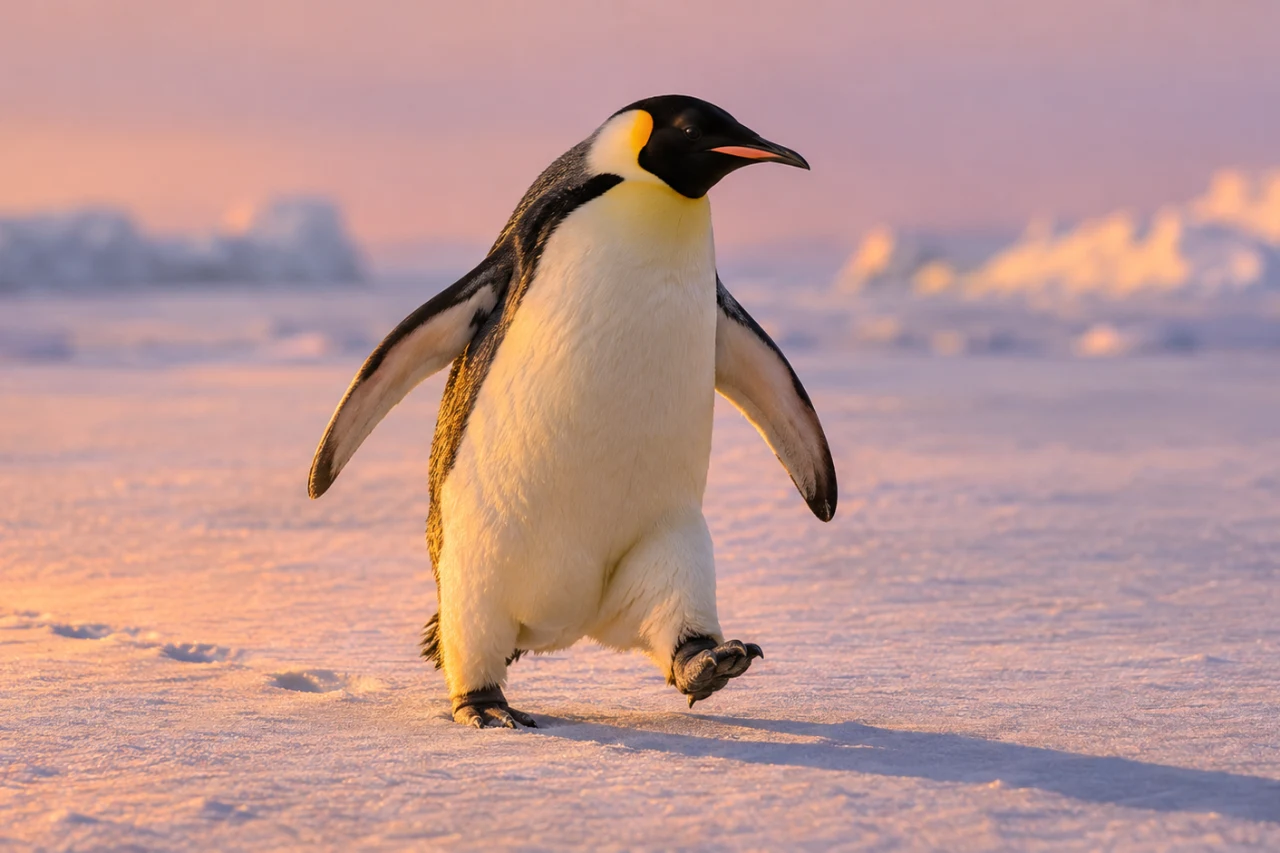
Watching a penguin rock from side to side as it walks across the ice, it can look a little clumsy. In fact, penguins do spend far more energy walking than other animals of a similar weight. But when scientists measured their steps closely, they found that the waddle is not wasteful at all. It is a trick that makes up for short legs.
A bird for whom walking is hard work
In the 1970s, a study in Antarctica put penguins on a treadmill and measured their breathing through a mask. It found that penguins use about twice as much energy to walk a given distance as other animals of a similar weight. Compared with a dog of similar weight, they also burned about twice as many calories.
For a long time, scientists therefore guessed that the waddling gait was what made penguins waste energy. They assumed that swaying from side to side cost needless effort.
Regaining energy by swaying
In 2000, Griffin and Kram of UC Berkeley in the United States had five emperor penguins walk across a force platform at SeaWorld San Diego and measured their body movement with every step. The result was the opposite of what was expected.
As a penguin tilted its body from side to side, the energy stored in the height of its body and the energy of its forward motion were traded back and forth like a pendulum. In this way, the penguins recovered up to 80% of their mechanical energy with each stride. The team explained that this is higher than the roughly 65% for humans and among the highest of any land animal. Their calculations showed that without the waddle, less energy would be recovered and the muscles would have to do more work.
Walking is still costly for penguins because of their short legs. Emperor penguins and rheas (South American birds that resemble ostriches) produce a similar average force when walking, but penguins have to produce that force twice as fast. The faster muscles must generate force, the more energy they use.
Short legs and a gait that does not topple
Penguins have short legs because of their life in the water. The researchers explained that short legs make the body streamlined, which is good for swimming and diving, and may also help reduce heat loss while incubating eggs in winter. Kram said that long legs would be good for walking but bad for swimming and for standing in the cold.
The waddle also appears to help with balance. In 2016, a team from the University of Roehampton in the United Kingdom had 10 king penguins walk on a small treadmill and measured their gait with accelerometers. The heavier the penguin, the more it swayed from side to side. The researcher explained that waddling makes the gait more stable, keeps the birds from falling over, and also keeps walking from becoming more costly.
A penguin’s waddle is a trick for recovering energy and keeping its balance while walking on short legs.
Notes and references · Griffin & Kram 2000, Nature. Gait analysis of 5 emperor penguins (up to 80% of mechanical energy recovered per stride). Also consulted: UC Berkeley press release and Willener et al. 2016, PLOS ONE (king penguins)
Editorial standardsReport an error
Quick quiz