No. 282Nature4 minviews 37
Published by GK Library Annex
Is there really water in a camel’s hump?
The hump holds fat, not water, and the camel’s water-saving secrets are hidden all over its body.
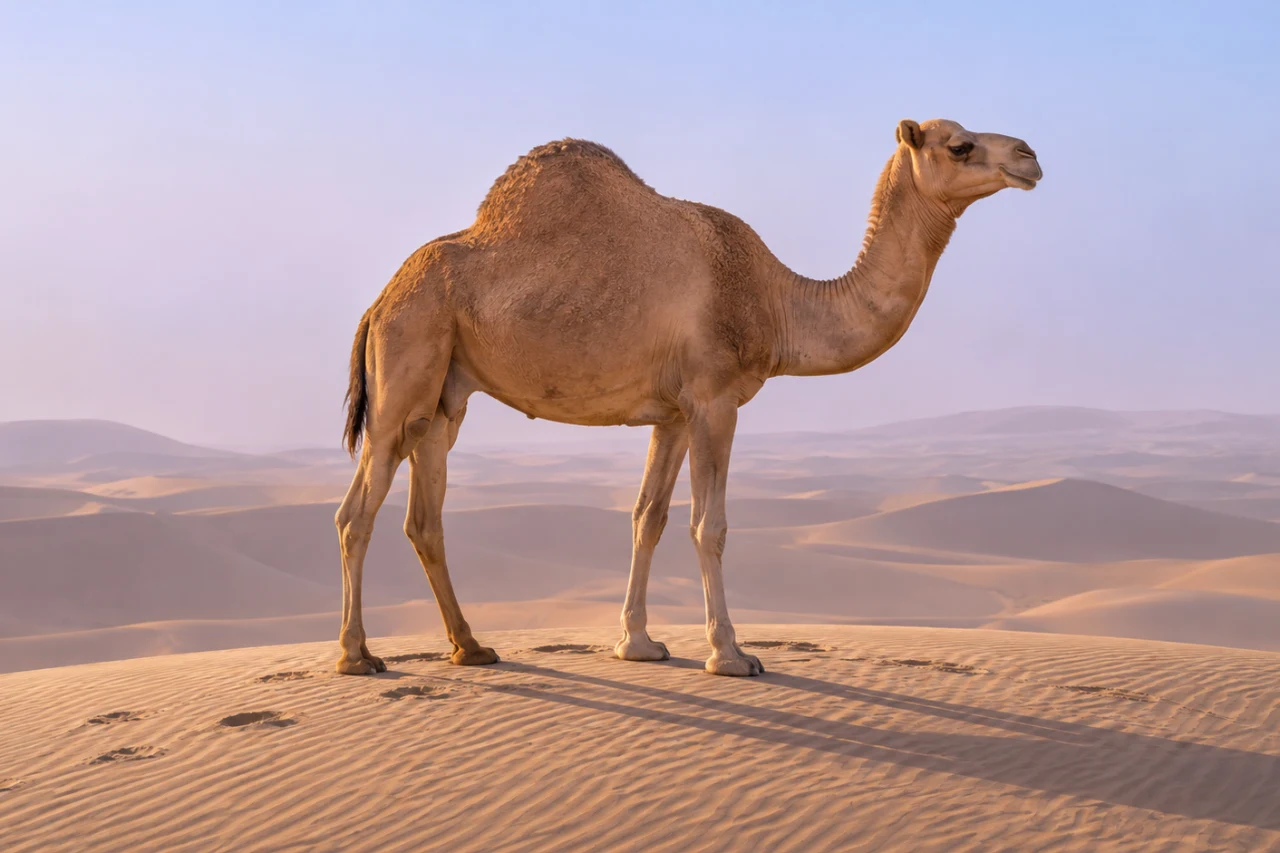
When you picture a camel crossing the desert, the hump on its back is the first thing you notice. Since camels can go a long time without drinking, it’s easy to assume the hump is a water bag. But what fills the hump isn’t water. It’s fat. So how do camels last so long without water?
The hump is filled with fat
Sources such as Britannica, the San Diego Zoo and SeaWorld all explain that a camel’s hump stores fatty tissue, not water. This fat is an energy store the camel draws on when food is scarce. National Geographic notes that the fat in the hump lets camels go several months without eating.
That’s why the shape of the hump depends on how well the camel has eaten. If it goes a long time without food, its body draws on the fat in the hump, and the hump shrinks and droops to one side. Once the camel eats well again, the hump stands upright as before. According to SeaWorld, newborn calves have no hump, and the fat layer develops only after they start eating solid food. The dromedary camel has one hump, and the Bactrian camel has two.
Why keep it on the back?
There seems to be a reason for gathering the fat into a hump on the back. Britannica explains that concentrating fat in the hump keeps the rest of the body from being covered by a fat layer, which reduces how much heat gets trapped inside the body during the day. At night, the stored heat escapes through the rest of the body.
If the fat were spread evenly under the skin all over the body, heat would have had a hard time escaping, as if the camel were wrapped in a thick blanket. In a hot desert, getting rid of heat matters as much as storing energy, so the hump handles both jobs at once.
The real secrets of saving water
The ability to go without water comes not from the hump but from small adaptations all over the body. The San Diego Zoo says a camel can go a week or more without drinking water. According to SeaWorld, a dromedary camel can tolerate losing water equal to more than 30% of its body weight, and when it finds water, it can drink about 100 L in just 10 minutes.
The shape of its red blood cells helps it gulp down so much water at once. According to Britannica, a camel’s red blood cells are oval, so they are more elastic and change shape more easily. This lets the camel handle drinking large amounts of water, and lets its blood flow relatively easily even when the body is short of water.
Body temperature is also used to save water. SeaWorld explains that a healthy camel’s body temperature rises and falls between 34 and 41.7°C over the course of a day. By letting its body temperature climb along with the air temperature, the camel has less need to sweat to cool down. National Geographic notes that the complex folds inside a camel’s nose create a large surface area, so that on chilly desert nights moisture condenses inside the nose as it breathes, reducing the water it loses.
A camel’s hump is a fat store, not a water bag, and its water-saving power comes from oval red blood cells, a body temperature that rises and falls, and the folds inside its nose.
Notes and references · Britannica · San Diego Zoo · SeaWorld · NatGeo. Hump stores fat (Britannica, San Diego Zoo); about 100 L in 10 minutes, body temperature 34–41.7°C, water loss of over 30% (SeaWorld); oval red blood cells (Britannica); nasal folds (National Geographic)
Editorial standardsReport an error
Quick quiz