No. 254Science4 minviews 174
Published by GK Library Annex
Why won't magnets stick to stainless steel?
Both are mostly iron, yet a magnet clings to the fridge door and slides off the pot
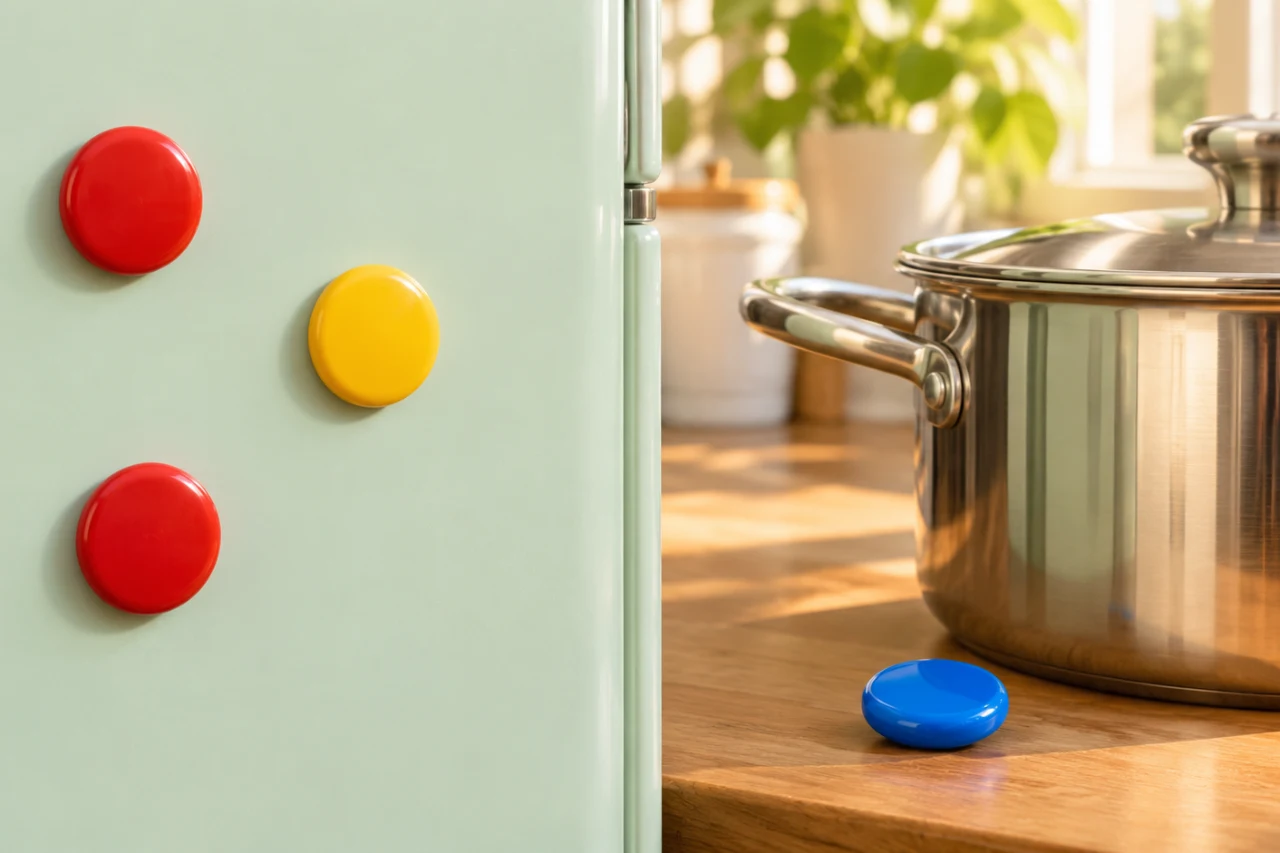
A magnet that holds fast to the fridge door sometimes slides limply off a stainless steel pot or sink. Stainless steel is also a metal made mostly of iron, so why does this happen? The answer lies less in the added ingredients themselves than in how those ingredients change the arrangement of the atoms.
How iron sticks to a magnet
Iron is naturally a metal that magnets attract strongly. Each iron atom behaves like a tiny magnet, and ordinary iron contains many regions where these tiny magnets line up in the same direction. When you bring a magnet close from outside, these regions turn to face it, and the two pull on each other.
That is also why magnets stick so well to fridge doors made of painted steel sheet. Even with paint on the surface, the steel underneath still pulls on the magnet, so it can easily hold a sheet of notepaper in place.
An atomic arrangement changed by nickel
Stainless steel is steel made by adding more than 10% chromium to iron so that it does not rust easily. Among its grades, ones common in kitchens, such as 304, contain about 18% chromium plus roughly 8% nickel. Nickel helps an atomic arrangement called austenite stay in place even at room temperature.
In austenite, iron atoms stack so that they sit at the corners of a cube and at the center of each face. With the arrangement changed this way, the tiny magnets of the iron atoms cannot line up in one direction, so a magnet held against it produces almost no pull. The British Stainless Steel Association (BSSA) explains that the response of austenitic stainless steel to a hand-held magnet is negligible.
Some stainless steel does stick
Not every stainless steel ignores magnets. Ferritic stainless steels such as 430, which contain chromium but no nickel, have an atomic arrangement similar to ordinary iron, so magnets stick to them well. If a pot or a set of cutlery is marked with numbers like 18-10 or 18-0, they often refer to the proportions of chromium and nickel.
Even austenitic grades are not always completely unmoved. In parts that have been bent or pressed into shape, some of the atomic arrangement turns into martensite, which magnets attract. Using a sink as an example, the BSSA notes that the flat drainer shows a weak response to a magnet, while the pressed bowl, especially its corners, pulls more strongly. So even on the same sink, how well a magnet sticks can vary from spot to spot.
Magnets barely stick to stainless steel because nickel changes the arrangement of the iron atoms, but they can stick to nickel-free types or to bent parts.
Notes and references · British Stainless Steel Association (BSSA). Based on the BSSA technical articles "Magnetic Properties" and "Is stainless steel non-magnetic?": the magnetic response of austenitic grades, cold working and martensite, and the sink example.
Editorial standardsReport an error
Quick quiz