No. 273Health4 minviews 97
Published by GK Library Annex
Why does hair turn gray?
When the cells that make color dwindle or get stuck, hair grows in without any color.
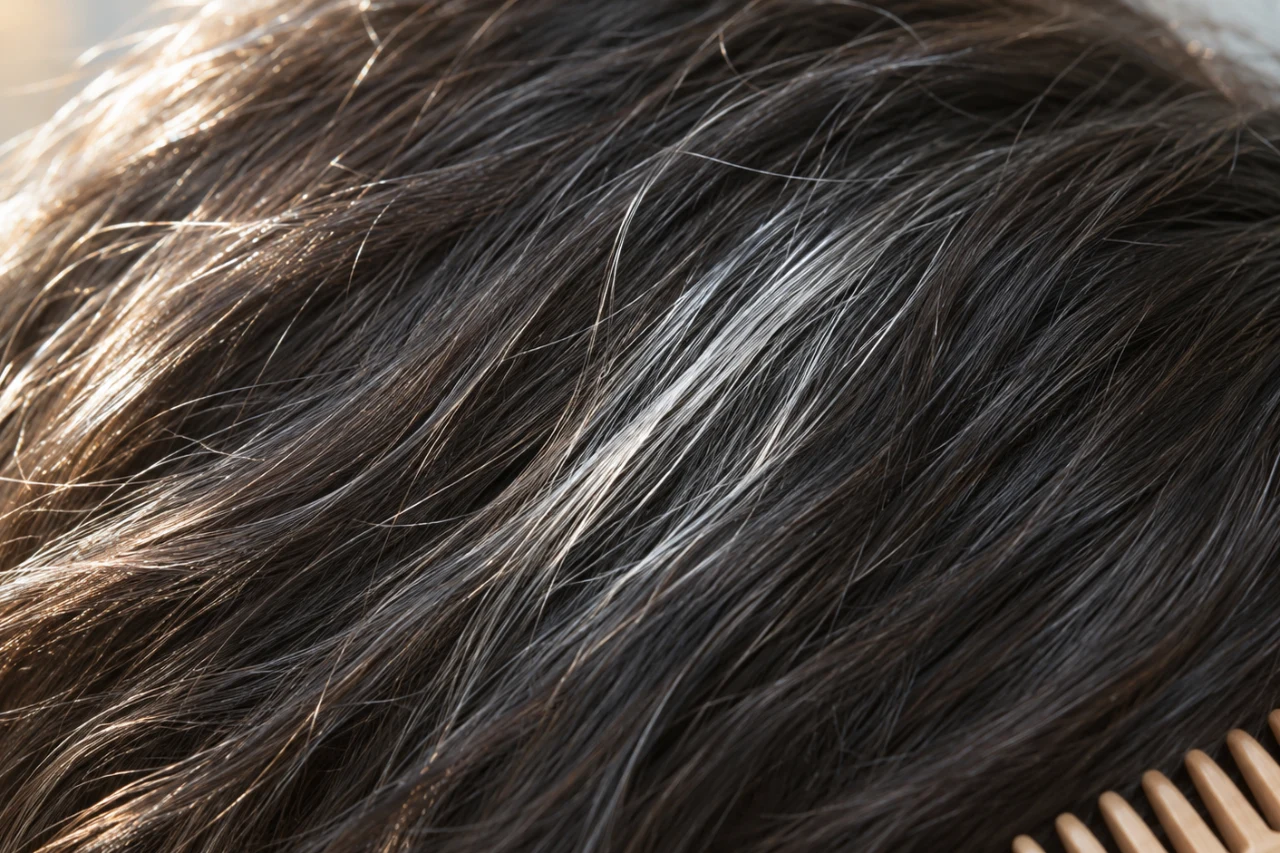
Spotting a single white strand glinting among your dark hair in the mirror can be a little unsettling. Is hair white to begin with, or does the color it had drain away? The answer lies deep at the root of each hair, in tiny cells that make color.
Color is set at the root
Hair color comes from a pigment called melanin. The more melanin, the darker the hair; the less, the lighter. The cells that make this pigment are melanocytes, which sit inside the hair follicle (the small pocket a hair grows from). As a hair grows, these cells pass pigment into it, so its color is already decided before it emerges from the scalp.
Cleveland Clinic in the US describes gray hair as hair with little to no melanin. A dark hair that has already grown out does not suddenly fade to white one day; instead, a new hair that grew without receiving pigment shows up as a gray hair. When colorless strands mix with dark ones, they can look gray or silver from a distance.
Color-making stem cells dwindle
Melanocytes are newly produced from melanocyte stem cells in the follicle. The American Academy of Dermatology (AAD) explains that melanin stops being regenerated after roughly 7 to 15 hair growth cycles. Since each growth cycle lasts several years, many people begin to see gray hairs around their 30s or 40s.
In 2023, a team led by Mayumi Ito at New York University in the US published a mouse study in the journal Nature. Melanocyte stem cells shuttle between two compartments in the follicle: in one they mature into pigment cells, and in the other they revert to a stem-cell state. In older mice, however, more and more stem cells got stuck between the two compartments and could not move. These trapped cells could neither make pigment cells nor prepare for the next cycle. The team suggested this may explain how hair grays with age, but whether the same happens in people still needs confirmation.
Stress and genes also play a part
In 2020, a team led by Ya-Chieh Hsu at Harvard University in the US revealed a link between stress and gray hair in Nature. When mice were stressed, sympathetic nerves reaching into the hair follicles released norepinephrine, and in response the melanocyte stem cells all turned into pigment cells at once and left the follicle. Within a few days the stem cells were all gone, and the hair that grew afterward was white. The US National Institutes of Health, quoting the researcher, reported that this damage was permanent in mice. However, some research suggests that in people some gray hairs may grow back in their original color when stress eases, so more research is needed.
When you go gray depends largely on genetics. If your parents grayed early, you may too. Cleveland Clinic considers graying premature if it begins before age 20 in people with light skin or before age 30 in people with dark skin. Smoking and vitamin deficiencies can also contribute, and treating a deficiency may slow the process. If you pluck a gray hair, a gray hair grows back in its place, and plucking repeatedly may just thin your hair.
A gray hair is a hair that grew without receiving pigment. Age and genetics matter most, and stress and nutritional deficiencies can also play a role.
Notes and references · NIH, Nature (2023, 2020), AAD, Cleveland Clinic. Ito team (Nature 2023) on melanocyte stem cell movement, Hsu team (Nature 2020) on stress and sympathetic nerves, American Academy of Dermatology and Cleveland Clinic guides on gray hair
Editorial standardsReport an error
Quick quiz