No. 272Nature4 minviews 83
Published by GK Library Annex
How do owls turn their heads all the way around?
What the neck does for eyes that cannot roll, and the secret that protects the blood vessels
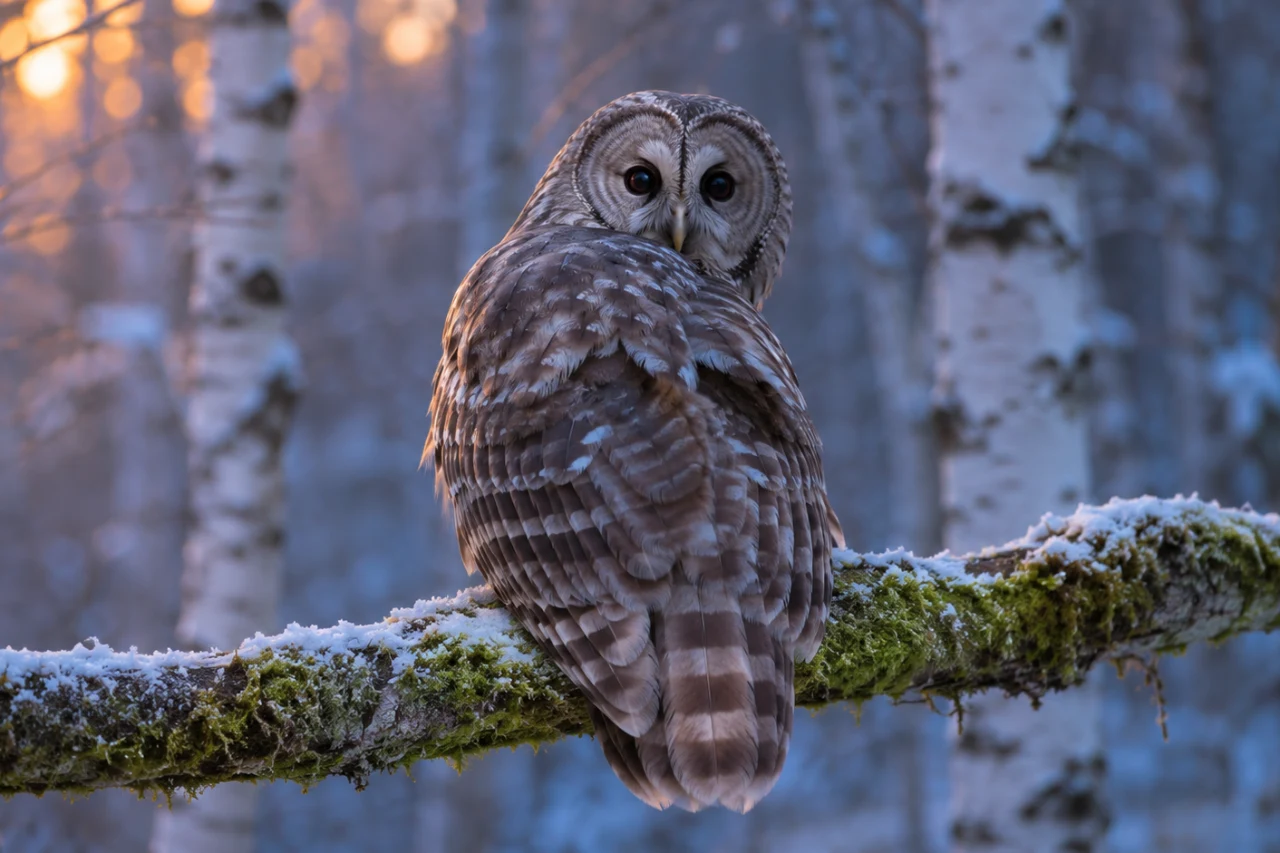
In photos of owls, you often see the body facing away while the face looks straight back at you. If a person turned their head like that, their neck would not survive, yet owls swivel their heads around as if it were nothing. What secret is hidden in an owl's neck?
Turning the head instead of the eyes
Owls are famous for their huge eyes, but those eyes are not round balls like ours; they are closer to elongated tubes. The National Audubon Society explains that an owl's tube-shaped eyes do not move at all within their sockets. A person can keep the head still and simply roll the eyes to look sideways, but an owl has to turn its whole head to look at something.
That is why an owl's neck is so flexible. According to several studies, owls can turn their heads up to 270 degrees in one direction. That is not a full circle (360 degrees), but it means an owl can start turning to the left, pass behind its back, and end up looking out to its right side. And while humans have 7 neck vertebrae, owls have 14, so they can spread the twist across many more joints.
Why the blood vessels don't kink
The real challenge is not the neck bones but the blood vessels. Arteries that carry blood to the brain run through the neck, so twisting the neck sharply can easily stretch or compress them. To solve this puzzle, a team at the Johns Hopkins University School of Medicine in the United States examined 12 owls that had died of natural causes (three species: snowy owls, barred owls and great horned owls). They injected contrast dye into the blood vessels, studied them with CT scans and angiography, and turned the heads by hand to see how the blood flowed. They found four major adaptations that keep owls from being injured when they turn their necks.
The first is the bony channel inside the neck vertebrae. The holes in the bone through which the vertebral artery passes are about 10 times wider than the artery itself, and that extra space acts like a cushion that gives the artery room to move. This feature appeared in 12 of the 14 neck vertebrae. Second, the artery skips the lower segments of the neck and enters the bony channel only at the 12th neck vertebra, which gives the vessel extra slack.
Reservoirs that store blood
The third secret lies in the vessels at the base of the head. When the researchers injected dye and turned the heads, the vessels just below the jaw swelled and held blood like small reservoirs. They appear to keep supplying blood to the large brain and eyes while the head is turning. In humans, arteries generally just get narrower as they branch and do not balloon like this.
Fourth, the two routes carrying blood to the head, the carotid and vertebral arteries, were linked by small vessels so that blood could pass between them. Even if one route is briefly squeezed shut, blood can still reach the brain through the other. Such connections are not usually seen in adult humans.
By contrast, the human vertebral artery runs tightly against the bony channel in the neck, and the vessel walls are vulnerable to even minor damage. The researchers suggested that this difference could help explain why people's neck blood vessels are easily injured when the neck is snapped hard in a car accident or jolted roughly as on a roller coaster.
Owls cannot roll their eyes, so they use 14 neck vertebrae to turn their heads up to 270 degrees, while roomy bony channels and blood-storing vessels protect the blood flowing to the brain.
Notes and references · Johns Hopkins University owl study, National Audubon Society. Based on reports of the Johns Hopkins School of Medicine study (de Kok-Mercado and Gailloud, Science 2013) by JHU Hub, phys.org and Smithsonian Magazine, plus National Geographic and the National Audubon Society's "13 Fun Facts About Owls"
Editorial standardsReport an error
Quick quiz