No. 274Science4 minviews 97
Published by GK Library Annex
Why Are Coffee Stains Darker at the Edge?
The brown ring left by spilled coffee comes from an invisible current flowing toward the edge.
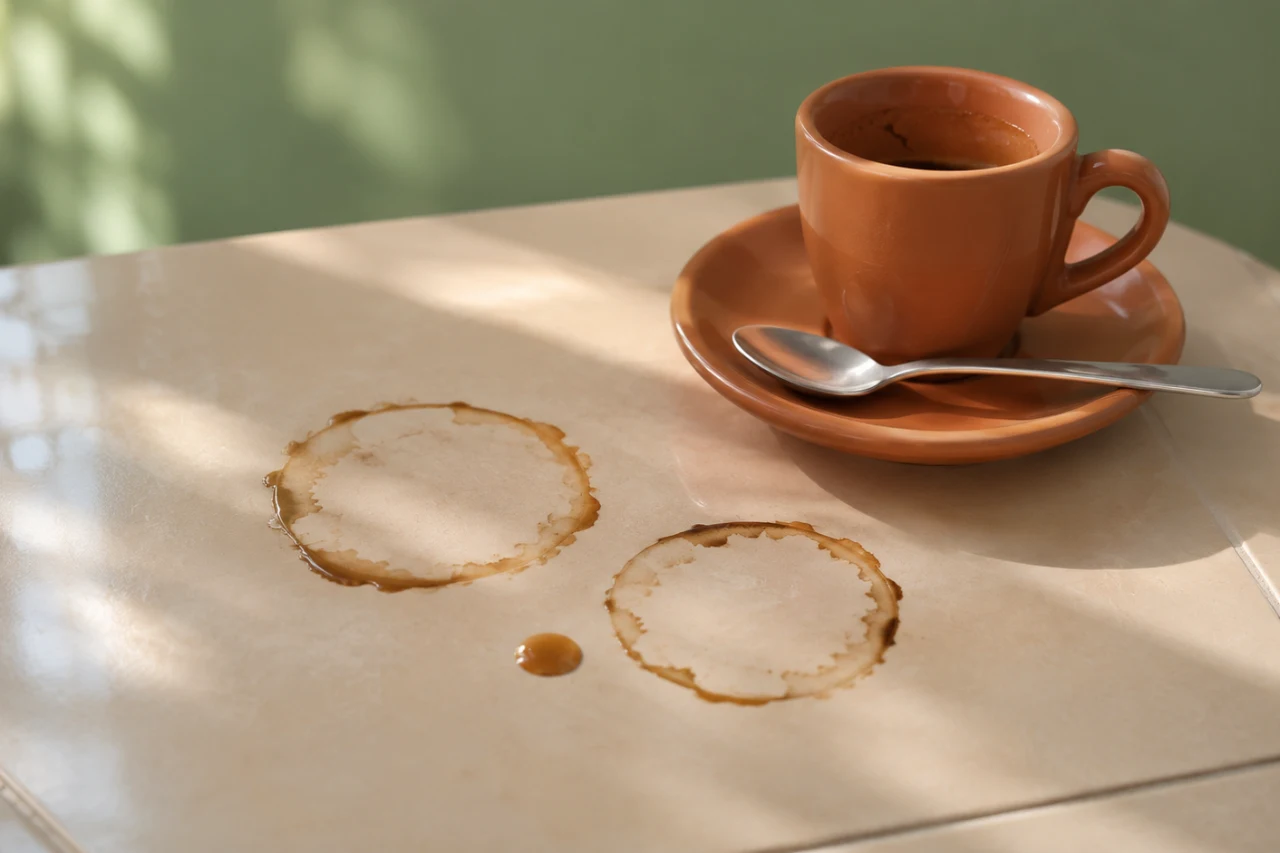
If you spill a drop of coffee on a table and leave it, a brown circle remains where it dried. Look closely, though, and you will see a ring: pale in the middle and dark only at the edge. The coffee particles were evenly mixed throughout the drop, so why did they all crowd to the rim? This ordinary stain is a genuine research topic that physicists worked out in a paper in 1997.
A question that began on a kitchen counter
Sidney Nagel, a physicist at the University of Chicago in the United States, became curious while looking at coffee stains left on his kitchen counter at home. His question was why material that starts out spread across the whole drop ends up at the edge. He dug into the problem with colleagues, and the results, from a team that included graduate student Robert Deegan, physicist Thomas Witten and mathematician Todd Dupont, were published in the scientific journal Nature in 1997.
The team ran experiments under many different conditions. According to the University of Chicago news publication, red wine, milk, tea and soup also left rings, and the same happened on metal, plastic and glass. Even drying a drop hanging upside down gave the same result. So it was not caused by some special ingredient in coffee or by the weight of the particles.
A current flowing to the edge
The answer the team found is a flow that appears when three conditions come together. The paper listed them: the liquid meets the surface at a nonzero angle, the edge of the drop is held in its starting position, and the liquid evaporates.
A table surface has tiny bumps you cannot see, and the edge of the drop catches on them. As the water dries, the drop ought to shrink, but its edge cannot move. On top of that, at the edge the vapor that escapes is less likely to settle back, so more water evaporates there. To replace the lost water, water from the middle of the drop flows outward, and the coffee particles are carried along with that current. Once all the water has dried, the particles piled up at the edge remain as a dark ring.
When the team looked through a microscope, the particles did not drift around at random; they all moved toward the edge. In one experiment in the paper's manuscript, about 90% of the observed particles reached the edge. In an experiment where the edge was covered to block evaporation, no ring formed, and only a faint smudge was left in the middle.
How to stop the ring
This principle goes beyond coffee stains. Wherever material has to be spread evenly, such as printing by spraying ink, painting or making tiny electronic circuits, ring stains are a nuisance. The team at the time also predicted that the principle could be useful for paint, growing protein crystals and making small electronic circuits.
In 2011, another team in the United States reported in Nature that simply changing the shape of the particles can prevent the ring. When they used elongated, ellipsoidal particles instead of round ones, these particles strongly deformed the water surface and pulled on each other, forming loose clusters. The clusters could not reach the edge and settled fairly evenly. On the other hand, when they added a surfactant that lowers surface tension, the ellipsoidal particles gathered at the edge again and formed a ring.
The dark rim of a coffee stain forms because water flowing outward to replace the water that evaporates quickly at the edge carries the particles there.
Notes and references · Deegan et al. 1997, Nature; University of Chicago Chronicle. Based on Deegan et al. 1997, Nature, "Capillary flow as the cause of ring stains from dried liquid drops"; University of Chicago Chronicle, October 1997, "Coffee stains"; and Yunker et al. 2011, Nature.
Editorial standardsReport an error
Quick quiz