No. 284Technology3 minviews 31
Published by GK Library Annex
How does a thermos keep tea hot for so long?
Tea poured in the morning is still warm in the afternoon, and the secret is the empty gap between two walls.
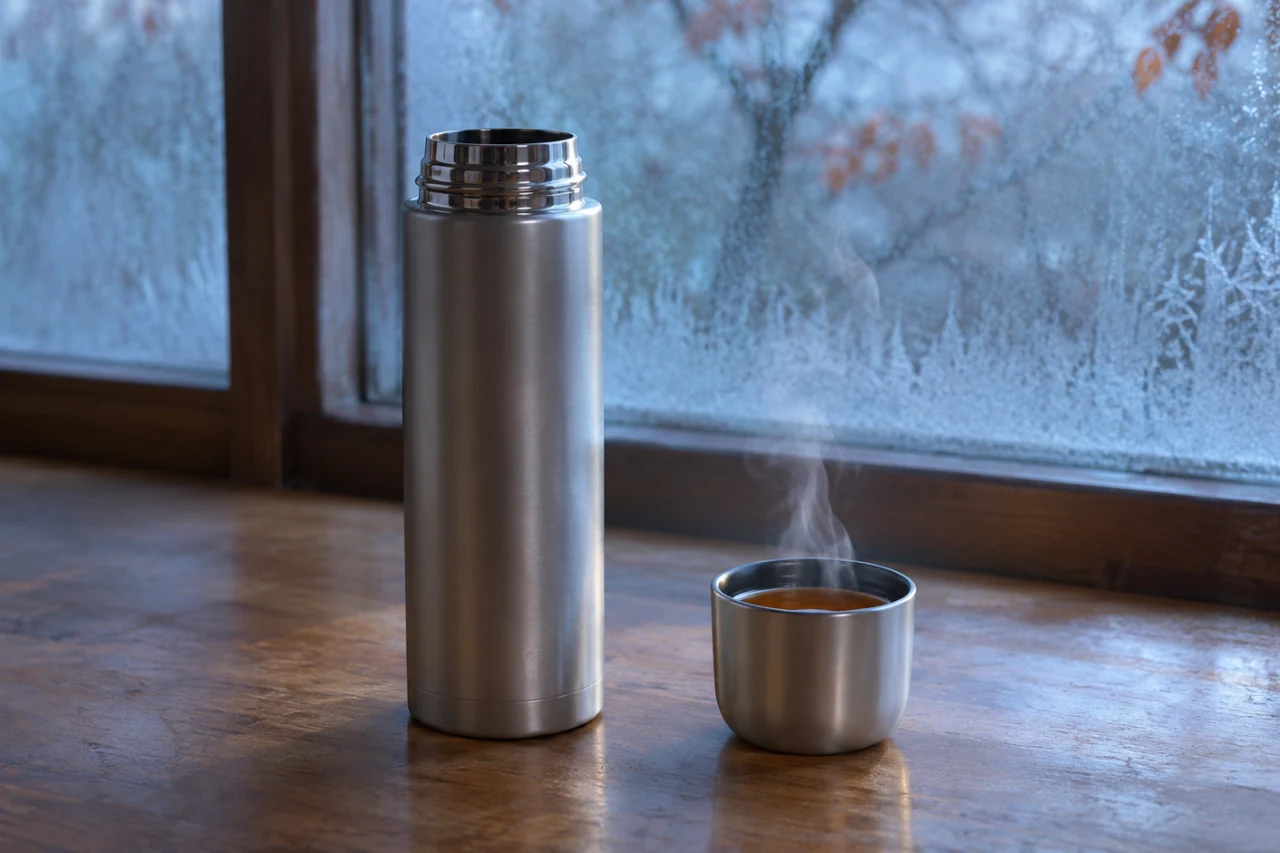
Fill a thermos with hot tea in the morning, and it still steams when you pour it after lunch. The same tea left in a mug turns lukewarm in no time, so why does it cool so slowly inside a thermos? The answer is a design that blocks the escape routes for heat one by one.
Three ways heat escapes
A hot drink cools because its heat moves out into its surroundings. Heat travels in three main ways: conduction, where it passes through materials that touch; convection, where warmed air or water moves and carries heat with it; and radiation, where it spreads as light such as infrared without needing any material at all.
Tea in a mug loses heat through all three at once. Heat passes through the walls of the mug into your hand and the table, the air around the mug warms up and rises, taking heat away, and the surface of the mug also gives off heat as infrared. A thermos is a container that narrows all three of these routes.
Why the space between the walls is empty
A thermos has two walls, and the space between them is a vacuum with almost all the air pumped out. Conduction and convection only happen when there is material to carry the heat. Because the two walls do not touch and there is almost nothing between them, heat from the inner wall has no way to cross to the outer wall.
Radiation, however, can pass through a vacuum. That is why the walls are made of a shiny, mirror-like material or given a shiny coating. A shiny surface absorbs very little light, and for the same reason it gives off very little infrared even when it is warm. The remaining weak spot is the mouth, where the two walls are joined. A little heat is conducted there, which is also why the opening is made narrow: to lose less heat.
A bottle first meant to keep things cold
The design was created by the Scottish scientist James Dewar. According to the Royal Institution in Britain, Dewar made this flask in 1892 to store gases that had become liquid at extremely low temperatures. Turning gases into liquids was expensive, so he needed to keep the liquids from boiling back into gas while he studied them.
Dewar never patented the invention. In 1904, a company founded by two German glassblowers saw that it could keep things warm as well as cold, patented it and gave it the name Thermos. Because the design blocks the routes heat uses to move in or out, a thermos keeps both hot tea and ice water for a long time on the same principle.
A thermos blocks conduction and convection with a vacuum between its two walls and cuts radiation with shiny walls, so it holds heat for a long time.
Notes and references · Royal Institution · University of Illinois. Based on the Royal Institution collection notes (Dewar’s 1892 vacuum flask and the 1904 Thermos patent) and a University of Illinois physics Q&A (how conduction, convection and radiation are blocked).
Editorial standardsReport an error
Quick quiz