No. 243Technology4 minviews 156
Published by GK Library Annex
Why are keyboard keys in QWERTY order?
It isn’t alphabetical, yet the layout has barely changed in nearly 150 years. Here is how it came to be.
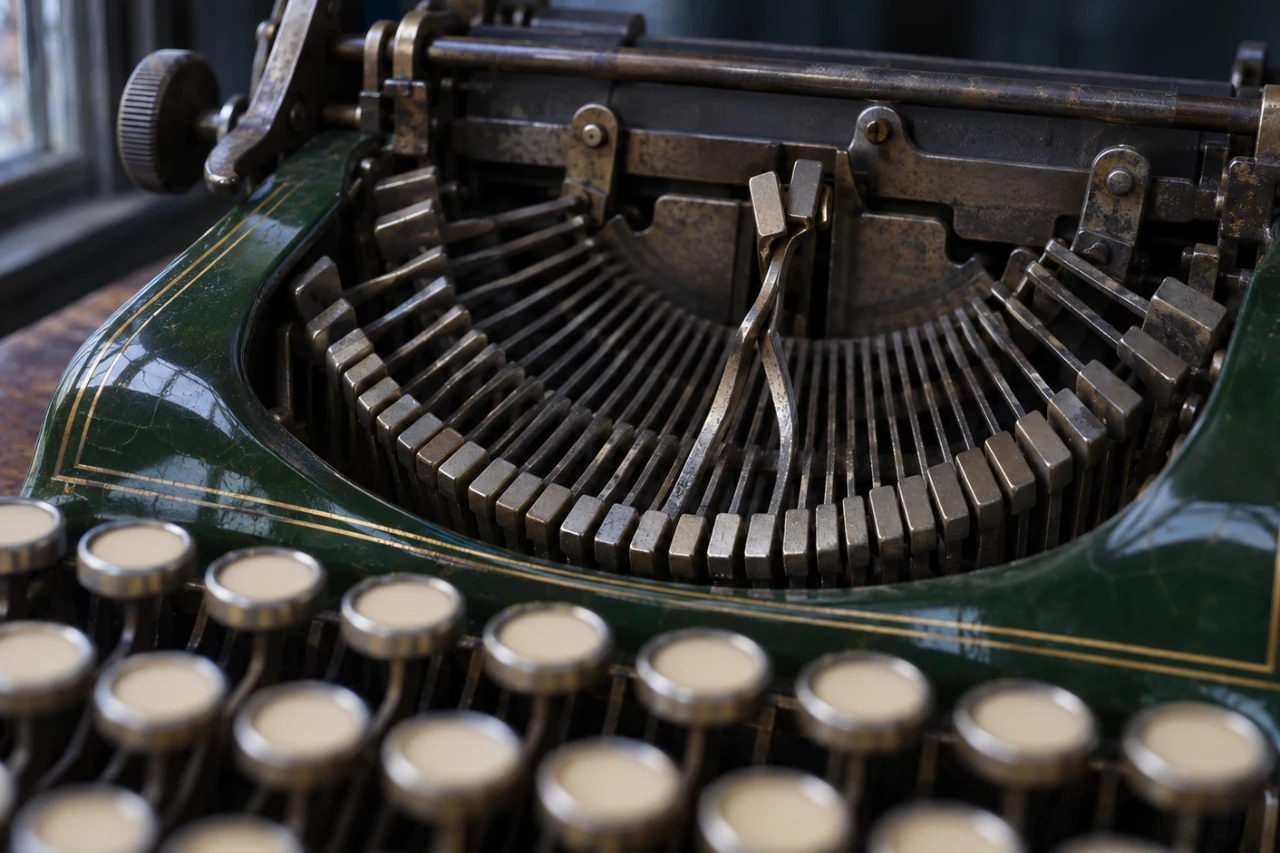
Look at the top-left row of a computer keyboard and you’ll see Q, W, E, R, T and Y side by side. It isn’t alphabetical, and it doesn’t seem to group the most common letters either. The layout comes from the typewriter, a machine far older than the computer.
It started with the typewriter
The QWERTY layout was created by Christopher Latham Sholes, a newspaperman and inventor in Milwaukee in the United States. Sholes and his partners patented an early typewriter in 1868. Its first keyboard looked like a row of piano keys, and the letters were laid out in alphabetical order.
Over the next few years Sholes kept moving the letters around. In 1873 he signed a manufacturing deal with Remington, a company famous for firearms, and a layout almost identical to today’s QWERTY first appears on record in U.S. Patent No. 207,559, issued in 1878.
To stop jams, or thanks to telegraph operators?
The best-known explanation is jam prevention. Old typewriters had metal arms carrying the letters, called typebars, arranged in a semicircle. If you struck neighboring bars in quick succession, they could catch on each other and stick. So the story goes that letters that often appear together were placed apart. However, er, one of the most common letter pairs in English, sits right next to each other, so this explanation doesn’t cover everything.
In 2011, Koichi Yasuoka and Motoko Yasuoka of Kyoto University in Japan offered a different interpretation. Many early typewriter users were telegraph operators who transcribed Morse code, and the researchers argued that the layout shifted bit by bit to meet their needs. For example, in American Morse code, Z was easily confused with the signal for S followed by E, so placing Z and E near S made transcription easier. Even today, it is hard to say for certain which explanation is correct.
Once people get used to it, it’s hard to change
Sales and training also helped QWERTY become the standard. Remington ran paid typing courses, and by around 1890 more than 100,000 Remington typewriters with the QWERTY layout were in use. In 1893, five typewriter companies merged to form the Union Typewriter Company and adopted the layout as the de facto standard.
In the 1930s, August Dvorak in the United States introduced the Dvorak keyboard, which gathered the most frequently used letters on the middle row, but it never caught on widely. Huge numbers of people had already learned to type on QWERTY, and machines and textbooks were built around it. This tendency for an early choice to keep carrying on is called path dependence. It is why QWERTY has survived even on computers and smartphones, where typebars can’t jam at all.
QWERTY was shaped by the needs of typewriter-era machines and their users, and once everyone was used to it, it became too hard to change, so it is still with us.
Notes and references · Smithsonian Magazine. “Fact of Fiction? The Legend of the QWERTY Keyboard,” covering the research of Yasuoka and Yasuoka (2011, Kyoto University) and U.S. Patent No. 207,559
Editorial standardsReport an error
Quick quiz