No. 270Technology4 minviews 80
Published by GK Library Annex
Why can only your phone camera see a remote control’s light?
Let’s find out why a remote’s signal, invisible to our eyes, flashes on a phone screen.
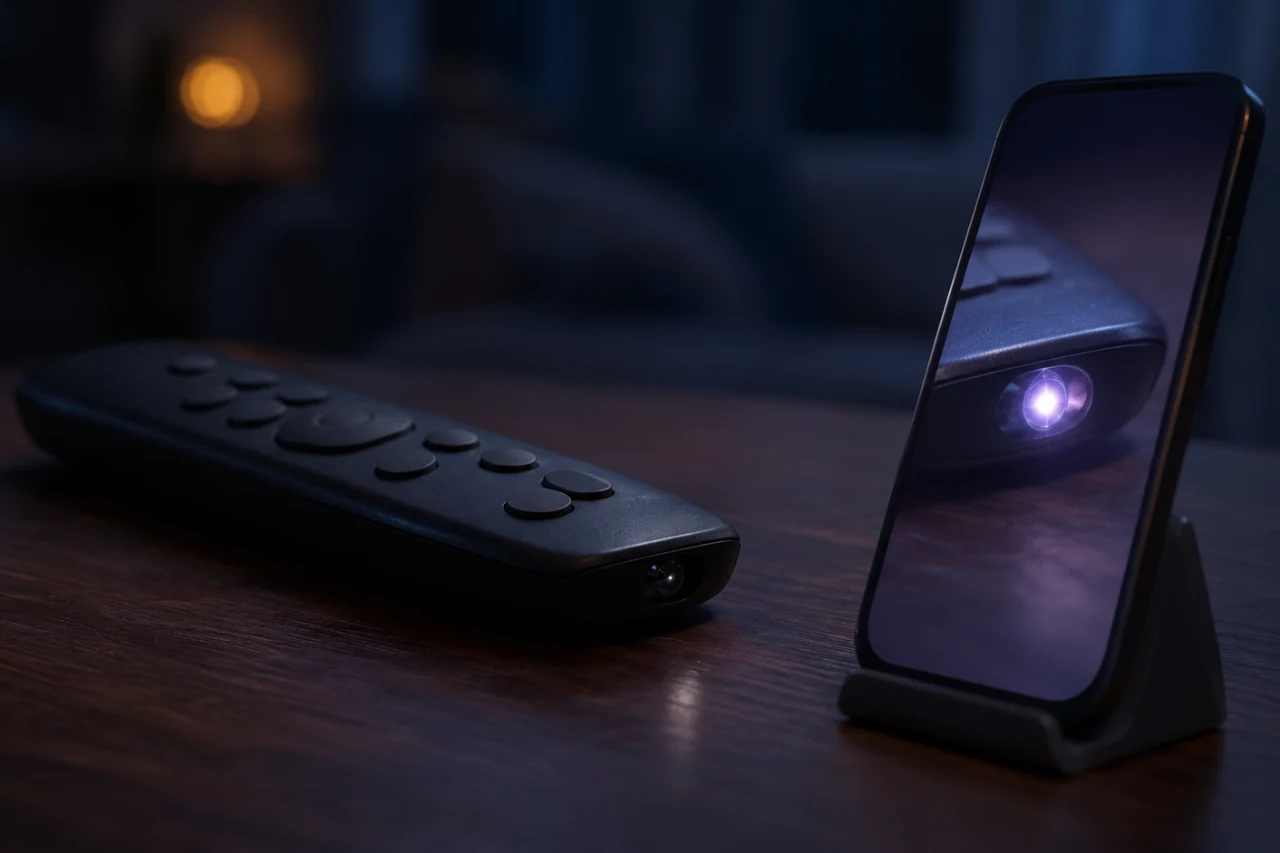
When you press a button on a TV remote, you can stare at the small lens on its tip all you like and never see it light up. But if you turn on your phone camera, point it at that lens and press a button, the lens on the screen blinks white. It is the same light, yet our eyes miss it while the camera catches it. The secret lies in the wavelength of the light the remote uses.
Infrared, the light we can’t see
Light changes color depending on its wavelength. According to NASA, the human eye can typically detect light with wavelengths from 380 to 700 nanometers, and red has the longest wavelength among them, at around 700 nanometers. Light with even longer wavelengths is infrared.
Infrared was first discovered in 1800 by the astronomer William Herschel. He split sunlight into the colors of the rainbow and placed a thermometer in each color. The temperature rose from blue toward red, and the warmest spot was just beyond red, where no color could be seen. NASA gives the wavelength of a typical remote control’s light as around 940 nanometers. That is well beyond what the eye can see, which is why the lens looks dark.
Remotes talk with light
Every time you press a button, the remote sends a signal by switching infrared light on and off in short bursts. The infrared receiver in the TV reads the pattern of these flashes and turns the power on or changes the channel and volume. Because the signal travels as light, blocking the path between the remote and the TV with your hand or an object keeps it from arriving, and the remote stops working.
Infrared often makes people think of heat, but the amount of infrared coming from a remote is very small. That is why you feel no warmth even if you hold your hand against the lens and press a button.
Camera sensors sense infrared too
A digital camera contains a CCD or CMOS sensor that converts light into an electrical signal. According to teacher materials from the Lunar and Planetary Institute (LPI) in the United States, these sensors are more sensitive to near-infrared light just beyond the visible spectrum than to visible light, and CCDs respond out to about 1,000 nanometers.
If pictures were taken as is, the colors would not match what people see, so cameras usually have a filter that blocks infrared between the lens and the sensor. However, how well the filter works varies from device to device, so light shining straight at the camera from close range, like a remote’s, can show up on the screen as a white or purplish dot. This difference is also why it shows up clearly on some cameras and barely at all on others. When a remote isn’t working, pointing a phone camera at it is an easy way to gauge whether it is sending a signal.
A remote sends signals using infrared light of about 940 nanometers. The human eye only sees up to around 700 nanometers, but camera sensors also respond to near-infrared, so the light appears on the screen.
Notes and references · NASA Science “Infrared Waves” and “Visible Light,” LPI teacher materials. NASA describes visible light as 380–700 nm, a typical remote as about 940 nm, and Herschel’s discovery in 1800. Materials from the Lunar and Planetary Institute (LPI) explain the near-infrared sensitivity of CCD and CMOS sensors and infrared-blocking filters.
Editorial standardsReport an error
Quick quiz