No. 244Science4 minviews 168
Published by GK Library Annex
Why does a candle flame always point up?
Tilt the candle and the flame still points upward. What shapes it is the flow of air around the flame.
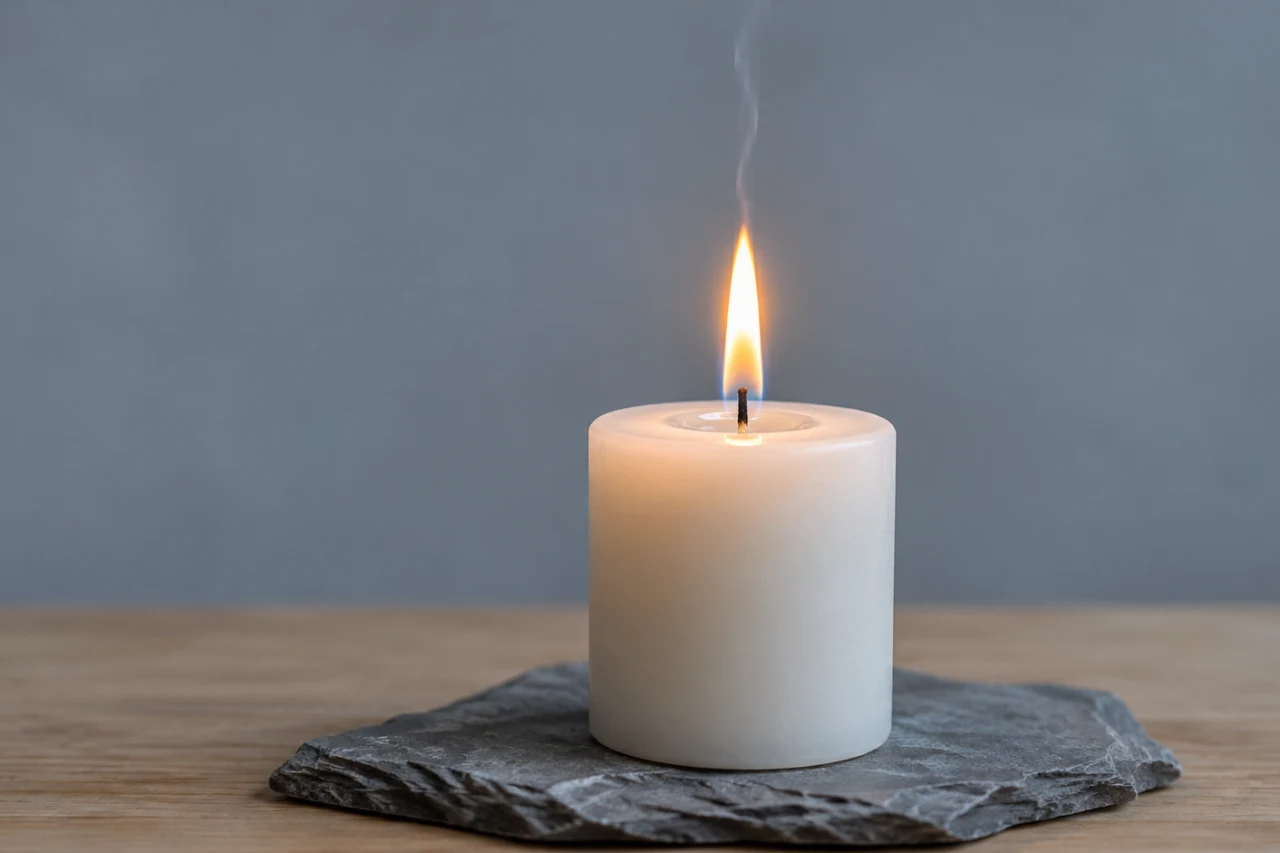
Whether it is a candle on a birthday cake or one lit during a power cut, the flame always points upward in a teardrop shape with a sharp tip. Even if you tilt the candle, the flame does not lean with it but stands straight. The shape of the flame is set less by the fire itself than by the air moving around it.
It is the vapor that burns, not the wax
When you light a candle, the paraffin around the wick melts first and forms a small pool. This liquid climbs up through the tiny gaps between the threads of the wick, the way water creeps up a tissue. This is called capillary action.
When the liquid reaches the tip of the wick, the heat of the flame turns it into gas, and this vapor burns when it meets oxygen in the air. So what actually burns is not the solid candle but the vapor that comes from it. In the winter of 1860, the British scientist Michael Faraday showed this process step by step with a single candle in his Christmas Lectures at the Royal Institution, and those lectures, collected in a book, are still widely read today.
Hot gas rises
The gas inside a flame is so hot that some parts exceed 1,000 degrees. When gas is heated it expands, so for the same volume it becomes lighter. Being lighter than the cool air around it, the hot gas floats upward like a cork in water. This force created by the difference in weight is called buoyancy.
As the hot gas moves away, cool air rushes in from below and from the sides. This air brings fresh oxygen that keeps the flame burning, and at the same time it draws the flame up into a long shape. That is why the flame is round at the bottom and pointed at the top, like a teardrop. The flame stays upright even when the candle is tilted because this flow is set by gravity, not by the candle.
The colors are tied to this flow too. At the bottom, where oxygen flows in easily, the fuel burns cleanly and looks blue. The yellow glow higher up is light given off by tiny carbon particles that have not fully burned and are glowing from the heat.
In space, it turns round
So what happens where there is almost no gravity? NASA has carried out candle experiments in the microgravity environment inside spacecraft. There, hot gas does not rise even when it becomes lighter, so no upward flow forms. The candle flame becomes a round ball wrapped around the wick, and its light turns dimmer and bluish.
With no flow carrying gas upward, oxygen can only seep in slowly from the surroundings, and the flame grows weaker as a result. In the end, a candle on Earth rises tall in a teardrop shape thanks to gravity, which separates heavy cool air from light warm air.
A candle flame points up because heated, lighter gas rises while cool air rushes in from below. Without gravity, the flame turns round.
Notes and references · NASA, Candle Flame – 1g vs Microgravity. NASA material comparing candle flames on the ground and in microgravity. The combustion process follows Faraday's Royal Institution lectures, The Chemical History of a Candle.
Editorial standardsReport an error
Quick quiz