No. 94Technology3 minviews 33
Published by GK Library Annex
Can your phone scan a QR code with a torn corner?
Is it worth trying your phone on the QR code on a crumpled, stained flyer?
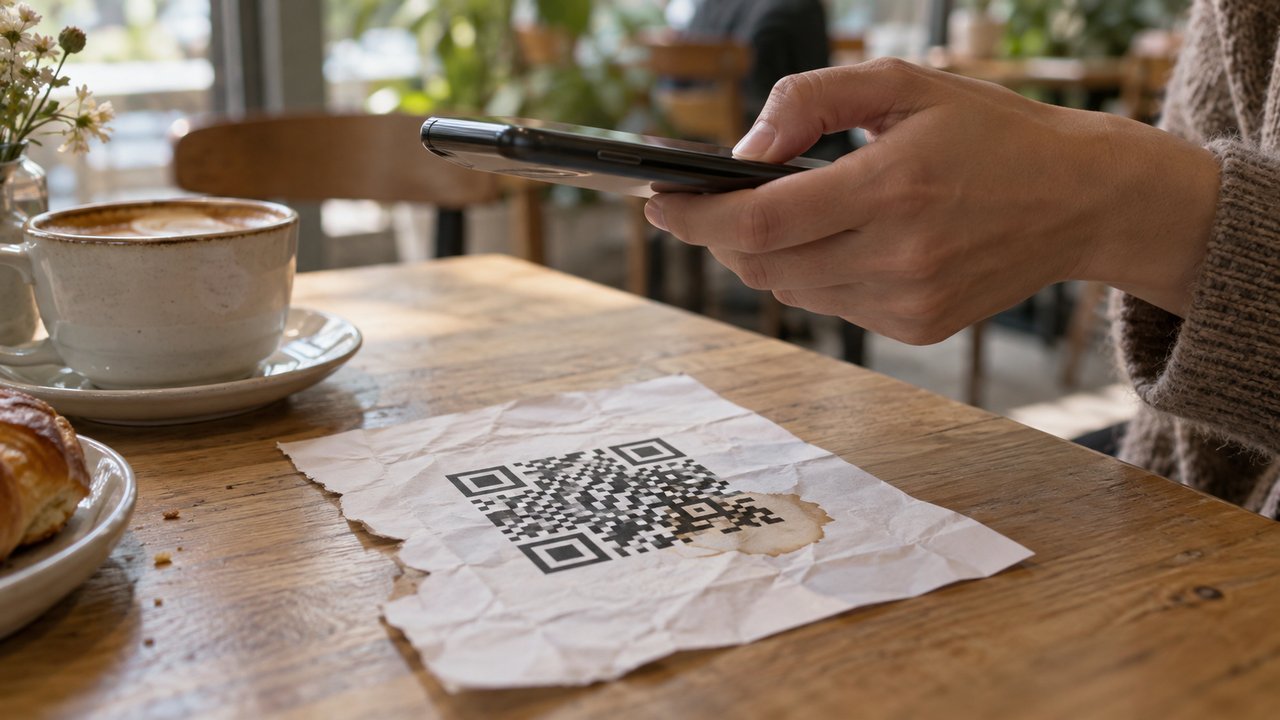
A QR code with a small tear or stain on one side can often still be scanned. That is because it contains extra information from the start to recover its contents if it gets damaged.
Spare data is built in from the start
According to DENSO WAVE, the Japanese company that created the QR code, every code carries extra information for fixing errors on top of the content itself. It uses Reed-Solomon coding, the same method used on music CDs. The code first appeared in 1994 for factory use, so it had to stay readable on grease-stained paperwork, something a smudged barcode can't manage.
When you make a QR code, you choose one of four levels of spare data. The lowest can recover the content with about 7% damaged, the highest with about 30%. The most common level is about 15%. More spare data makes the pattern larger and denser, so DENSO WAVE suggests a high level for factories where codes get dirty and a low level for clean places that need to hold a lot of content.
Protect the three corner squares
The large squares in three corners are markers that let your phone find the code's position and direction. The developers studied printed patterns on flyers, magazines and boxes for a long time and built these squares from a black-and-white width ratio that almost never appears in print: 1:1:3:1:1. That's why your phone spots them quickly even at an angle.
So a small stain is usually fine, but if one of those squares is badly covered, reading gets hard. For a crumpled code, smooth the paper flat and keep all three squares on the screen.
30% isn't about area
It's easy to think a code survives as long as no more than 30% of it is torn, wherever the damage is. But that figure doesn't refer to the pattern's area. It refers to how many of the 8-bit chunks of data can be restored. The same size stain can have different results depending on which cells it covers.
The blank border matters too. DENSO WAVE asks for a margin four small cells wide on every side with nothing printed in it. A code pushed right up against the edge of a flyer, or with text crowded next to it, may not scan even when the pattern itself is intact. If you're putting one up where wind and rain can wear it down, like outside a shop, choose a higher level and leave a generous margin.
Related reads
Spare error-correction data lets a QR code scan even when part of it is damaged, but covering the three corner squares or the blank border makes it hard to read.
Notes and references · DENSO WAVE QRcode.com. Based on DENSO WAVE's QRcode.com pages "Error Correction Feature," "History of QR Code" and "Point for determining the code area." How much damage a code can take depends on the level chosen and where the damage is.
Editorial standardsReport an error
Quick quiz