No. 216Science4 minviews 63
Published by GK Library Annex
A star that crosses the sky without blinking may be the space station
If a bright dot crosses the sky in a few minutes within an hour or two after sunset, it is quite likely the International Space Station
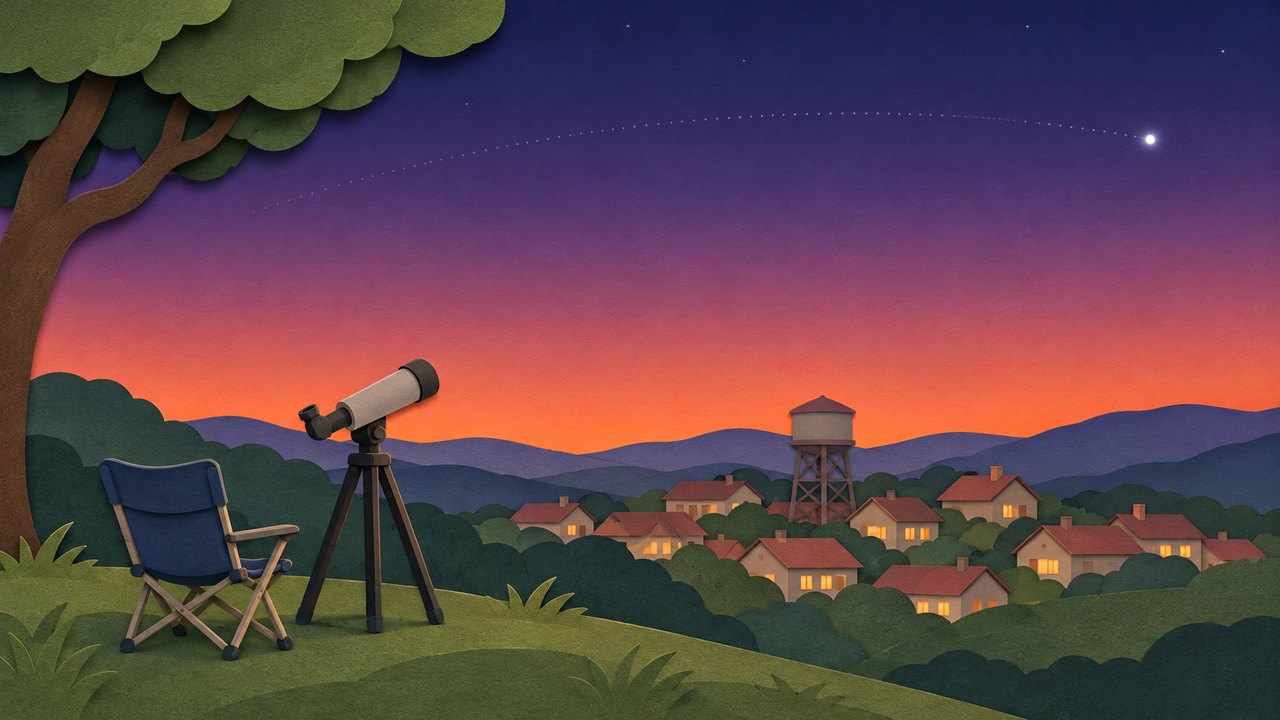
If a dot as bright as a star glides smoothly across the sky without blinking not long after sunset, it may be the International Space Station. The ISS can be seen with the naked eye, no telescope needed, and NASA describes it as the third-brightest object in the sky after the Sun and the Moon.
It doesn't shine on its own
The space station isn't visible because it turns on lights. It is visible because it reflects sunlight, the same way the Moon shines. It is about the size of a football field and carries wide solar panels, so it reflects quite a lot of light.
That is why there are set times when you can see it. The best window is an hour or two after sunset or before sunrise, when the ground is already dark but sunlight still reaches the station about 400 km overhead. It is like a valley lying in shadow at dusk while only a tall mountaintop still glows in the sun. At midday the sky is too bright, and in the middle of the night the station is also inside Earth's shadow, so it is hard to see.
How to tell it from a plane
Planes have blinking red and green lights and sometimes change direction. The space station has no blinking lights and crosses the sky in a straight line. It usually appears in the western sky and moves east.
The speed is different too. An airliner flies at around 1,000 km per hour, while the space station circles at about 28,000 km per hour. It takes a little over 90 minutes to go once around Earth, so the astronauts aboard see the sun set about 16 times a day. Seen from the ground, a single pass is over in a few minutes.
It can vanish in the middle of the sky
Sometimes the bright dot you are watching suddenly fades and disappears before it even reaches the horizon. That happens when the station enters Earth's shadow and no longer receives sunlight. Nothing is broken.
If you want to see it, enter where you live on NASA's Spot the Station website or app, and it will tell you the time, the direction it appears from and its maximum height. Passes that rise 40 degrees or more above the horizon are easier to see because buildings block less of the view. If you make a fist and stretch your arm out, one fist is roughly 10 degrees high. As long as the sky is clear, your naked eyes are enough, with no equipment.
A bright dot that crosses the sky in a straight line within a few minutes, without blinking, after sunset or before sunrise may be the ISS reflecting sunlight.
Notes and references · NASA Spot the Station; ESA; Sky & Telescope. Brightness, speed (about 28,000 km/h) and the 40-degree guide: NASA FAQ. Altitude of about 400 km: ESA. 16 sunsets a day: Sky & Telescope 2014. Visibility and brightness vary by pass.
Editorial standardsReport an error
Quick quiz