No. 217Everyday life4 minviews 70
Published by GK Library Annex
Does hot water freeze faster than cold water?
A student making ice cream made the idea famous, but careful measurements usually show cold water wins
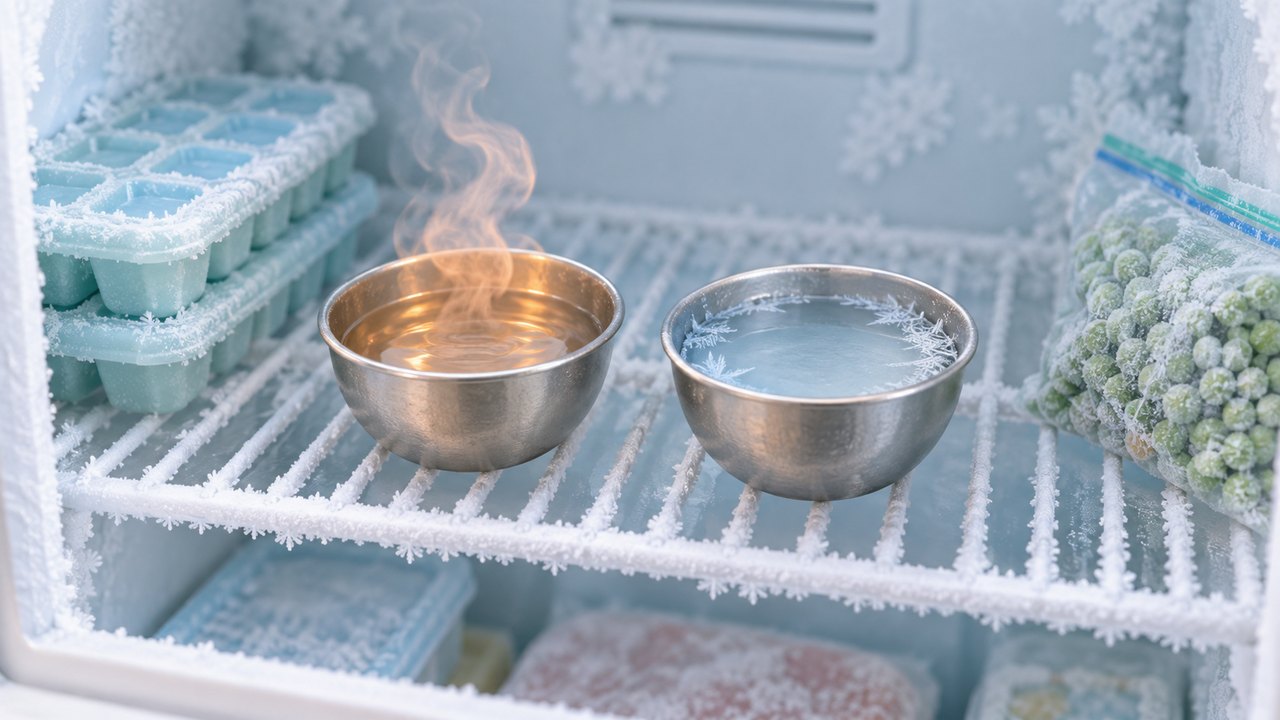
You may have heard that hot water freezes faster than cold water in the freezer. It's called the "Mpemba effect," but in experiments where every condition is matched, cold water usually reaches 0°C first. Even so, there are good reasons the story has survived so long.
A name that started with ice cream
In the 1960s, Erasto Mpemba, a secondary school student in Tanzania, was making ice cream at school. Worried he'd lose his spot in the freezer, he put his boiled milk mixture in without letting it cool. About an hour and a half later, his had frozen, while a classmate's mixture, which had been cooled first, still hadn't fully set.
Mpemba asked university lecturer Denis Osborne about it, and in 1969 the two published their experimental results together in a physics education journal. Similar observations appear much earlier, even in the writings of Aristotle.
Measured again, the result changed
In 2016, British researchers Burridge and Linden used the same containers, the same water and the same cooling conditions, changing only the starting temperature, and timed how long each sample took to reach 0°C. The hot water took longer. That makes sense when you think about it: for 80°C water to freeze, it has to pass through 20°C first, so at that point it is already behind water that started at 20°C.
They also reviewed earlier reports and pointed out that placing the thermometer just 1 cm higher or lower can make it look as if the hot water pulled ahead, because cooling water is warmer at the top than at the bottom. They added, however, that the original experiment by Mpemba and Osborne can't be fully explained by this kind of error.
Why home freezers cause confusion
A kitchen has far more variables. Hot water loses a little volume as steam, and the bottom of the container can melt the frost and settle more firmly onto the cold floor of the freezer. Which shelf the container sits on and how often the door is opened can also sway the result. Osborne knew about the frost issue and placed the containers on polystyrene foam during his experiments to prevent it.
The definition of "frozen" also varies. The result changes depending on whether you mean the moment ice first forms on the surface or the moment it's frozen solid all the way through. If you want ice quickly, cold water is the safe choice. A hot container can also warm up the food next to it.
Under the same conditions, cold water usually freezes first; cases where hot water wins often come down to how it was measured or the freezer setup.
Notes and references · Mpemba & Osborne 1969; Burridge & Linden 2016. Physics Education 1969, "Cool?"; Scientific Reports 2016. The Mpemba effect is defined differently from study to study, and the debate continues.
Editorial standardsReport an error
Quick quiz