No. 194Science3 minviews 89
Published by GK Library Annex
Why Orion shines in winter and Scorpius in summer
The stars stay put, but as Earth circles the Sun, the direction we face at night changes. Here is also why stars rise about 4 minutes earlier each day
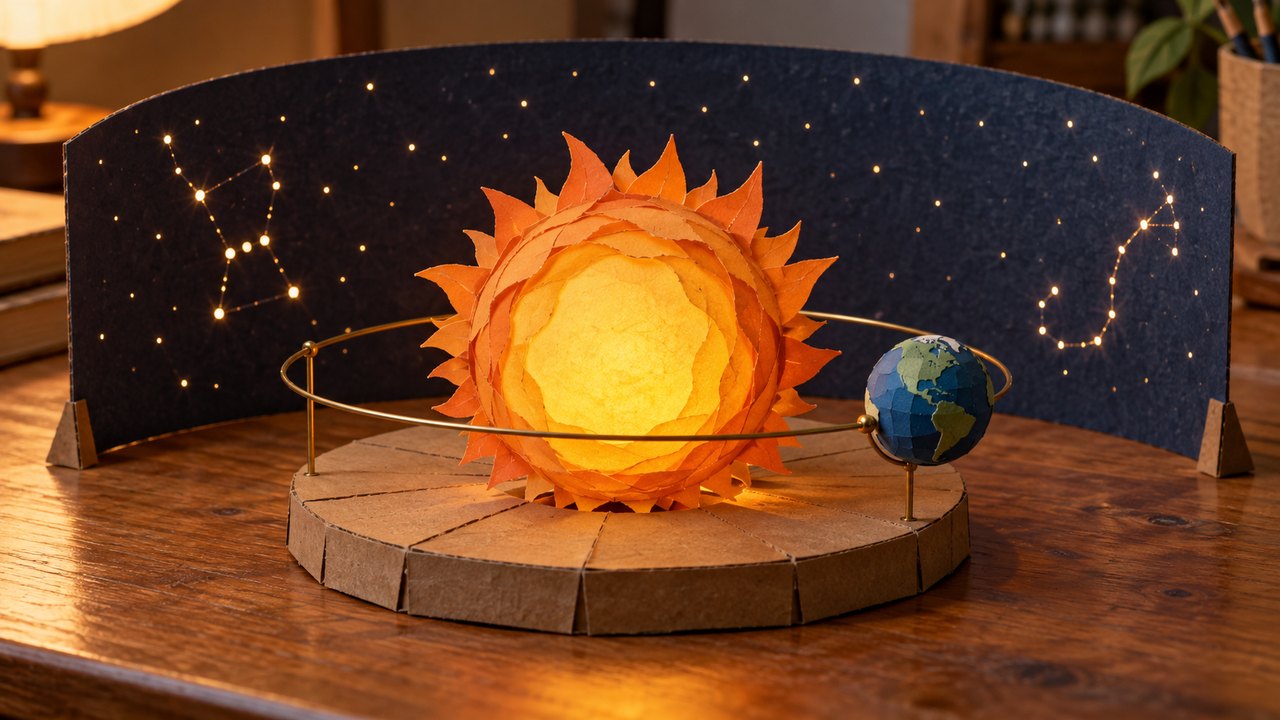
The constellations in the night sky change with the seasons, but not because the stars move. As Earth travels around the Sun once a year, the direction of space we look toward at night slowly shifts.
Night means facing away from the Sun
At night we look at the part of the sky on the opposite side of Earth from the Sun. But because Earth is orbiting the Sun, the direction that side points to changes with the seasons. NASA's science site for kids explains that the night sky looks slightly different each night because Earth is in a different spot in its orbit.
Constellations that lie in the same direction as the Sun are up during the day. They have not disappeared; the sky is simply too bright to see them.
Stars rise 4 minutes earlier each day
A day measured by the Sun is 24 hours, but Earth takes about 23 hours and 56 minutes to turn once relative to the stars. During each day Earth moves a little along its orbit, so it has to turn about 4 more minutes to bring the Sun back to the same spot.
Since our clocks follow the Sun, the same star rises about 4 minutes earlier every night. That adds up to about 2 hours in a month and about 6 hours in three months. So a constellation that rose in the early evening in winter rises with the Sun in summer and becomes hard to see at night.
Why Orion and Scorpius take turns
In the Northern Hemisphere, including Korea, Orion is the signature constellation of the winter night sky, while Scorpius sits low in the southern sky on summer nights. The two lie almost on opposite sides of the sky. So when one is high in the night sky, the other is near the Sun and hard to see.
In late autumn like now, Orion climbs up from the east as the night goes on. In just a few weeks, you can see it sitting a little higher at the same hour.
Where you live matters too
Where you live matters as much as the season. NASA explains that the Northern and Southern Hemispheres face different parts of the sky, so people in Australia can see some constellations that differ from those seen in the United States. In the Southern Hemisphere the seasons are also the reverse of Korea's, so Orion shows up on summer nights there.
The constellations themselves keep almost the same positions for a very long time. That is why people have long used them to tell the seasons and find their way.
Constellations change with the seasons because Earth's orbit changes the direction we face at night. The same star rises about 4 minutes earlier each day.
Notes and references · NASA Space Place, What Are Constellations?. Explains that the night sky changes with Earth's position in its orbit. The 4-minute calculation draws on the OpenStax astronomy textbook section Keeping Time
Editorial standardsReport an error
Quick quiz