No. 206Science4 minviews 122
Published by GK Library Annex
What lights the faint circle beside a crescent moon?
Sunlight bounced back by Earth gently lights the moon's dark side
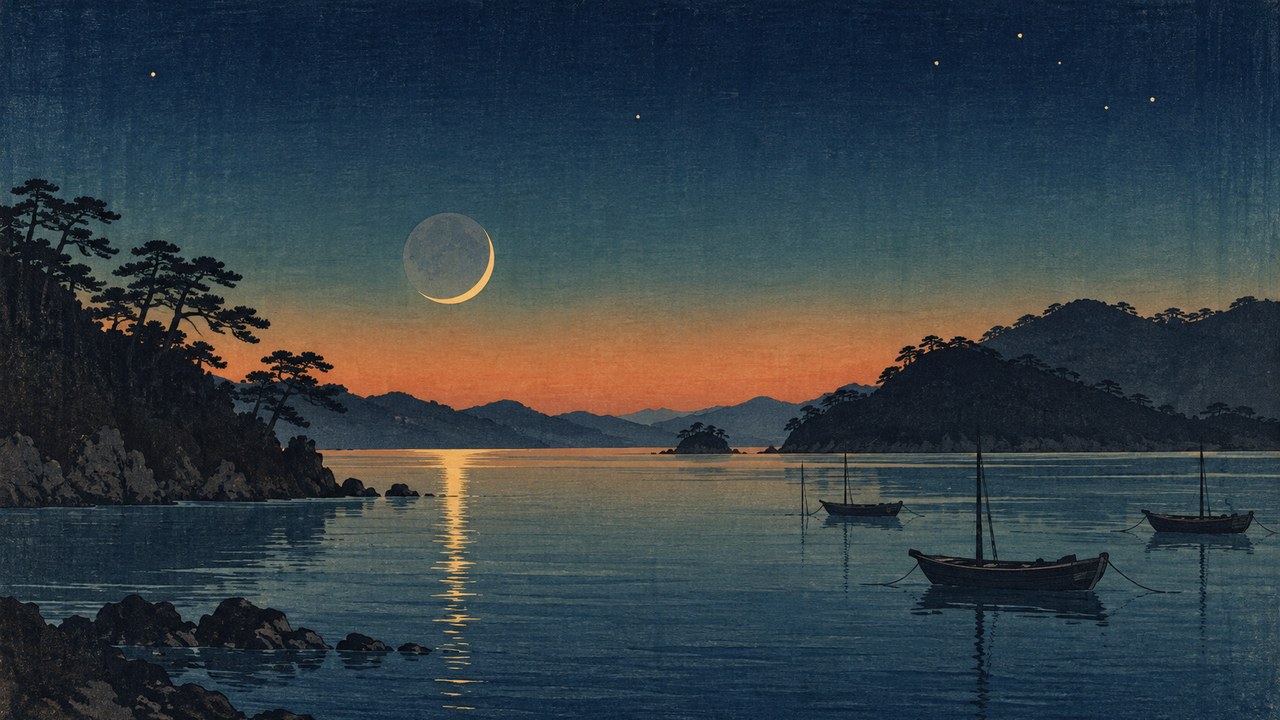
When a thin crescent moon hangs in the western sky after sunset, you can sometimes see the rest of its disk as a faint round glow, even though that part isn't lit by the sun. That dim light is sunlight reflected by Earth, which reaches the moon and then comes back to our eyes. Because it is light from Earth, it is called earthshine.
From the moon, Earth looks nearly full
During a crescent phase, the moon sits on the same side of the sky as the sun, as seen from Earth. From our side we mostly see the moon's night side, but if you looked back at Earth from there, you would see almost all of Earth's sunlit day side. So while we see a crescent moon, a nearly full, round Earth hangs in the moon's sky.
Seen from the moon, Earth is about four times wider than the moon looks from Earth, and its clouds, oceans and ice reflect sunlight well. That makes the lunar night at that time far brighter than a full-moon night here. That light hits the moon's surface, reflects once more and travels back to Earth, so we see a very faint, ashen circle.
It shows best when the moon is thin
Earthshine is easiest to see when the moon is thin, as a waxing or waning crescent. Look at the western sky for an hour or two after sunset, or the eastern sky before sunrise. Once the moon grows past half, Earth seen from the moon becomes a thinner crescent and gives less light, while the moon's bright part grows and dazzles your eyes, so the faint part gets lost. It is easier to see where the air is clear and there are few lights around.
If you take a phone photo bright enough for the faint part, the crescent tends to blow out into a white smear. That is why it can look clearer to the naked eye or through binoculars than in photos.
Da Vinci figured it out first
Leonardo da Vinci is credited as the first to properly explain this faint light. In the early 1500s, in his notebook known as the Codex Leicester, he wrote that Earth reflects sunlight and lights the moon's dark side. He thought the oceans did most of the reflecting, but in fact clouds play a bigger part.
This light is still used in science today. Since the late 1990s, researchers at Big Bear Solar Observatory in the United States have measured the brightness of earthshine to work out how much sunlight Earth sends back. The cloudier the side of Earth facing the moon, the slightly brighter the moon's dark part becomes.
The faint circle beside a crescent moon is earthshine: sunlight bounced off Earth lighting the moon.
Notes and references · Da Vinci's Codex Leicester; Big Bear earthshine data. Da Vinci (early 1500s) credited the seas, but clouds reflect much of it. Earthshine varies with cloud cover on the side of Earth facing the moon (measured since the late 1990s).
Editorial standardsReport an error
Quick quiz