No. 218Time3 minviews 121
Published by GK Library Annex
Why snooze is 9 minutes, not 10
No record settles it; the best-known story is a 1950s clock gear
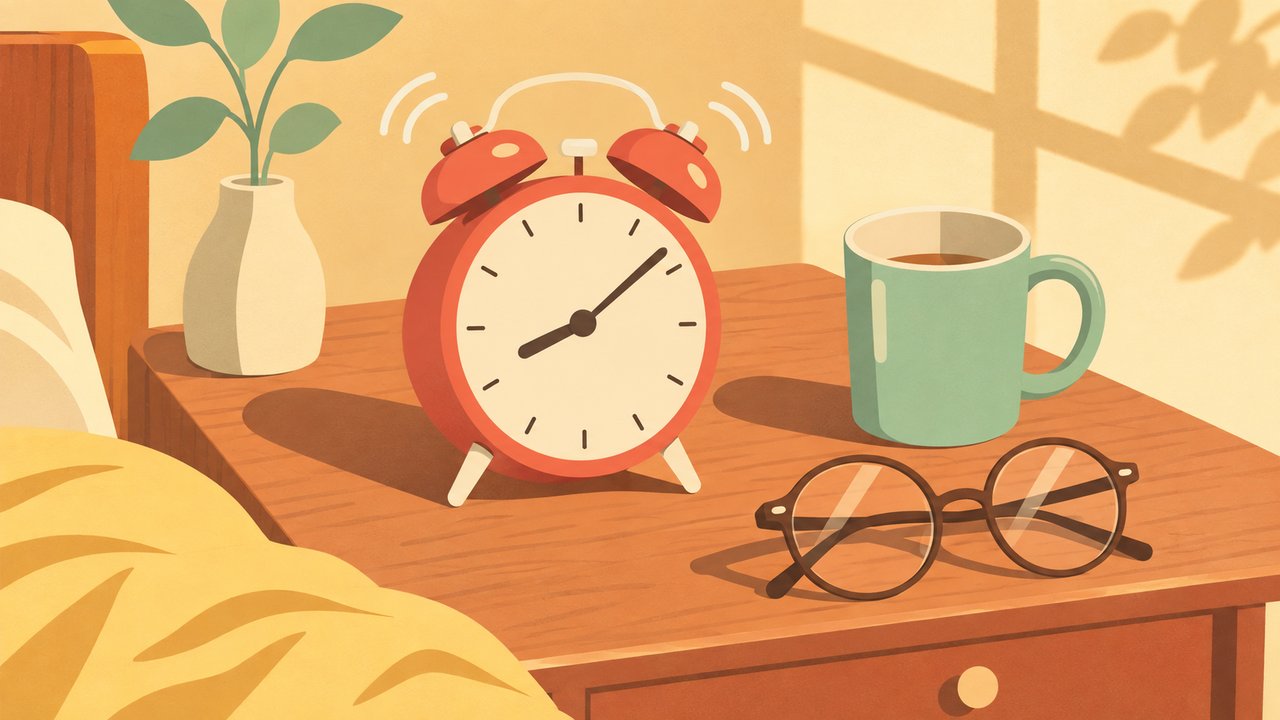
The best-known explanation for why an alarm's snooze interval is often 9 minutes is the gear layout of 1950s mechanical clocks, where a neat 10 minutes was hard to hit. But the clock makers left no explanation of their own that we could find, so it remains the most plausible guess rather than a settled fact.
The clock came first, the number later
Devices that make an alarm ring again after a set time were around from the early 1950s. U.S. Patent 2,541,817, granted to Edward L. Gordon in 1951, meshes a toothed bar with a gear on the minute-hand shaft, and when the bar slowly rises, the alarm is released. The number nine does not appear anywhere in that patent.
As a product, the 1956 GE Telechron "Snooz-Alarm" is often named as the first. If you delay three times by 9 minutes, a 7:00 alarm ends up at 7:27.
The nine-tooth explanation
The most widespread explanation goes like this. The gears in alarm clocks of that era were already standardized, and the snooze gear's teeth had to mesh with them. One more tooth would have pushed the delay just past 10 minutes, so to avoid complaints about sleeping more than 10 minutes, the makers supposedly chose nine. That guarantees at least 9 and at most 10 minutes.
This explanation comes from a post on the website of a collector of Telechron clocks, and the author himself presents it as a guess that it was probably so. It has not been confirmed by any company design document or announcement.
It started at 15 minutes
A February 1956 trade-magazine item, reproduced on the same site, says this clock gives about 15 minutes of quiet after the alarm is stopped. The collector timed an early unit of his own at 16 to 17 minutes. Some say the design was therefore reworked to cut the delay to about 9 minutes, but that too remains an assumption.
Another explanation going around says 9 is the largest single digit. Yet it has been pointed out that this cannot fit a 1956 clock, which had hands rather than a digital display. According to reports, the iPhone's alarm also defaulted to 9 minutes from the first model, and from iOS 26 it can be set from 1 to 15 minutes. Real habits vary: in a Swedish survey, the 1,195 snooze users averaged 8 minutes between alarms.
Nine minutes is no law; it is a habit explained, with thin records, by 1950s clock design.
Notes and references · Telechron.net, 1951 patent, Willamette Week, Sundelin. Telechron.net (cites 1956 trade press), patent US2541817, WW 2026 column, Sundelin et al. 2024 (sleep journal). The origin of 9 minutes is not an established fact.
Editorial standardsReport an error
Quick quiz