No. 269Money4 minviews 89
Published by GK Library Annex
Why does the dollar sign $ have a line through an S?
Where did the $ that stands for American money come from? Let's walk through the explanations that have been passed down, one by one.
We see $ all the time on price tags and in exchange-rate news. Because it looks like the letter S with a vertical line through it, it's easy to guess that it combines the initials of the United States. But the symbol is more closely tied to the Spanish silver coins that circulated in the Americas before the U.S. dollar existed. Its exact origin is still not certain, but the explanations that have been passed down narrow to a few.
The dollar's ancestor was a Spanish silver coin
Even the name "dollar" didn't start in the United States. According to Encyclopaedia Britannica, "dollar" comes from the German word "thaler." Thaler is a shortened form of "Joachimsthaler," a silver coin first struck in 1519 from silver mined in St. Joachimsthal in Bohemia.
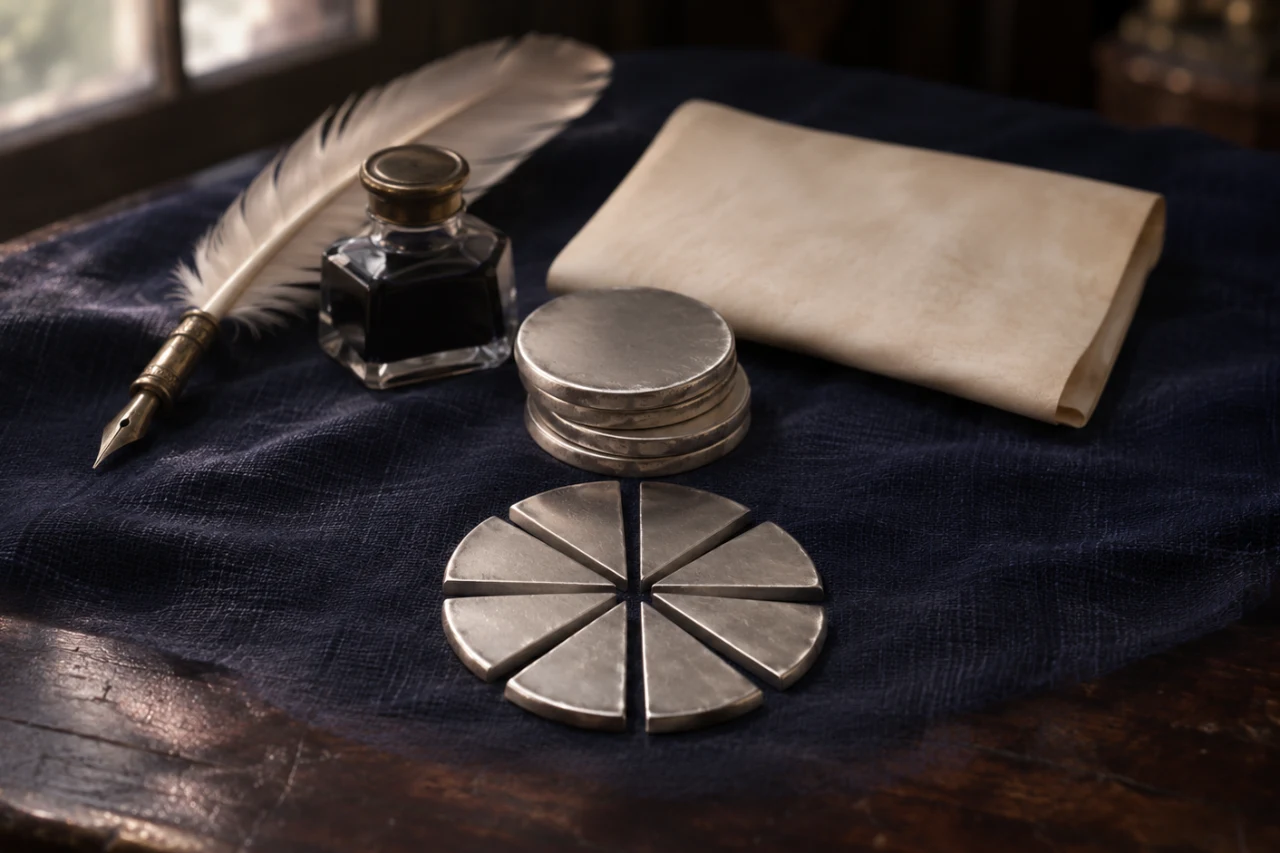
In the colonial Americas, the money that circulated widely was the Spanish silver coin. It was called the peso in Spanish and "pieces of eight" in English, because one coin was worth 8 reales. A Federal Reserve source explains that this Spanish dollar served as the unofficial currency of the American colonies for much of the 17th and 18th centuries, and that when people needed change, they cut the coin into eight pieces. The United States named its monetary unit the dollar in 1792, and the silver coins it first struck in 1794 also took the Spanish dollar's name, weight, and value as they were.
The widely known "Ps" theory
The explanation most often given for the origin of $ is that it came from "Ps," an abbreviation of peso. The idea is that writing the P and s on top of each other produced the shape of an S with a vertical line through it. As evidence, Britannica points to a handwritten invoice from 1778 by Oliver Pollock, a financier who helped fund the American Revolutionary War. In this document, the P appears written over the s. However, Britannica adds that there is little evidence this notation was in common use at the time.
The first appearance of $ in print came a little later. Britannica explains that the earliest known printed example dates from 1797. In other words, a symbol first used in handwriting later made its way into print.
The number 8, pillars, and "US"
There are other explanations too. Spain created a silver coin worth 8 reales through a currency reform in 1497, and some speculate that $ is a quickly written number 8. But no documents have been found in which 8 was written this way. Another theory says it came from the "Pillars of Hercules" on the coat of arms of Ferdinand II of Aragon (reigned 1479–1516). In this reading, the vertical line is a pillar and the S is a ribbon wrapped around it, but there is little evidence for this either.
The popular story that it is "a U and an S combined to mean the United States" has no basis. Britannica notes that this claim, which appears in Ayn Rand's 1957 novel "Atlas Shrugged," has nothing to do with the facts. Meanwhile, $ is now used not only in the United States but also for many other currencies, such as the Canadian and Australian dollars and the Mexican peso, and a version with two vertical lines is occasionally used as well.
The origin of $ is not certain, but the most widely known explanation is that it came from "Ps," an abbreviation of the Spanish silver peso. The theory that it combines U and S has no basis.
Notes and references · Britannica, "dollar sign" and "dollar"; Liberty Street Economics (New York Fed blog). Britannica describes Pollock's 1778 handwritten document, the first printed example in 1797, and the number 8, Pillars of Hercules, and "US" theories. The New York Fed blog says the Spanish dollar was the colonies' unofficial currency.
Editorial standardsReport an error
Quick quiz