No. 201Everyday life3 minviews 85
Published by GK Library Annex
Why grapes spark in the microwave
Grapes trap microwave waves and pour the energy into the spot where they touch
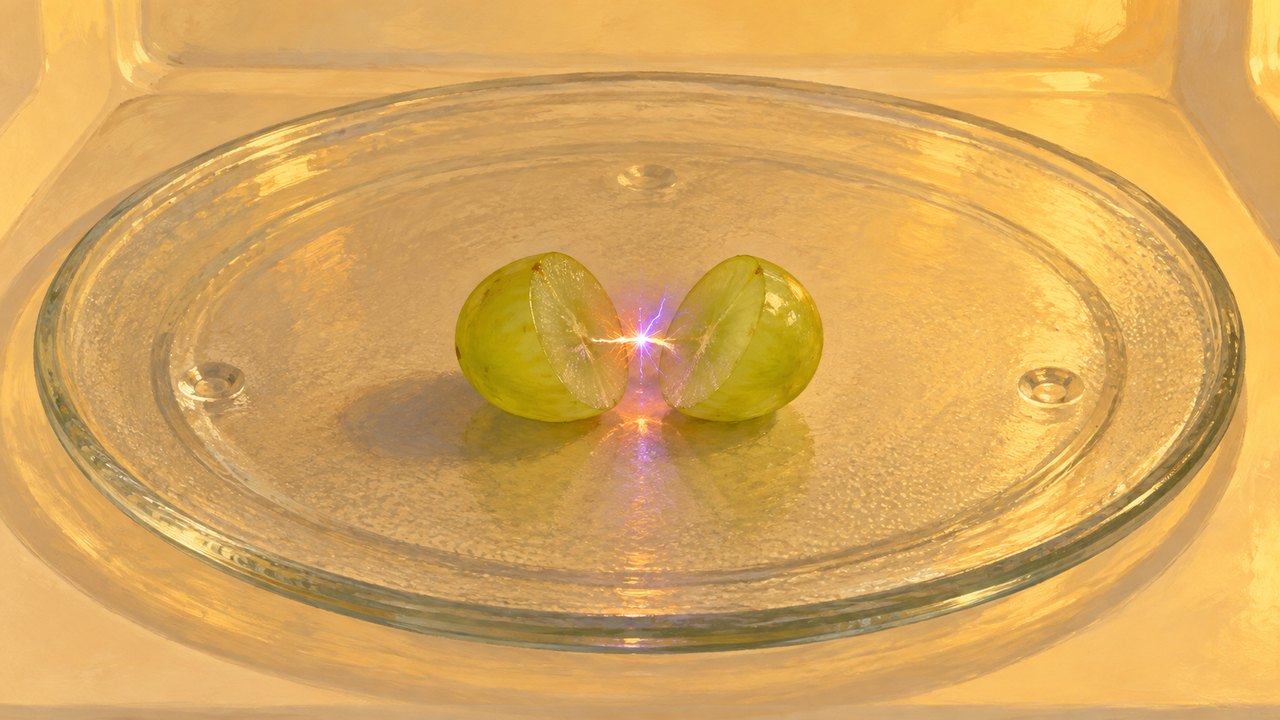
Put a grape cut in half into a microwave and a small spark flashes. The size of a grape is just right for trapping the waves a microwave gives off, so energy piles up at the single point where the two pieces touch. The spark isn't something burning; it's plasma, air glowing with light.
A grape is a container for waves
A microwave oven heats the water in food with electromagnetic waves that vibrate about 2.45 billion times per second. In air, one of these waves is about 12 centimeters long, much longer than a grape.
But once the wave enters water, it slows down a lot and its length shrinks to just over 1 centimeter. A grape, which is mostly water, happens to match that length well, so the waves circle around inside the grape, can't escape, and build up.
Energy gathers at the touching point
In 2019, a research team at Trent University in Canada confirmed this with experiments and calculations and published the results in the scientific journal PNAS. A single grape on its own does nothing much, but when two grapes touch, the energy each one has trapped rushes all at once into the tiny point where they meet.
That point heats up in an instant, and substances in the grape such as sodium and potassium break off as electrically charged particles. These particles turn the surrounding air into glowing plasma, which is why you see orange and violet sparks.
The skin doesn't need to connect them
It used to be commonly explained that the thin strip of skin joining the two grape halves acts like a wire and makes the spark. But the team showed that simply placing two whole grapes together, with no skin bridge, is enough to make sparks.
The same thing happened with water-filled jelly beads. So what makes the spark isn't the grape as a fruit so much as the shape: two round lumps of water of a similar size touching each other.
Better not to try it
Plasma is extremely hot, so it can scorch or damage the inside walls of a microwave. Even the research team used a modified microwave oven and equipment built for experiments, and observed it only briefly.
At home, when you heat several small round fruits like grapes or cherry tomatoes touching each other, similar sparks can occasionally appear. If you need to heat them, keep the pieces apart and heat them in short bursts; that is much safer.
Grapes trap microwave waves and focus the energy where they touch, turning the air into glowing plasma.
Notes and references · Khattak et al., PNAS 2019 study on grape plasma. Based on the Trent University study showing that grapes and water beads trap microwave waves and form a hot spot where they touch. The experiments used modified equipment.
Editorial standardsReport an error
Quick quiz