No. 188Everyday life3 minviews 97
Published by GK Library Annex
Does salt make water boil faster?
Salt raises the boiling point only very slightly. The burst of bubbles when you add it has a different cause
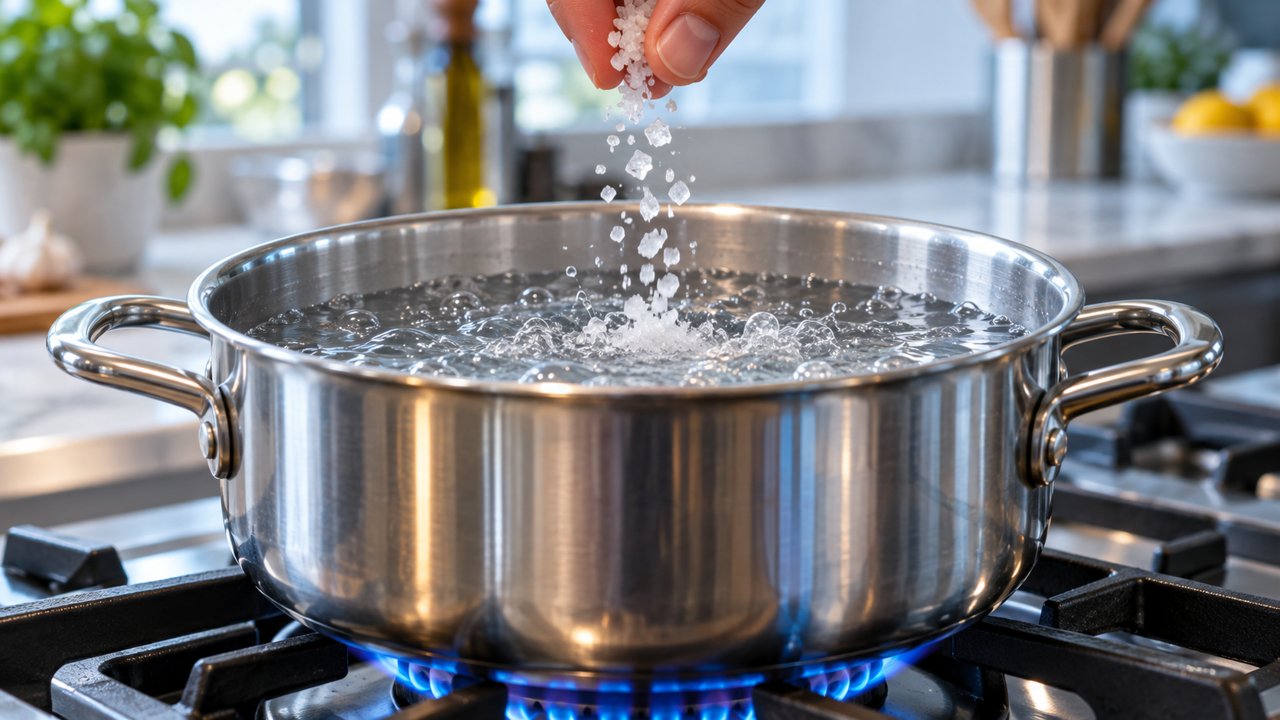
Adding salt to water does not make it boil faster. In fact, it raises the boiling point a tiny bit, so in theory it boils slightly later, but with the amount you use for cooking, the difference is hard to notice.
Salt raises the boiling point
When something that does not evaporate easily, like salt, dissolves in water, it becomes a little harder for water molecules to escape as vapor. So salt water has to get slightly hotter than plain water before it boils.
The change is very small, though. Dissolving about 10 g of salt, roughly a teaspoon, in 1 liter of water raises the boiling point by about 0.17°C. A kitchen thermometer can hardly show that difference. In theory, it only adds a tiny bit to the time needed to heat the water up to a boil.
Measured in a test, there is no difference
America's Test Kitchen, a US cooking research outlet, compared two pots of 4 quarts (about 3.8 liters) of water, one with 1 tablespoon of salt and one without. One tablespoon is the amount it uses to cook 1 pound (about 450 g) of pasta. Both pots came to a boil in the same time: 17 minutes and 30 seconds.
The outlet explains that raising the boiling point by 1°F (about 0.6°C) takes 1.5 tablespoons of salt per quart (about 0.95 liters) of water. That would be far too salty to cook with.
Why it bubbles up the moment you add salt
When you sprinkle salt into hot water, a sudden burst of bubbles rises, so it looks like the water is boiling harder. The surfaces of the salt grains become easy spots for bubbles to form, so air dissolved in the water and vapor that was just about to form come out as bubbles all at once. The temperature of the water as a whole has not gone up.
So salt goes into water for pasta or noodles to season them. If you want water to boil faster, putting a lid on the pot to keep heat from escaping works better than salt.
Adding it to water that is already boiling
If you add salt to water at a rolling boil, it foams up, settles down for a moment, and soon boils again. That is because the boiling point has risen slightly, so the water needs to heat up a little more.
At that point the salt water is only about 0.2°C hotter than plain water, so it does not noticeably shorten the time noodles take to cook. You can decide when to add salt based on taste alone.
Salt does not make water boil faster. It barely raises the boiling point; you add it for flavor.
Notes and references · America's Test Kitchen, "12 Common Cooking Myths, Debunked". In a test with 4 quarts of water and 1 tablespoon of salt, both pots boiled in 17 min 30 s. The rise of about 0.17°C for 10 g of salt per liter is a standard chemistry calculation.
Editorial standardsReport an error
Quick quiz