No. 183Science3 minviews 88
Published by GK Library Annex
Why does the Moon rise about 50 minutes later each day?
Unlike the Sun, the Moon rises at a different time every day, and the gap shrinks around the autumn full moon
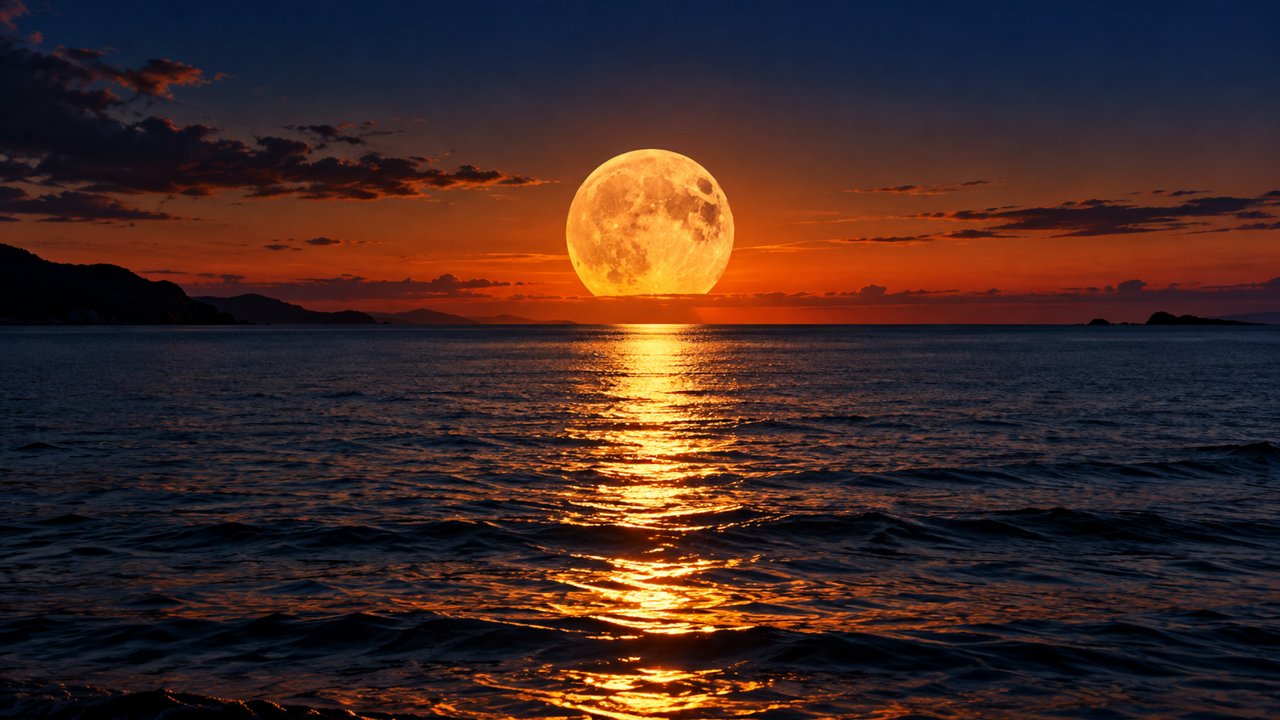
Moonrise gets later by about 50 minutes a day on average. The Sun rises at nearly the same time each day, but the Moon keeps running late because, as it orbits Earth, it shifts a little farther east every day.
How far the Moon moves in a day
The Moon takes about 27 days to go once around Earth. Seen from the ground, that means it moves roughly 13 degrees east each day, about the width of a fist held at arm's length.
Even after Earth turns all the way around to face the direction where the Moon rose yesterday, the Moon has moved on by about 13 degrees. Earth turns about 15 degrees an hour, so it has to keep turning a little longer before the Moon comes up over the horizon. That extra time works out to about 50 minutes a day on average.
Rise times change with the Moon's shape
Because moonrise keeps slipping later, the Moon's shape and its rising time change together. A full moon rises in the east around sunset and stays in the sky all night. A half moon lit on the right rises around midday and is seen high in the evening sky, while a half moon lit on the left does not rise until around midnight.
That is why some days you can see a pale Moon in daylight, and a few days after the full moon it becomes hard to find the Moon in the early evening.
The autumn full moon runs less late
Fifty minutes is only an average. In reality the delay ranges from the low 20s to nearly 75 minutes depending on the season and latitude, because the angle between the Moon's path and the horizon keeps changing.
Around the autumn full moon, this path lies at a shallow slant, almost lying down along the horizon, so the Moon rises less late than its daily motion would suggest. According to NASA, the delay is only 25 to 30 minutes in the northern United States, and just 10 to 20 minutes farther north, in Canada and Europe. Seoul, at a similar latitude, can be expected to see a similar shortening to the northern United States.
A common misconception and moon-watching tips
It is easy to assume the Moon, like the Sun, rises at about the same time every day. So if you saw the full moon at 7 p.m. today and go out at the same time tomorrow to see it again, it may still be below the horizon or hanging low.
If you plan to go out to see the Moon, just head out a little later than the day before: around 50 minutes usually, or a bit less around the autumn full moon. If you need the exact time, the most reliable option is to check the moonrise times for each region published by the Korea Astronomy and Space Science Institute.
The Moon shifts about 13 degrees east each day, so it rises about 50 minutes later on average, and the gap shortens around the autumn full moon.
Notes and references · NASA "The Next Full Moon is the Harvest Moon" (2021). Moonrise is about 50 minutes later on average; around the autumn full moon, 25 to 30 minutes in the northern US and 10 to 20 in Canada and Europe. The Seoul figure is an estimate based on latitude
Editorial standardsReport an error
Quick quiz