No. 203Numbers3 minviews 116
Published by GK Library Annex
Why does a football always have exactly 12 black pentagons?
Hexagons alone can't close into a ball; 12 pentagons are what create the curve
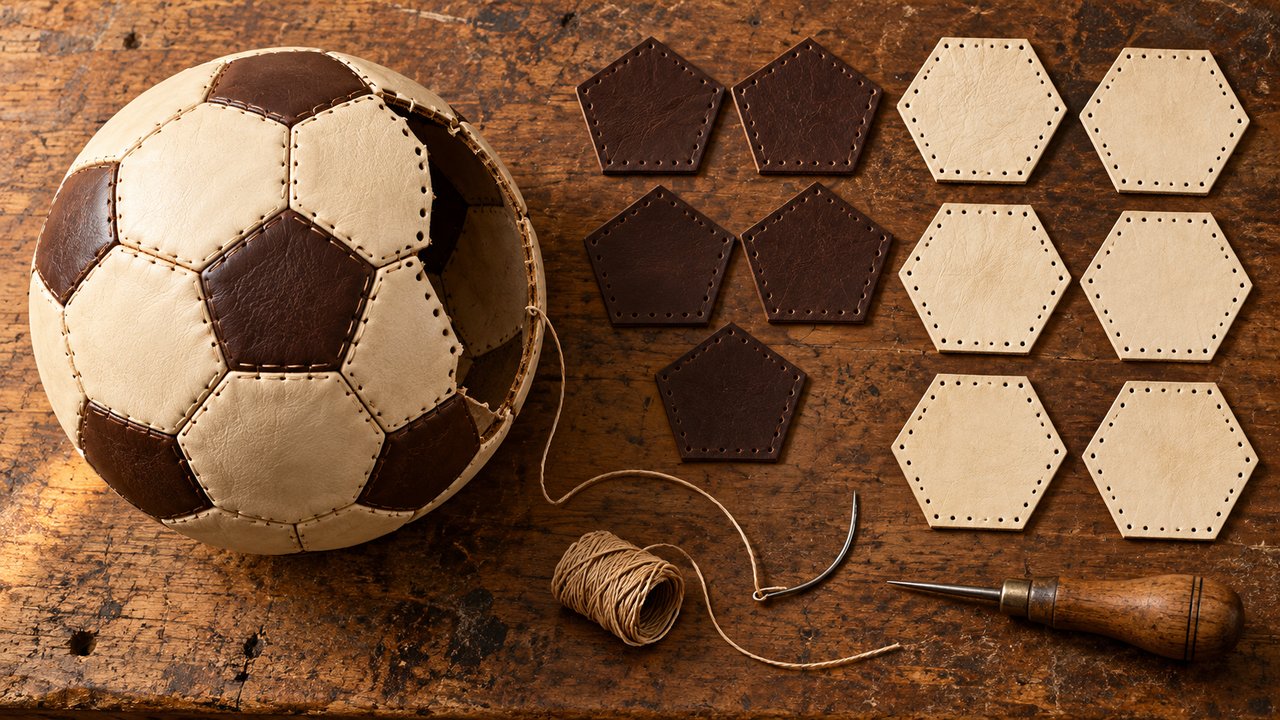
The classic black-and-white football is made of 12 black pentagons and 20 white hexagons, 32 pieces in all. There is a reason there are always exactly 12 pentagons. If you join only hexagons together, they just spread out flat and never close into a ball.
Hexagons alone stay flat
Think of a honeycomb. When three regular hexagons meet at a corner, their angles add up to exactly 360 degrees, so they form a flat floor with no gaps. No matter how many you add, the floor never bends.
Each angle of a pentagon is 108 degrees, so when one pentagon and two hexagons meet, the total falls a little short of 360 degrees. That shortfall makes the surface fold inward, creating a curve. In effect, the pentagons are what roll the ball into a round shape.
The number 12 comes from a calculation
If three pieces meet at every corner and the pieces are only pentagons and hexagons, a closed ball always needs exactly 12 pentagons. It doesn't matter whether there are 20 hexagons or 30. The answer follows directly from the relationship between the numbers of corners, edges and faces worked out by the 18th-century mathematician Euler.
So even if you add more hexagons to make a bigger ball, there are always 12 pentagons. The football shape is what you get by cutting off the 12 corners of an icosahedron, a solid with 20 triangular faces, so you can think of each cut as leaving one pentagon behind.
The black-and-white pattern was for television
This 32-piece ball became known around the world around the time of the Telstar, the official ball of the 1970 World Cup in Mexico. Many households watched matches on black-and-white television then, and a ball mixing black pentagons and white hexagons showed up well on screen, with its spin easy to see.
Still, once the leather pieces are stitched together and the ball is inflated, each piece bulges outward, so a real ball is much closer to a sphere than to a polyhedron.
Today's balls have far fewer pieces
Since 2006, official World Cup balls have used far fewer pieces. The 2006 ball had 14 pieces and the 2014 ball had 6, and some are joined with heat instead of stitching. Fewer pieces and shorter seams make it easier to make a ball evenly round.
The same shape also appears in science. A molecule of 60 carbon atoms discovered in 1985 has exactly the shape of a football and is called the "buckyball"; its discovery won the 1996 Nobel Prize in Chemistry.
A ball closed from pentagons and hexagons needs exactly 12 pentagons; only the hexagon count can change.
Notes and references · Euler's polyhedron formula and World Cup ball records. The 12 pentagons follow from Euler's formula. The link between Telstar's pattern and TV is a widely told explanation, and panel counts follow published data for each tournament.
Editorial standardsReport an error
Quick quiz