No. 228Numbers3 minviews 73
Published by GK Library Annex
Why Is One Liter Exactly 1,000 cc?
A liter is the volume of a cube 10 cm on each side
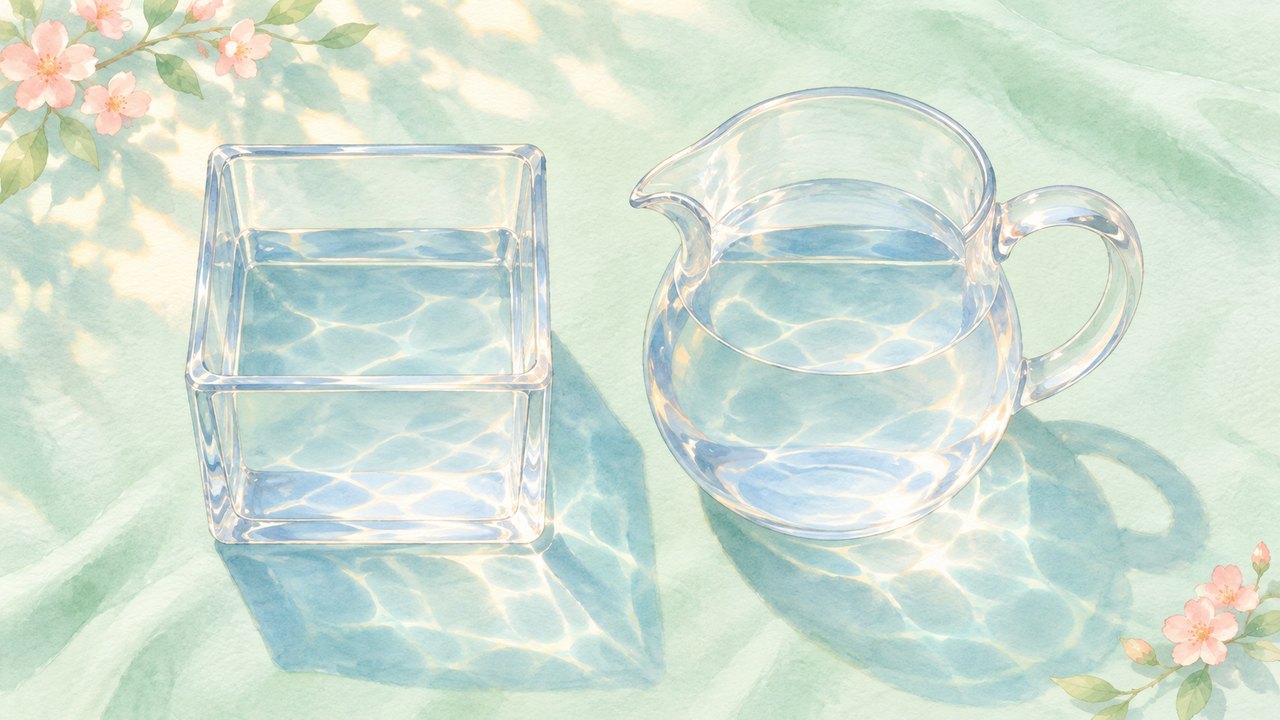
One liter (L) is exactly the volume of a cube 10 cm on each side. That volume is 1,000 cm³, which is why a liter equals 1,000 cc. It is no coincidence: in 1964 the General Conference on Weights and Measures (CGPM) made "liter" a special name for the cubic decimeter.
Where the 1,000 comes from
cc stands for cubic centimeter (cm³). One decimeter (dm) is 10 cm, so a cube 10 cm on each side has a volume of 10 × 10 × 10 = 1,000 cm³. We call that volume one liter, so one liter is 1,000 cc.
A milliliter (mL) is the same size as a cubic centimeter, so one liter is also 1,000 mL. A 1 L carton of milk at the store and a bottle labeled 1,000 mL hold the same amount, written in different units.
It was not always 1,000 cc
The liter was created in France at the end of the 18th century, together with the metric system. But in 1901 the CGPM declared a different definition for a time: one liter would be the volume taken up by 1 kg of pure water at its densest (about 4 °C) under standard atmospheric pressure.
It looked convenient, since 1 kg of water would simply be 1 L. But precise measurements showed that this volume was about 1,000.028 cm³, slightly more than 1,000 cm³. In other words, that liter was larger than 1,000 cc by about 0.0028%. Even across 1,000 liters, the gap came to only about 28 mL.
How it is defined today
In 1964 the CGPM abrogated the 1901 definition and declared that the word "liter" may be used as a special name for the cubic decimeter. So today 1 L is exactly 1 dm³, or 1,000 cm³. The liter is not itself a unit of the International System of Units (SI), but a unit accepted for use with the SI.
That does not make 1 L of water exactly 1 kg. At about 4 °C, where water is densest, 1 L weighs about 0.99997 kg, and it gets a little lighter as the water warms. In the kitchen, treating 1 L of water as 1 kg is a perfectly good approximation. The capital L was allowed in 1979 because a lowercase l is easily confused with the numeral 1.
A liter is a cube 10 cm on each side: exactly 1,000 cc, and slightly less than 1 kg of water takes up.
Notes and references · BIPM CGPM resolutions. Based on the 1901 CGPM declaration, 1964 CGPM Resolution 6, and the SI Brochure (9th ed.). The 1964 text advises against using "liter" for high-accuracy volume results.
Editorial standardsReport an error
Quick quiz