No. 223Psychology3 minviews 57
Published by GK Library Annex
The experiment where 24 jams sold worse than 6
A tasting table swapped between 6 and 24 jams, and the share of buyers differed about tenfold
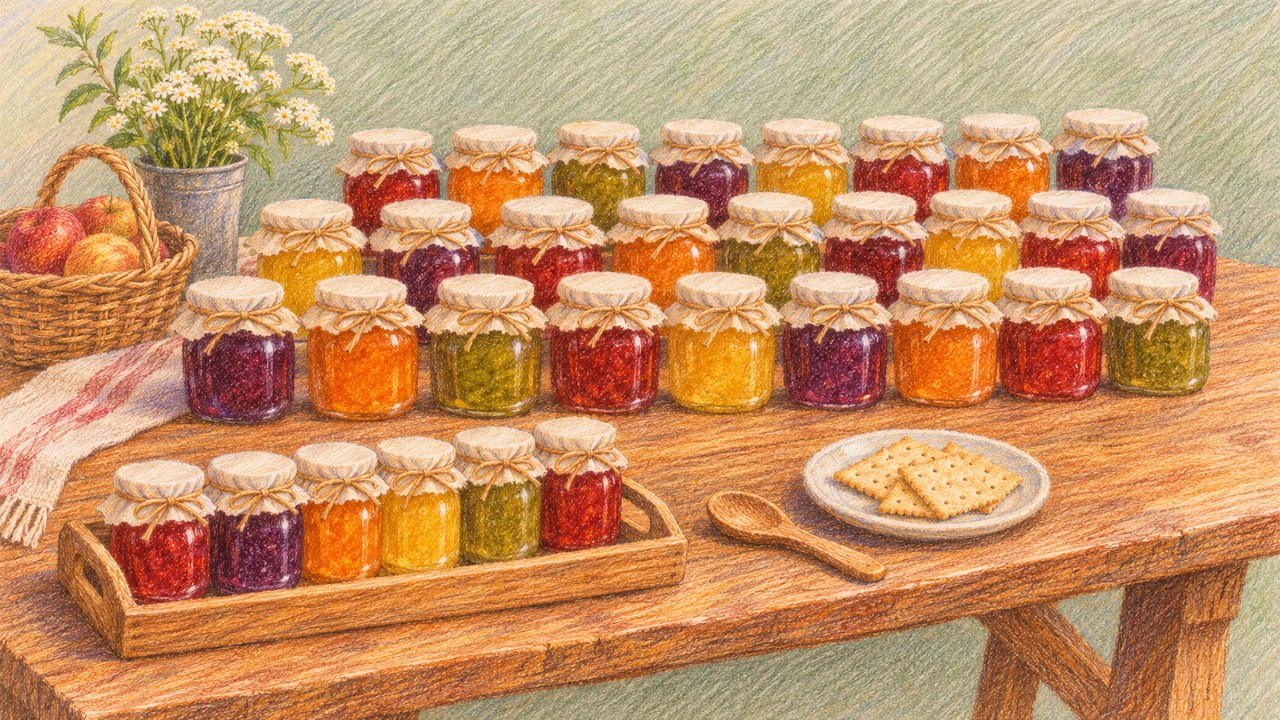
One experiment found that a tasting table with only 6 jams led to about ten times the share of buyers as a table with 24 jams. It spread as the idea that too many options make people not want to choose, but later studies did not always find the same result.
The jam tasting table
In a study published in 2000, researchers set up a jam tasting table at the entrance of an upscale grocery store in California. They alternated between displaying 24 jams and displaying only 6, and gave everyone who came up to the table a $1 coupon for the jam. More people gathered at the larger display: 60% of passersby stopped, compared with 40% for 6 jams.
But among the people who tasted, only 3% (4 people) bought a jam from the 24-jam table, versus about 30% (31 people) from the 6-jam table. The researchers explained that when there are too many options, the motivation to choose gets weaker.
The chocolate experiment
In another experiment in the same paper, participants chose one chocolate from either 6 kinds or 30 kinds. Those who chose from 30 said choosing was more enjoyable, but also harder and more frustrating. They were less satisfied with the chocolate they picked: 5.5 on a 7-point scale, lower than the 6.3 of those who chose from 6.
As payment for taking part, 12% of the 30-kind group chose a box of chocolates instead of money, compared with 48% of the 6-kind group. The more choices on display, the more fun, but satisfaction after choosing actually dropped.
What we learned later
In 2010, an analysis pooled 50 experiments of this kind and recalculated. The average downside of having many options was close to zero, and results varied widely between experiments. Some experiments found that many options were fine or even more satisfying. That means you cannot always expect a dramatic result like the jam table.
There are hints that the effect shows up more easily when the options are complicated or when you are not sure what you want. But no condition was found that guarantees it. If you hesitate for a long time in front of a menu, try narrowing it to two or three candidates and deciding on one criterion first.
Too many options can put you off choosing, but not always. Narrow the list and set a criterion first.
Notes and references · Iyengar & Lepper (2000); Scheibehenne et al. (2010). The jam and chocolate experiments are from a 2000 paper. A 2010 analysis pooled 50 experiments, with an average effect near zero and large differences between studies.
Editorial standardsReport an error
Quick quiz